Showing posts with label Northern Leaf-tailed Gecko. Show all posts

Sunday, 27 July 2014

27th July 2014 Kingfisher Park Birdwatchers Lodge

Weather Report
The first week was mainly dry and sunny' but 3.5mm of rain fell over two nights, the second week began dry before we had 4mm of rain which fell over two days. Temperatures ranged from a cool low of 11.5ºC up to 23ºC, very pleasant and great birding weather.

Last Two Weeks Bird Sightings:-
These can be found on the Eremaea eBird site. 13th - 19th July and 20th - 26th July

The first week has 98 sightings and the second week 109. Rainfall was 6.5mm over four days, much of this fell at night or was fine mist during the day. Overall it was great birding over the two weeks.


Birding Highlights:-

A few waterbirds were around in the local lagoons and Barramundi Farm; these included A couple of Green Pygmy-goose, Pacific Black Duck, Australasian Grebe, Little Black and Little Pied Cormorant, a single Australian Pelican, Great, Intermediate and Cattle Egret, White-faced Heron, Australian White and Straw-necked Ibis plus three Royal Spoonbill. Orange-footed Scrubfowl (they should be called orange-legged) have been very noisy calling day and night and chasing each other, they are quite comical to watch as they strut around.


Orange-footed Scrubfowl


Raptors were quite good with Black-shouldered Kite, Swamp and Spotted Harrier, Grey Goshawk, Collared Sparrowhawk, Black and Whistling Kite along with White-bellied Sea-Eagle. A Red-necked Crake was calling one evening but not seen. Brown Cuckoo-Dove have been taking advantage of several fruiting trees including Celerywood and a Strangler Fig with up to five seen at one time. Bar-shouldered Dove have been around the Lodge grounds and at the Barramundi Farm, they are a very attractive dove.


Bar-shouldered Dove


A single Wompoo Fruit-Dove has been around the Lodge grounds and calling. Not much cuckoo action with only a Fan-tailed Cuckoo heard and a Little Bronze-Cuckoo seen. Barn Owl have been noisy with one pair having three juveniles to feed and another pair with at least two chicks still in a nest. The two Barking Owl which have been around on and off for the last two years continue to be around, but not every night. Australian Owlet-nightjar has been heard on several nights, but not seen. Papuan Frogmouth numbers have increased to five in the immediate area with a male and female taking up residence in our orchard, so hopefully they will stay and breed here, welcome back! This picture shows three Papuan Frogmouth roosting during the day and pretending not to look like birds.


Papuan Frogmouth


Rainbow Bee-eater are still with us, but only about 12 have been recorded which is a decrease in numbers over the last few weeks. Up to six Double-eyed Fig-Parrot have been coming to a fruiting Cluster Fig to feed on the green fruits. At least two pairs of Spotted Catbird are in the Lodge grounds and our neighbours Carol and Andrew's garden. This one was queuing up for a free feed at their bird feeder.


Spotted Catbird

Our single Noisy Pitta continues to make appearances in our orchard to the delight of our guests. 15 species of honeyeater were recorded including at least two Black-chinned (Golden-backed Form) were are still around. A single male Yellow-throated Scrubwren is still with us after first being sighted a month ago, an altitudinal migrant from the mountains behind us. Yellow-breasted Boatbill have been showing well and coming down to lower levels in the rainforest for good views as have the Pied Monarch. A male Common Cicadabird was seen on a couple of morning walks, which was the first sightings for this year.


Common Cicadabird - male


A couple of Bower's Shrike-thrush are still around and showing well. Australasian Figbird have been scarce over the last few weeks, but towards the end of the second week they re-appeared in flocks of 30-40. These males are eating the fruits of an Umbrella Tree in front of our units.

 
Australasian Figbird - male


A female Shining Flycatcher flew through our neighbours garden whilst it was cutting a corner on a bend in Bushy Creek; we only see this species occasionally throughout the year. Another occasional visitor was a Tawny Grassbird foraging near the entrance to the Lodge and darting into the adjacent cane paddock. A few Chestnut-breasted Mannikin were also foraging alongside the cane paddock.


Further Afield:-

Numbers of Blue-faced Parrot-Finch near Abattoir Swamp have increased from the two reported last blog to at least five, but they are very difficult to locate. At Abattoir Swamp our neighbour Andrew Iles (bird guide) had Varied Sitella, which is uncommon at that location. Mt. Lewis is still the place to find the 13 “Wet Tropic” endemics with all being seen in the last two weeks – not on the same day though! At least three Lesser Sooty Owl were seen one evening. Just outside our 1.5km Lodge reporting area were five Purple Swamphen foraging alongside the Rex Highway which is not a good idea! Hopefully they will learn the error of their ways and relocate to the nearest wetland. Square-tailed Kite has been reported in Mt. Molloy and further north at Maryfarms. Hasties Swamp, near Atherton, has been turning up some good waterbirds including Freckled Duck and Glossy Ibis. A Brown Goshawk was around Euluma Creek road in Julatten one afternoon, always nice to see this species.

Reptiles and Mammals:-
The last few weeks have been extremely good for our night walks with plenty to see. One of the highlights was a Short-beaked Echidna which was the first we have seen this year. Other species seen were Striped and Green Ringtail Possum, Northern Brown and Long-nosed Bandicoot, Fawn-footed Melomys feeding on the fruit of an orange tree in our orchard, a brief glimpse of a Platypus in Bushy Creek and Several Northern Leaf-tailed Gecko. A few frogs were also spotlighted – Jungguy Frog, White-lipped Tree Frog, Roth's (Laughing) Frog, Desert Tree Frog, Dainty Green Tree Frog, Cogger's Frog and one small Cane Toad. Apart from those seen on the night walks we also had Bush Rat, Giant White-tailed Rat, Eastern Horseshoe and Northern Broad-nosed Bat, Spectacled Flying Fox a couple of Australian Scrub Python. A large Carpet Python was over the road in the Geraghty Park hall during a residence meeting.
Thanks to our guests for reporting sightings and to Carol and Andrew Iles our roving bird guides for their input into this weeks blog.If you need bird guiding click on their link and send an email.


Kingfisher Park Birdwatchers Lodge Business and Property For Sale
Click here for more sale details


Monday, 30 July 2012

29th July 2012 Kingfisher Park Birdwatchers Lodge


The first week had 3 rain days amounting to 11mm, which was just enough to keep the ground soft, the second week was dry with sunshine and a little cloud cover. The top temperature was a pleasant 22.1ºC and the minimum was 13.1ºC. The humidity was high up to 97% and down to 71%.


Bird sightings for the first week were 96 seen plus 3 heard. The second week had slightly more sightings due mainly to the great weather but also more birds calling, 105 seen plus 5 heard. Mammal and reptile species were slightly more than the last two weeks – 23 species were seen over the two weeks. The last two weeks bird lists are on the Eremaea Birds Website for Week1 and Week2 plus morning walk lists can also be found at this link on Eremaea Birds


Birding Highlights:
The return of Metallic Starling to their nest tree in Geraghty Park on the 27th July, one day later than last year. Whether these are over-wintering birds from the coastal areas between Daintree and Cairns or migrants returning from Papua New Guinea we don't know but we would like to think they are returning migrants – welcome back. 


Metallic Starling

One female Cotton Pygmy-goose was on one of the McDougall Road lagoons late in the second week and Superb Fruit-Dove returned to the Lodge grounds foraging high in the rainforest canopy near the Crake Pool. A Swamp Harrier was along McDougalls Road one day and is an uncommon visitor for us. A Pale-vented Bush-hen was heard near the local Barramundi Farm which confirms their presence in the area but no sign of them showing at this time of year. Little Kingfisher was still making appearances on the Crake Pool and Bushy Creek over the two weeks and a White-cheeked Honeyeater was foraging at the back of the local nursing home. A common bird out towards Abattoir Swamp 6km away but uncommon around the Lodge. 


White-cheeked Honeyeater

Several Black-chinned Honeyeater (Golden-backed form) were taking advantage of the flowering Queensland Blue Gum in Geraghty Park whilst on a morning walk. The same walk also produced a male Satin Flycatcher, again in Geraghty Park, showing its iridescent black plumage.

Other sightings:
Several Orange-footed Scrubfowl (one of the megapodes) pairs have started to get aggressive towards each other with some quite ferocious fights going on around the grounds with them making more noise than usual - if that is possible! This one is showing off its punk hairdo.


Orange-footed Scrubfowl

Wompoo Fruit-Dove have been calling and taking advantage of some of the fruiting rainforest trees which are becoming available now around the Lodge grounds. A few Topknot Pigeon are coming back but not in the numbers we had earlier in the year when when we had hundreds flying over. Australian Swiftlet are taking advantage of recently cut cane paddocks to feast on the disturbed insects along with the Fairy Martin who have been in flocks of over 100. A few egret have been showing, mainly at the local Barramundi Farm, with Eastern Great, Intermediate, Cattle and Little mingling with the Australian White Ibis and a few Royal Spoonbill. Pacific Baza have been making an appearance once or twice each week and an Australian Hobby swooped down onto a pile of mulch in the camping area to grab a small unfortunate mammal, which looked like a Fawn-footed Melomys. A juvenile Scaly-breasted Lorikeet has taken up residence in one of our grevillea's and has been foraging in it for the last 5-6 days, it appears to be on its own with no sign of the parents. As you can see from this photo the bird has hardly any tail.


Scaly-breasted Lorikeet - juvenile

Double-eyed Fig-Parrot were feeding in a fruiting fig tree behind the local nursing home with at least 10 seen whilst on a morning walk. Despite fruit still in the tree they have not been back for nearly a week. The same tree was also attracting mobs of Australian Figbird (surprise!) and a few Barred Cuckoo-shrike. A Fan-tailed Cuckoo which was calling in Geraghty Park was the first record for here this year but they have been heard in the district for about a month. The pair of Barking Owl reported in previous blogs are still with us and made an early evening appearance in the camping area, much to the delight of several of our guests, calling and showing well for a few minutes before heading off for their night-time foray for food. The two pairs of Eastern Barn Owl nearby appear to have chicks in their nests as we saw one brief appearance of a small bird with fluffy down and another more mature bird in the second nest. Unfortunately we found one injured E. Barn Owl under one of the nests and another bird which looked like a non-flying juvenile on the ground during the day. This bird was quite lively spreading its wings in defence and bill snapping upon approach but there was a couple of Sulphur-crested Cockatoo above it in a tree squawking drawing attention to it. So the owl was coerced into moving a short distance into the rainforest edge for shelter where hopefully the parents would find it.

Sulphur-crested Cockatoo

Azure Kingfisher have been along Bushy Creek and the Noisy Pitta mentioned in the last blog is still coming to the feeder for a bit of banana occasionally. Spotted Catbird are also coming to the feeder for banana and calling a lot whilst lurking around in the rainforest. Thirteen species of honeyeater were seen over the two weeks which is a good number; they have plenty of flowering plants to choose from at the moment. A pair of Yellow Honeyeater have started using one of our bird baths and this one was enjoying a bit of a preen and a shakedown in the sun.

Yellow Honeyeater

Olive-backed Oriole have been around and showing well which is unusual for them as they are more often heard than seen. An adult Black Butcherbird has been around in the rainforest and on one occasion flushed from under the raised boards of the tour group eating area in front of the units, probably looking for a Bush Rat. We still have both Grey and Rufous Fantail foraging around the grounds and quite often they are following each other around. Spectacled Monarch have started chasing and calling a lot, maybe prelude to breeding.


Spectacled Monarch

Pied Monarch are showing well with four foraging on the same tree on the edge of the orchard. Lemon-bellied Flycatcher have been coming down low, perching on fences and pouncing onto the ground for insects. This behaviour makes a change from having strain ones neck looking skywards for birds perched on tree branches which is more normal, we think you can all relate to “birdwatchers neck”! The Olive-backed Sunbird who were mentioned in the last blog started to use their nest in Geraghty Park but the female found herself locked in the library room (next to her nest) one night and was not rescued until Lindsay went over with a key the next morning to release her. She was soon back on the nest and later in the week she was sitting, hopefully for a good outcome but it would be surprising if that clutch of eggs survived.


Olive-backed Sunbird
  
Further Afield:-
Our roving bird guide Carol Iles reported Varied Sittella opposite Lake Mitchell (between Mareeba and Mt. Molloy), Black-breasted Buzzard at Biboora near Mareeba and at Maryfarms to our north on the way to Mt. Carbine Sacred and Red-backed Kingfisher, a flock of White-winged Triller (adult females), Black-faced Woodswallow and Diamond Dove still along West and East Maryfarms Roads. Cotton Pygmy-goose were on Lake Mitchell, two male and four female/juvenile male Golden Bowerbird were on Mt. Lewis one morning along with another nine of the twelve “wet tropic” endemic birds Fernwren, Atherton Scrubwren, Mountain Thornbill, Macleay's Honeyeater, Grey-headed Robin, Chowchilla, Bower's Shrike-thrush, Victoria's Riflebird and Tooth-billed Bowerbird. Not bad getting ten out of the twelve endemics in one morning. Up to six Blue-faced Parrot-finch have been seen near Abattoir Swamp but they have been difficult to find. Squatter Pigeon have been seen in Mt Molloy near the school (visit after 4.00pm).

Reptiles and Mammals:-
The cooler drier weather has restricted sightings of some of the frogs and reptiles resulting in a lower than previous weeks reptile and mammal count of 23 species. Highlight here was the sighting of three Platypus in Bushy Creek, two adults and one juvenile which is great confirmation that they have been breeding. Both Striped and Green Ringtail Possum
were seen but only once or twice during the last two weeks. Northern Leaf-tailed Gecko have again been reliable on night walks, whilst two Boyd's Forest Dragon have been around the reception area until the last couple of days when the temperatures have dropped.

Other Happenings:-
We attended the Birdlife North Queensland meeting at the Wildlife Habitat in Port Douglas on 28th July with about 50 members and guests. The entertainment for the evening started off with an entertaining bird quiz prepared and hosted by Murray Hunt (Daintree Boatman). Our team finished up in a draw for first place which required a tie breaking question to decided the outcome, luckily for us we answered this question to take the spoils! All good fun. This was followed by Andrew Forsyth from Red Mill House in the Daintree Village presenting an overview of birdwatching in the far north Wet Tropic area. Andrew illustrated the reasons for birders to come to our region which has over 350 species of birds occurring in a very diverse range of habitats along with specialist birding accommodation and tour guides to give visitors a complete birding experience. This was followed by one of the wildlife keepers at the Wildlife Habitat giving a talk about the breeding success of their pair of Black-necked Stork, which was very informative. The birds are currently sitting on three eggs which are due to hatch around the beginning of August. The evening was a great success and is the start of of monthly meetings to be held by the group. More information can be found on the Birdlife North Queensland website. 


BirdLife Meeting at Wildlife Habitat


Sunday, 20 May 2012

20th May 2012 Kingfisher Park Birdwatchers Lodge


8.5mm of rain fell over the last two weeks on 5 rain days. Most of the other days were either sunny and very pleasant or cool and overcast. The minimum temperature was down to 15.2ºc and the maximum only up to 23.7ºc. The humidity was quite high and varied between 72% and 95%.

Bird species were for the week before last were 100 seen and 3 heard, this last week sightings were 86 seen and 9 heard. 20 mammal and reptile species were seen. The last two weeks bird lists are on the Eremaea Birds & Eremaea Birds website and morning walk lists can also be found at this link on Eremaea Birds

Highlights:
The highlight for the last two weeks has to be the return of “Katie” our Buff-banded Rail after being away since Christmas. Those of you who don't know, Katie was one of two Buff-banded Rail chicks raised by our neighbours Carol and Andrew Iles (well known bird guides). Katie took up residence in the Lodge grounds and was very good at cleaning rooms of insects as well as cleaning out a few guests caravans, she was very popular but occasional blotted her copybook by pecking a few guests. Hope she has matured and now behaves herself. She turned up this past week knocking on the kitchen door for some free handouts and as a thank you she cleaned up a few rooms, the office and reception area of insects! Great to have her back after running off with her boyfriend five months ago. Nice to know what she was doing; we were rather hoping she would be back with a few little Katies but not to be. 

Buff-banded Rail - Katie

Lowlight was the last of our Buff-breasted Paradise-Kingfisher who departed on the night of 7th May to head north to Papua New Guinea, this is the latest departure we have recorded at the Lodge.

Apart from Katie their has been a few more highlights: First returning birds for the season were, an Oriental Cuckoo photographed by one of our guests perched on a fence post along Mt. Kooyong Road, a male Cotton Pygmy-goose on a lagoon along McDougall Road which was only present for one day, an Australian Reed-Warbler heard in the adjacent cane field along Bushy Creek, Golden Whistler calling in the Lodge grounds after an absence of two years – they migrate altitudinally from the mountains behind the Lodge as does the occasional Bowers Shrike-thrush we saw this week pouncing onto the ground to grab a large grasshopper in the camping area. Another migrant turned up in our neighbours garden, two Satin Bowerbird.

Other sightings:

A few waterbirds were found in the lagoons along McDougall Road, these included Magpie Goose, Wandering Whistling-Duck, Pacific Black Duck, Hardhead, Australasian Grebe, Australasian Darter, Little and Pied Cormorant and White-faced Heron but as in previous weeks they are in low numbers and moving around the area. Pigeons have been quiet with only Topknot Pigeon seen over the last two weeks when up to 45 birds were seen foraging in a fig tree along McDougall Road. Still no sign of any Papuan Frogmouth around the area but we did hear Australian Owlet-nightjar calling in the Lodge grounds on several occasions. Raptors have again been around but infrequently; those recorded were Black-shouldered Kite, White-bellied Sea-Eagle, Whistling, Brahminy and Black Kite, Grey Goshawk and Brown Falcon.


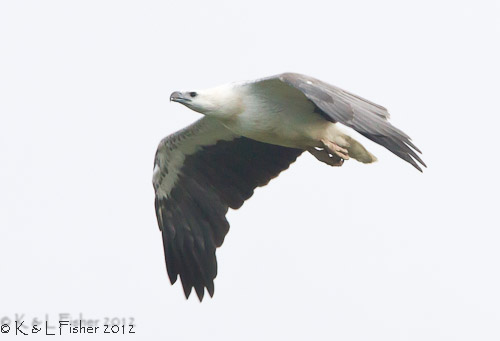
White-bellied Sea-Eagle
 
Bush Stone-curlew have been seen regularly roosting near the local nursing home (shown below) and Masked Lapwing have been gathering in small groups of up to 16 birds. 
 

Bush Stone-curlew

Sulphur-crested Cockatoo have been getting stuck into some of the fruit in our orchard and our neighbours garden. They have been into the Grapefruit’s, destroying the flesh to get at the seeds also some of the mandarins have gone the same way.This one decided to investigate a tree hollow and got a surprise as it contained an Eastern Barn Owl and it's letting the owl know what it thinks of it!

Sulphur-crested Cockatoo

Little (Goulds) Bronze-Cuckoo have been the most common cuckoo around with one sighting of a Pheasant Coucal and a Brush Cuckoo. Little Kingfisher was seen in the previous week but not this week however Azure Kingfisher has been seen regularly in and around Bushy Creek and the Crake Pool. Blue-winged Kookaburra have been vocal and flying around Geraghty Park and Laughing Kookaburra numbers are the highest we can remember (which is not very long!). 


Laughing Kookaburra

Noisy Pitta are still with us, calling but not being seen – not enough effort being put in to find them! Spotted Catbird are putting in infrequent visits to the feeder to grab some banana and a Great Bowerbird was feeding on palm seeds at the rear of the Lodge. Lovely Fairy-wren continue to be heard and seen in our neighbours garden, usually late afternoon. Brown Gerygone have ventured into the rainforest adjacent to the orchard and Fairy Gerygone have started calling and chasing each other. Twelve species of honeyeater were seen and one, Black-chinned heard. Of these the Scarlet is the most spectacular but tends to stay high in the eucalypt trees for tantalising glimpses. Little Shrike-thrush have been as active as ever, this one was foraging on the ground and grabbed a moth. 
 

Little Shrike-thrush

Black Butcherbird has been around lurking in the rainforest but only heard. A Spangled Drongo has started to visit our feeder by the reception and is probably the same one we have had visiting for the last few years. Rufous and Grey Fantail along with the Northern Fantail have been regularly sighted around the Lodge grounds as have Pied Monarch and Yellow-breasted Boatbill. Lemon-bellied Flycatcher were foraging across the Rex Highway opposite Geraghty Park about a metre above the ground which is unusual as they are normally high up in the trees and sallying forth to catch insects high up. A few juvenile Metallic Starling are still around which is late in the season up here. They maybe found on the coast between Cairns and Port Douglas all year around. Olive-backed Sunbird have been busy foraging and checking out old and new nest sites.

Olive-backed Sunbird - male

Large flocks (200+) of Chestnut-breasted Mannikin, mainly immatures, are still around which indicates a good breeding season.

Chestnut-breasted Mannikin - juveniles

Further Afield:-
22 Sarus Cranes were seen at Gallows Farm on the road from Atherton to Malanda on the Atherton Tableland. A Black-breasted Buzzard was a good sighting at Maryfarms north of Mt. Carbine as they are very uncommon in our area. Also at this location were seven Brolga soaring overhead. Both the Maryfarms sightings were made whilst our neighbour Carol was guiding our guests. Del Richards from Fine Feather Tours reported a female Satin Flycatcher in Julatten and a Red-backed Kingfisher at the bottom of the Rex Range between Julatten and Mossman, both species are migrants to our area. Mt. Lewis is as good as usual with a (Lesser) Sooty Owl seen on a night spotlighting tour. During the day most of the Wet Tropic endemics have been seen including a female or immature Golden Bowerbird, Fernwren and Atherton Scrubwren. Blue-faced Parrot-Finch have not been seen on Mt. Lewis for several weeks now and have not turned up in areas they appear in at lower altitudes as their food source has not started seeding yet. There has been reports of them in the Gurka Road area on the Atherton Tableland at the back of Mt.Bellinden Ker.

Reptiles and Mammals:-
A Carpet Python was a visitor to our neighbours house and stayed around for at least 10 days, this is a species we have not recorded in the Lodge grounds in the seven years we have been here. A 2.5m Australian Scrub Python (formerly Amethystine Python) was spotted slowly making its way across the path to our storage shed before disappearing into an old rock pile in the rainforest. A Northern Leaf-tailed Gecko was spotlighted low down on a tree around the orchard one night and Boyd's Forest Dragon sightings have become less frequent over the last two weeks. This gecko is in typical head down pose and very well camouflaged. 


Northern Leaf-tailed Gecko

A Green Ringtail Possum was seen for the first time in more than a month before four were seen on another night, this was followed by none on the following night – that's spotlighting for you. Meanwhile Striped Possum have been seen a few times and one was calling all night on one occasion. A Yellow-footed Antichinus (small placental mammal) has been active during the day coming to the feeder for banana and making an appearance on the reception counter before being chased out! With the drier weather frogs have retreated and apart from White-lipped Green Tree Frog not been seen over the last week and the previous week only turned up one Jungguy Frog.

Other Happenings:
Bird photography has become a major interest with birdos and non-birdos alike; you definitely don't need to be fashion conscience, photographers shall remain nameless!


Photographers Fashion

On the 6th May the moon was the closest it had been to the earth for 20 years and luckily it was a clear night so we could view the moon and take a few images of it. Hope it is this clear when we have the total eclipse in mid-November this year.


Moon

Sunday, 4 March 2012

Birdwatchers Lodge in Far North Queensland, Australia.


Well we had 208.5mm of rain this week and it was not even as a result of the Monsoonal Trough, which is still north of us hovering over Papua New Guinea and the top of Cape York Peninsula. Our rain came from the south-east and headed our way from off shore. It did flood the road to Mount Molloy for a day and flooded access to our water pump beside Bushy Creek. The overcast days kept the temperatures to a maximum 28.1ºc and the minimum up slightly on the previous week to a low of 22.3ºc.

The wet weather allowed fewer bird watching opportunities hence the lower than normal species number of 83 seen and 9 heard. 26 mammal and reptile species were seen. The weeks bird list is on the Eremaea Birds website and morning walk lists can also be found at this link on Eremaea Birds

Highlights:
An Eastern Spinebill turned up in one of our Grevillea's along Mt. Kooyong Road which is an unusual event. They are normally found up on Mt. Lewis more often than down around the Lodge. At last our Papuan Frogmouth was back in a Mango Tree in the orchard, roosting during the day, will she stay around? Red-necked Crake are still around with their 3 juveniles and calling infrequently.

Other sightings:
Orange-footed Scrubfowl have been active scrapping up debris and moving it across the road to the reception and onto their mound beside the road. Most of the debris has ended up on the road! This one was having a break from nest building duties to sit out in the sun in front of the cookshed.

Orange-footed Scrubfowl

The wet weather sent the waterbirds in all directions with few in the wetlands along McDougall Road. A few Magpie Goose were found perched in a tree with several Little Black Cormorant and an Intermediate Egret. Superb Fruit-Dove were heard but both Pied Imperial and Topknot Pigeon were seen. These Pied Imperial Pigeon were perched high in a Blue Quondong tree.


Pied Imperial Pigeon
A few Cattle Egret still in breeding plumage were accompanying cattle in a paddock along McDougall Road. Raptors were again absent with only one Whistling Kite seen and White-bellied Sea-Eagle heard. Pale-vented Bush-hen were again see in in the gully behind our neighbours house and heard calling from several other areas around the Lodge. Three Bush Stone-curlew were resting up for the day under some trees near the local nursing home and a pair of Double-eyed Fig-Parrot were seen flying over in the same area.


Bush Stone-curlew

Channel-billed Cuckoo are still around but less than five seen and heard. Other cuckoos around were Little (Gould's) Bronze-Cuckoo and Brush Cuckoo. Eastern Barn Owl were again in Geraghty Park but no records of Sooty Owl this week. Still one Buff-breasted Paradise-Kingfisher nest with chicks in but juveniles from other nests are growing fast and calling for food all day long. The parent birds are very obvious as they search for food, surprisingly some are still in very good condition with long straight tail streamers at a time when they are unusually damaged or bent from going in and out of the nest chamber for at least 6 weeks. Noisy Pitta was heard but not seen but Spotted Catbird have been seen. Red-backed Fairy-wren were again along McDougall Road while Lovely Fairy-wren were in our neighbours garden near Bushy Creek. Twelve honeyeater species for the week including the previously mentioned Eastern Spinebill and several views of the spectacular Scarlet Honeyeater. This Graceful Honeyeater was sitting on the ground for no apparent reason; it soon moved and flew up when approached.

Graceful Honeyeater

A pair of Cicadabird were on the edge of the orchard late on Saturday afternoon flying around and calling as they enjoyed the sunny conditions.


Cicadabird - male

Black Butcherbird have been around in the rainforest and a pair of Willie Wagtail were taking advantage of the newly mowed orchard to search for insects. Black-faced Monarch are still calling and spending most of their time foraging in the rainforest canopy unlike the Spectacled Monarch who are foraging down to ground level. A pair of Pied Monarch were bathing in Bushy Creek early in the week before it flooded and Yellow-breasted Boatbill have been very active and calling a lot in the rainforest. Lemon-bellied Flycatcher have been calling also and foraging in and around the Queensland Blue Gum in Geraghty Park and the edge of the Lodge grounds. Metallic Starling are still with us but numbers are still dwindling as some head north to Papua New Guinea.

Further Afield:-
Wet weather has caused the temporary closure of the Mt. Lewis road (beyond the gate). This will not effect our guests as this part of the road is a permit only area and they only need to go to the clearing at the 10km mark, the gate is a few hundred metres beyond here. The area around the clearing and the walk to the miners dam has been producing many of the higher altitude endemic species such as Fernwren, Atherton Scrubwren, Mountain Thornbill, Macleay's Honeyeater, Bridled Honeyeater, Grey-headed Robin, Chowchilla, Bower's Shrike-thrush, Victoria's Riflebird, Tooth-billed Bowerbird and a female Golden Bowerbird plus Blue-faced Parrot-Finch at the clearing.


Blue-faced Parrot-Finch

Also on Mt. Lewis was Rufous and Grey Fantail plus sub-species Keasti. With the rain of the last week this part of the road may well become impassable as well but in any case four-wheel drive will be required. The small wetland at Brady Road, Mareeba had quite a few waterbirds plus juvenile White-bellied Cuckoo-shrike and Dollarbird. Also here was a displaying Horsfield's Bushlark which was high above the wetland. There are still plenty of Black Kite along the road from Mount Molloy to Mareeba, which is still surprising as normally most of them have gone inland however quite a lot of the inland is also very wet.

Reptiles and Mammals:-
The wet weather has certainly enticed a few more reptiles and mammals to come out of hiding with 26 seen this week which is more than we have had for most of the year. A nice 2.5m Australian Scrub Python (used to be called Amethystine Python) was crossing the road near our two bedroom units and a Brown Tree Snake was found by the birds coiled up on a callistemon outside the cookshed. A Northern Leaf-tailed Gecko was found during a nightwalk early in the week; the first for several months. Five frog species were found plus cane toads which were collected for disposal, humanely. Striped Possum were seen on three occasions which was the best sightings around the Lodge grounds for over a month. Fawn-footed Melomys, Yellow-footed Antichinus, Bush Rat, Giant White-tailed Rat and Northern Brown Bandicoot were all visitors to the seed feeder near the reception area in the evening. This is a Fawn-footed Melomys at the feeder, they look very cute but don't be fooled, as they love getting into vehicles and chewing the plastic wiring and hose pipes!

Fawn-footed Melomys

Must have been a good week for pythons as we found two more on a property along Euluma Creek Road, one was at least 3m long and quite thick the other one which was nearby was only about 2m and quite thin, great to see them around.

Sunday, 17 May 2009

17th May Report


Another dull drizzly week except for the Saturday when the sun came out along with the birds, we had 27mm in the rain gauge and overnight lows of 18ºC for the week. It was a much better week for sightings with 78 bird species seen and 5 heard plus 18 Mammal/Reptiles seen and 2 heard. We did not quite equal last Saturday nights owl count but this Saturday night was exceptional spotlighting with 3 owl species – Rufous, (Lesser) Sooty (3 sightings of the same bird) and an Eastern Barn coming out of his nest hollow.

Rufous Owl

An Australian Owlet-nightjar was lurking in the low bushes around Geraghty Park and back at the lodge there was surprisingly many frog species despite the cool dry weather. We had Rainforest Stream Frog Litoria wilcoxi (always a possibility it could be Litoria jungguy as they are almost impossible to separate in the field), White-lipped Tree Frog Litoria infrafrenata, Desert Tree Frog Litoria rubella, Cogger’s Barred Frog Mixophyes coggeri and Cane Toad Bufo marinus. Other sightings were of 3 separate Northern Leaf-tailed Gecko (note: excellent camouflage in photo below), Fawn-footed Melomy’s, Eastern Horseshoe Bat, Bush Rat, Giant White-tailed Rat, Feather-tailed Glider, Northern Brown and Long-nosed Bandicoot and Spectacled Flying Fox.

Northern Leaf-tailed Gecko

This was one of our best nights spotlighting which will be hard to repeat. During the week we had good looks at the Chestnut-breasted Cuckoo which returned for a few days before leaving at the end of the week again, a rufous morph of the Tawny Frogmouth was being harassed in the rainforest by smaller birds and was probably the same bird reported in the 21st December report. Other winter visitors to turn up in the week were White-necked Heron opposite Geraghty Park with several Australian White Ibis, Nankeen-night Heron at the Crake Pool, Bridled Honeyeater in Geraghty Park, Scarlet Honeyeater in flowering eucalypts on the perimeter of the lodge grounds and a Bower’s Shrike-thrush calling high up in our rainforest. Boyd’s Rainforest Dragons were active after the drizzle stopped as was a large Amethystine Python.

Further afield one of our guests who went out with Del Richards reported a Cotton Pygmy-goose at Hasties Swamp outside Atherton and also one at Mareeba Tropical Savanna and Wetland Reserve. Five Sarus Cranes were reported from a paddock just north of Lakeland on the way to Cooktown.