Showing posts with label Hasties Swamp. Show all posts

Sunday, 24 August 2014

24th August 2014 Kingfisher Park Birdwatchers Lodge

Weather Report
The first week had 32.5mm of rain which fell over six days, the second week had no rain just sunshine. Temperatures ranged from a cool low of 13.2ºC up to 23.8ºC which is about average for this time of year.

Last Two Weeks Bird Sightings:-
These can be found on the Eremaea eBird site. 10th - 16th August and 17th - 23th August The first week we had 106 sightings and the second week 112, pretty good numbers!

Morning and Evening Guided Walks:-
Morning walks (2½ hours) produced between 43-55 species, the lower count was due to rain disrupting the walk. The species lists can be found on the Eremaea eBird site. Click on Explore Data then Hotspots and type in Kingfisher Park – you will then see the Lodge in the drop down menu. Click this on and a map will appear with two markers, click these and you can have access to all our records. It sounds long winded but it is really easy. Alternatively you can click this link which will take you directly to Hotspots http://ebird.org/ebird/hotspotshttp://ebird.org/ebird/hotspots.
Again we saw up to 11 Barn Owl on night walks and one Barking Owl. Mammal sightings were good with two Tree Mouse (Prehensile-tailed Rat) on one night, Fawn-footed Melomys, Eastern Horseshoe Bat and Northern Blossom Bat, two Striped Possum and both Long-nosed and Northern Brown Bandicoot. Frogs seen were Jungguy Frog, White-lipped Tree Frog, Red Tree Frog, Roth's (Laughing)Tree Frog, Dainty Green Tree Frog, Cogger's Frog and Cane Toad. Several Northern Leaf-tailed Gecko were also found.

Other Birding Highlights:-

Both Green and Cotton Pygmy-goose have been along McDougall Road as well as up to three Australian Pelican and White-necked Heron. Pacific Black Duck have been along McDougall including these two who were loafing, thought we would put in an image of these birds as some of the more common birds tend to get overlooked.


Pacific Black Duck

At least 32 Straw-necked Ibis were foraging in a cut cane paddock adjacent to the Lodge; straw-necks are not as common as Australian White Ibis around Julatten. Black-shouldered Kite have been regulars with one adult and two juveniles seen. A Pacific Baza was seen one day at the front entrance to the Lodge but not seen since. Also flying over the Lodge were a pair of Grey Goshawk being chased by a pack of Blue-faced Honeyeater. Another blue-face was seen chasing a Whistling Kite over Geraghty Park, this time it was hanging onto the tail of the kite! Other raptors seen were Wedge-tailed Eagle, White-bellied Sea-Eagle and over 50 Black Kite foraging in and around cut cane paddocks including this immature bird. 


Black Kite - juvenile

Red-necked Crake have started to call so we know they are around but only one sighting over the last two weeks. Wompoo Fruit-Dove have also been calling and being seen as a few more trees start fruit. Topknot Pigeon are still flying over in small flocks and very occasionally dropping into the Lodge grounds. An Australian Owlet-nightjar has been heard calling around the Lodge grounds and also in the vicinity of a previous daytime roost site but has not been seen. The two Papuan Frogmouth continue to roost in the Lodge grounds with four more seen roosting nearby. This is the male with the female hidden by the leaves in one of the Lodge mango trees about 6-7m up which is higher than they normally roost which is more like 4-5m.

 
Papuan Frogmouth

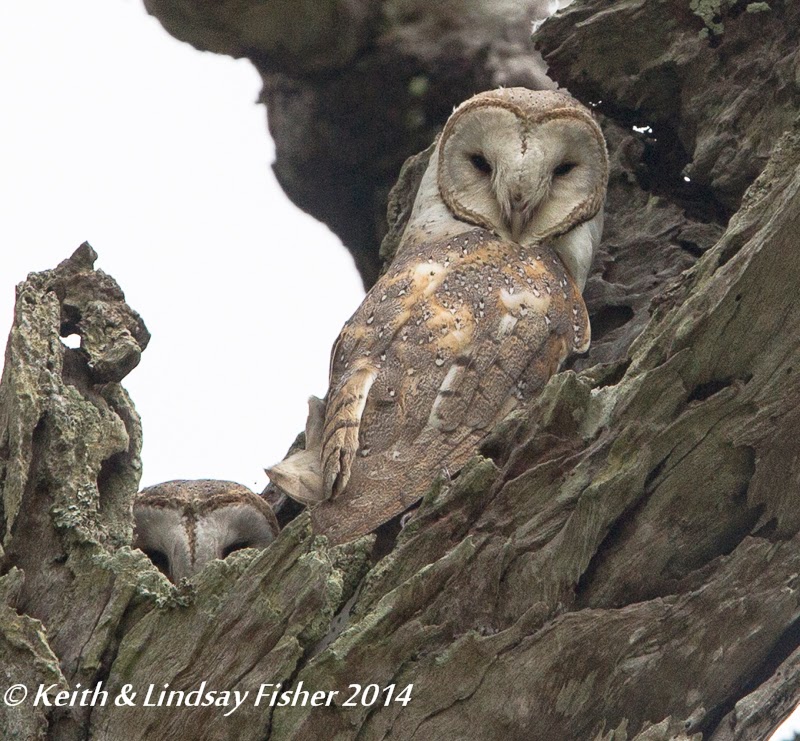
Two Azure Kingfisher have been seen along Bushy Creek flying along and perching near the Platypus viewing area, which has a nice new seat after the previous one was washed away in the flood caused by Cyclone Ita in March. Both Nankeen Kestrel and Australian Hobby have been seen around the Lodge. Scaly-breasted Lorikeet numbers have dropped off as the Queensland Blue Gum are finishing flowering but at least one pair are nesting in these trees and Double-eyed Fig-Parrot have been seen flying over since they, and the Australasian Figbird, have finished off the fruiting figs. Barn Owl have juveniles who have been sitting up in their nests dozing during the day like these ones were. 
 
Barn Owl - juvenile


Barn Owl - juvenile


Noisy Pitta have started to call and have been seen around the Lodge grounds, we still think we only have one bird present. There has been a couple of sightings of Lovely Fairy-wren in the grounds, one along Bushy Creek and another at the Crake Pool. Fourteen species of honeyeater were seen and one heard, which was only four less than the total recorded at the Lodge. Again Pied Monarch and Yellow-breasted Boatbill have both been calling well and being seen. Barred Cuckoo-shrike have made a few appearances but have not been regular. Golden, Grey and Rufous Whistler have all been seen in and around the Lodge as have Northern, Rufous and Grey Fantail. Only a couple of sightings of Leaden Flycatcher over the two weeks but Lemon-bellied Flycatcher have been around with up to six seen at a time. Victoria's Riflebird were seen in the first week but not in the second so they might have left. A Tawny Grassbird was briefly seen in an adjacent cane paddock where it was calling. Metallic Starling returned on the 10th August from Papua New Guinea with numbers continuing to increase along with the nesting activity at their colony in Geraghty Park.
Further Afield:-

Blue-faced Parrot-Finch are being seen infrequently near Abattoir Swamp with only a couple of birds seen. Australian Bustard are displaying at Maryfarms between Mt. Molloy and Mt. Carbine and a single Australian Pratincole is still present at this location after about 3 weeks. Mt. Lewis is as good as ever with bird guide Doug Herrington from Birdwatching Tropical Australia reporting five male Golden Bowerbird seen in one visit! All other “Wet Tropic” endemics were found here in the last two weeks, even more reason to stay at Kingfisher Park Birdwatchers Lodge! Our roving bird guides Carol and Andrew Iles reported Tawny Grassbird, White-eared Monarch, Shining Flycatcher and Red-winged Parrot from Julatten as well as an Australian Hobby whizzing down Mt. Molloy main street. Freckled Duck are still at Hasties Swamp near Atherton and have been almost continuously for the past two years, they were joined by an estimated 2000 Magpie Goose this week.


Identification of odd Looking Lewin's Honeyeater:-

The first two images of a meliphagous honeyeater were photographed at Malanda on the Atherton Tableland at about 900m, the third more typical Lewin's  was photographed at the Lodge, they are all ssp. mab, which occurs in Far North Queensland.

After some discussion with a few local and interstate experts it was agreed that this bird is an odd looking Lewin's, it certainly had the Lewin's call. It has an odd shaped ear patch, which is a lot smaller than a normal Lewin's of the ssp mab. The ear patch looks more like a Graceful. The lower mandible is slightly curved like a Graceful and not straight like Lewin's  the length of the bill looks slightly longer in these comparison images than Lewin's. The underparts don't have as much streaking as Lewin's and the face is less grey than a Lewin's. It is possible this could be a Lewin's/Graceful hybrid as there altitudinal range does overlap (Graceful usually occur below 600m). Note:- Lewin's Honeyeater ssp. mab does not have the distinct crescent shape to the ear patch of southern birds but a slightly less shaped crescent as shown in the 3rd image.Thanks to the experts for their comments. 


Lewin's Honeyeater ssp. mab


Lewin's Honeyeater ssp. mab


Lewin's Honeyeater ssp. mab - typical


Reptiles and Mammals

In addition to the mammals and reptiles mention on night walks we had other interesting sightings including Red-legged Pademelon, Agile Wallaby, Platypus with two regularly showing, Water Rat, Green Tree Snake and Australian Scrub Python. Over the two week we had 17 mammal species and 12 amphibian/reptiles.

Insect:-
This interesting beetle turned up at the reception area feeder one evening, it is a Carion Beetle Diamesus osculans. In Australia there are only three species in two genera mainly found in forested areas within 300km of coastal areas in eastern and northern Australia. This species is also found in Papua New Guinea and in Asia. (info. From “A Guide to the Beetles of Australia” George Hangay and Paul Zborowski). This is the first one we have seen in the Lodge grounds.
Carion Beetle

Thanks to our bird guide neighbours Carol and Andrew Iles for helping to compile the weekly bird lists, don't forget to contact them if you need any bird guiding.


Kingfisher Park Birdwatchers Lodge Business and Property For Sale
Click here for more sale details


Sunday, 8 September 2013

8th September 2013 Kingfisher Park Birdwatchers Lodge Report.

Weather Report
Patchy weather over the past two weeks, a few rain showers during the first week turning into drizzle and rain during the second with temperatures barely getting up to 20ºC, combined with strong wind it felt cold. However a few sunny breaks allowed some good birding. Temperatures ranged from 15ºC to 21ºC and rainfall amounted to 36mm

Past Two Weeks Bird Sightings:-
Bird sightings for the first week were 103, 101 seen and 2 heard, second week sightings were 104, 98 seen and 6 heard. The last two weeks bird lists can be found on the Eremaea Birds Website:- 25th August - 31th August and 1st September - 7th September.
Morning walks were good with between 57 and 60 species seen and heard in 2½hrs..

Birding Highlights:-
Red-necked Crake was seen twice and heard a few more times, the first sighting was in our neighbours garden moving through a gully and the second was when one popped up along Bushy Creek and was seen from the Platypus viewing area. The crake was also heard on several occasions, manly in the afternoon apart from once in the morning, whilst on a guided morning walk. Both adult male and female Australian King-Parrot arrived at the Lodge on the 28th August and stayed around for at least four days, they never stay any longer before they move off. They are normally found at higher altitudes on the mountains behind the Lodge especially Mt. Lewis. Barn Owl have at least three large chicks in one of their nests which is good news. This image shows the adult with a juvenile peering out of the nest hollow.

Barn Owl - adult + juvenile


This adult Barn Owl is peering out of a nearby daytime roost hollow, not at all concerned about parenting duties!


Barn Owl

Another uncommon bird to show was an Eastern Whipbird who came down to have a bathe in Bushy Creek one afternoon, this is another altitudinal migrant from the mountains. A Shining Flycatcher was seen in a very unlikely polluted swampy area late one afternoon. We do see them in the Bushy/Rifle Creek System from time to time. Our neighbours again had Blue-faced Parrot-Finch in their garden and said they were heading our way but they never arrived. They were the most notable sightings; other interesting observations were two Wompoo Fruit-Dove who came for a few days and a female Black-necked Stork who was seen, at the Barramundi fish farm and commuting to another nearby dam where it has been most days. A White-necked Heron was along McDougall Road on several occasions and a Little Egret was in a nearby dam, both these species are infrequent visitors. A good selection of raptors have been around with Black-shouldered Kite, White-bellied Sea-Eagle, Whistling and Black Kite, Grey Goshawk, Spotted Harrier, Nankeen Kestrel and Brown Falcon. 

 
White-bellied Sea-Eagle


A Buff-banded Rail has started coming into our neighbours garden, which has not been a common sight this year, very few sightings of a species that has been frequently seen around the Lodge in past years. Double-eyed Fig-Parrot have only been seen flying over the Lodge. No more action on the possible Barking Owl nest reported in previous blogs but they have been quiet over the last few weeks so maybe nesting elsewhere. 16 species of honeyeater were around over the last two weeks taking advantage of the abundance of flowering plants and trees. Graceful Honeyeater have been seen on the rainforest floor foraging on the tiny flowers of Balanophora fungosa a flowering plant that parasitises the roots of trees. It looks like a fungus hence the Latin name but it is not. Barred Cuckoo-shrike have been calling and seen a few times and Rufous Whistler have also been very vocal in the surrounding woodland areas. This female was no exception.

Rufous Whistler - female

All fantails are still around, (Rufous, Grey and Northern), along with Willie Wagtail. Both Pied Monarch and Yellow-breasted Boatbill have been seen and heard but no sign of the previously seen three female Victoria's Riflebird for the past two weeks. Grey-headed Robin are still with us and normally stay around until November before heading back up into the mountains for the “wet season”. Australasian Reed Warbler are still around despite their sugar cane habitat they had been in being harvested, one was seen in a nearby patch of Bamboo along Bushy Creek. Metallic Starling are continuing to build nests in ever increasing numbers and managing to keep the marauding figbirds at bay as they try and steal their nesting material. Mistletoebird have been busy foraging in the Celerywood trees and Olive-backed Sunbird have been busy seeing off their own reflection on the wing mirrors and windows of guests cars! This male Mistletoebird was caught with a leaf in its bill.


Mistletoebird - male

Further Afield:-
Our local Japanese guide Ota reported a Great-billed Heron at a private property at Malanda at an altitude of 700m which must be an altitude record for this species. We checked out several references but cannot find any mention of sightings at this altitude. He said that this was the third sighting over the past three years. If anyone knows of similar records at high altitudes we would like to hear about it. Several sightings of Black Falcon have been reported from the Atherton Tableland and at a swamp 4km north of Mareeba. Also reported from the Tableland was a Red Goshawk circling around with other raptors, Wedge-tailed Eagle, Brown Goshawk, Brown Falcon and Black Kite, more information about these sightings can be found on the Eremaea Birds Birdline. The four Freckled Duck reported from Hasties Swamp National Park, near Atherton, in the last blog grew to six a week later and when we visited a further week later there were 14 present. This image shows three Freckled Duck, one Hardhead, one Pink-eared Duck, 11 Plumed Whistling Duck and a Eurasian Coot at Hasties.

 
Various Duck

We also saw eight Nankeen Night-Heron flying around, hundreds of both Plumed Whistling Duck and Pink-eared Duck, many Hardhead, a single Sacred Kingfisher, an Australian Hobby and an Australian Reed-Warbler. This not so good image taken in the poor light shows one of the night herons flying over.

Nankeen Night-Heron

Full list can be found on the Eremaea Birds site. Bower's Shrike-thrush was seen along Pinnacle Road on the way to the Mowbray National Park and both Latham's Snipe and Cotton Pygmy-goose were reported at Lake Mitchell (between Mareeba and Mt. Molloy) by Klaus Uhlenhaut from Kirrama WildlifeTours . Del Richard's from Fine Feather Tours had three White-winged Triller along Euluma Creek Road in Julatten, which is quite unusual as they normally occur in the Lake Mitchell area to the west and northwards in the drier woodland areas.

Reptiles and Mammals: 
18 species of reptile and mammal were seen over the two weeks. Red-legged Pademelon were seen in the orchard and up to eight Agile Wallaby were foraging in a paddock behind the local nursing home. White-tailed Rat have been active and at least two juvenile ones have been seen. Green Ringtail Possum have been seen a couple of times in the Lodge grounds and a Striped Possum was in our neighbours garden. Platypus have been around late afternoon but more frequently seen around 6.30 in the morning. Frogs have been very quiet with only sightings of one Northern Dwarf Tree Frog and one White-lipped Green Tree Frog. Eastern Water Dragon have started to be more regularly seen in Bushy Creek and the only snake seen was an Australian Scrub Python. Further afield we saw a Keelback (Freshwater Snake) at Hasties Swamp.

Keelback (Freshwater Snake)

Orchids:-
These Pencil Orchid Dockrillia teretifolia have just started to flower around the area.

 
Pencil Orchid Dockrillia teretifolia


Also the Buttercup Orchid Cymbidium madidum has started to flower.


Buttercup Orchid Cymbidium madidum

Buttercup Orchid Cymbidium madidum

Kingfisher Park Birdwatchers Lodge Business and Property For Sale

Click here for sale details


Sunday, 16 June 2013

16th June 2013 Kingfisher Park Birdwatchers Lodge Report

Another two weeks with drizzle and sunshine, with the last few days of week two clearing up to great weather. Temperatures ranged from 17ºC to 26ºC, still a few degrees above the average for this time of year. Not good photography weather.
 
Past Two Weeks Bird Sightings:-
Bird sightings for the first week were 102, 98 seen and 4 heard, second week sightings were 104, 99 seen and 5 heard. These last two weeks bird lists can be found on the Eremaea Birds Website:- 1st June - 8th June and 9th June- 15th June

Birding Highlights:-
A first for a morning walk was Australian Pelican, two flew over Geraghty Park next to the Lodge. Morning Walk numbers ranged from 50 to 55 species which is quite good for June which is usually a bit quieter than the rest of the year. Straw-necked Ibis have been scarce in the area so far this year so 25 flying over the Rex Highway near Geraghty Park on the 15th was a surprise. They were coming in to land in a grassy cow paddock. An Emerald Dove was spotlighted roosting in the rainforest whilst on a nightwalk, this was a first for a nightwalk. 

 
Emerald Dove

Two good sightings were had of a Little Kingfisher perched over the Crake Pool on 4th June and again on the 15th, both late in the afternoon. A single Blue-faced Parrot-Finch flew over near the end of McDougall Road where the continuous rainforest from the mountains comes down to the lowlands, a first sighting at this altitude this year. Four Satin Bowerbird appeared in our neighbours garden early on the morning of the 7th, this is an occasional visitor to our area. An immature Olive-backed oriole was along the Geraghty Park Road foraging on some berries on the 8th and was joined by an adult on the 10th. A Large-billed Scrubwren, also on the 8th,, was seen carrying a leaf into a nest it was building about 4 - 5m from the ground. This is about the earliest they have been recorded nesting and the highest off the ground nest we have found in the Lodge, however they have been recorded up to 6m elswhere. Barking Owl have taken to perching on the cookshed roof in the early evening with one staying there for nearly an hour. Three immature Australian King-Parrot turned up on the 11th and were joined by another four on the 15th who flew over the orchard. Interestingly other sightings of immatures in 2011 were on the 12th and 15th June. A flock of Barred Cuckoo-shrike turned up at a fruiting fig tree, near the Lodge, for a day and cleaned up the ripe fruit. An Eastern Whipbird was heard calling from the hills across the Rex Highway from the Lodge. An overwintering Black-faced Monarch was seen foraging in the rainforest adjacent to the orchard and photographed by a guest. We do have the occasional overwintering birds but have not had any for a few years. Red-browed Finch have been very active with adults, immatures and juveniles around as well as adults displaying and building nests.


Red-browed Finch

Further Afield:-
On the 4th a Zebra Finch was at Maryfarms near Mt. Carbine, a lot further east than normal and quite a surprise, always a possibility of an escapee but none are known to be kept in captivity in the immediate area. Also here on the same day was a Black-breasted Buzzard. A Cotton Pygmy-goose was on a lagoon at Wetherby Station along the back road to Mount Molloy on the 6th, always an uncommon bird in our area. Also on the 6th a Crested Pigeon was in the area of the Mount Molloy school, again an uncommon species to be here but not surprising as they are north at Mt. Carbine and south at Mareeba. A Wedge-tailed Eagle was along Macleans Bridge Road in Julatten along with a Collared Sparrowhawk which are two uncommon raptor species in the area. (Thanks to Carol and Andrew Iles for some of these sightings).


Hasties Swamp National Park


A quick trip to Hasties Swamp found about 1500 Plumed Whistling-Duck, at least 500 Pink-eared Duck plus many more, a full list can be found on the Eremaea Birds Site.


Pink-eared Duck, Plumed Whistling-Duck and Pacific Black Duck

This Pink-eared Duck is showing the pink ear.


Pink-eared Duck and Plumed Whistling-Duck

Reptiles and Mammals:-
Nightwalks have turned up some good sightings including two Striped Possum, one in trees around the reception and over the bunkhouse plus another in a fruiting Rambutan tree in the orchard, 

 
Striped Possum


White-tailed Rat were climbing around the forest on vines, Spectacled Flying-fox feeding on a Soursop tree and a few frogs – White-lipped Green Tree Frog, Jungguy Frog, Cogger's Frog and Red Tree Frog. There was one sighting of Platypus in Bushy Creek which hopefully means they are back for an extended stay. Our neighbours had a Brown Tree Snake in their garden which was the only snake seen over the two weeks; maybe the cooler weather has slowed them down.

Other Interesting Sightings:-
A tiny inconspicuous luminescent fungi was spotted on the edge of the orchard in the rainforest on one night walk as well as a very colourful fruit sucking moth which was feeding on a fallen Rambutan fruit.

Shop News:-
The latest book in the shop is Australian Rainforest Fruits - A Field Guide - Wendy Cooper and William T. Cooper. This is an excellent guide combining Wendy's expertise in identification and Bill's fantastic paintings. Cost is $60.00.


Thursday, 14 March 2013

10th March 2013 Kingfisher Park Birdwatchers Lodge

Well we are back at the lodge after a very pleasant break from work. We will put together a trip report when time permits but briefly it was very hot and not an ideal time to be visiting South Australia. Birding was restricted to early mornings and late afternoon and it was hard work finding birds. We had a couple of lifers and many state “ticks” plus plenty of dips but managed to see some great country along the way. One bird which was particularly common around wetlands was the Australian Spotted Crake, one wetland we saw 50+, always good to see crakes.


Australian Spotted Crake


Anyway back to Far North Queensland! The blog is late this week due to our internet supplier having a problem at their exchange which caused us to be without a connection from Saturday until late Wednesday night – the joys of modern technology!


Weather Report:-

Weather over the last two weeks has been pleasant, up to 31.8ºC and down to 19.8ºC. Humidity ranged from a low of 64%, up to 94%. Rainfall has been very low and not typical for this time of year 47.5mm for the first week and 61mm for the second week, usually we are getting well over 100mm a week at this time of year. The “wet season” has still not happened but there is still time for it too happen. Most of the rainfall has been in the south-east of Queensland.


Past Two Weeks Bird Sightings:-
Bird sightings for the first week were 105, 92 seen and 13 heard, second week sightings were 100, 89 seen and 11 heard. The last two weeks bird lists can be found on the Eremaea Birds Website:-


Birding Highlights:-
Buff-breasted Paradise-Kingfisher have ended up with six active nests, one was started and bird sitting but somewhere along the way it was abandoned. So far only one nest has fledged young with two juveniles emerging from one nest after 27 days incubation. The other five nests have loudly calling chicks inside who should be emerging any day. The adult birds have been busy bringing food to the nests but the lack of insects has seen them bringing in smaller than usual prey, mainly small beetles with the occasional worms. Normal fledging period is 26-29 days.This image below shows how tight a fit it is to get into the nest to feed the young.

Buff-breasted Paradise-Kingfisher - feeding chicks at nest

This image shows the proud dad from the nest which has fledged two chicks.
Buff-breasted Paradise-Kingfisher

A pair of Red-necked Crake have been running around with at least one fluffy black chick, they put on a performance outside the reception area one night running backwards and forwards with chick in tow before disappearing into the forest. They have been seen several other times and three adults were heard calling near the Crake Pool late one evening. Pale-vented Bush-hen have been visiting our neighbours garden and an adult with a juvenile was there late in the week. A Papuan Frogmouth has been roosting around the reception and bunkhouse areas spasmodically over the last two weeks. Another one was seen near the nursing home along Mt. Kooyong Road late one afternoon being harassed by other birds. A second year Spotted Harrier has been around the McDougall Road area as have a few Varied Sitella, not normally this close to the lodge.

Spotted Harrier
Cattle Egret have returned with 15 seen still in breeding plumage. A Horsfield's Bronze-cuckoo was calling outside the reception area late one afternoon, an uncommon visitor. Channel-billed Cuckoo have been gathering in the area, before they continue north to Papua New Guinea and often seen flying towards McDougall Road late evening with up to 22 seen at one time. Both Barking Owl and Sooty Owl have been heard but not sighted. Two Noisy Pitta were heard calling near the Crake Pool in the orchard near where they had a nest 5-6 weeks ago. No reports as to whether the nest was successful or not. A Yellow-spotted Honeyeater has been sitting on a nest located under the eves of the unit accommodation for the past week, at least it is a dry location. An immature Eastern Whipbird turned up one day which is a very uncommon visitor from the mountains behind the lodge. There has been 11 records from 1996 between March and November with 8 of those records between May and July. 
 

Eastern Whipbird

Another uncommon visitor was a Yellow Oriole who had a dependant juvenile with it, surprising as there are no records of breeding near the lodge that we know about. A Grey-headed Robin arrived back at the lodge at the beginning of the second week (3rd March).


Further Afield:-
A small flotilla of 24 Australasian Grebe were swimming around in Brady Swamp at Mareeba along with other waterfowl such as two Pink-eared Duck, both Plumed and Wandering Whistling-Duck, Pacific Black Duck and Hardhead. 


Australasian Grebe
 
Also present were Spotted Harrier and an Australian Hobby. In the Port Douglas area were at least seven Pied Heron and a Pink-eared Duck on a small seasonal wetland, reported by David “Chook” Crawford from http://www.closeupbirding.com.au, he also said that the previously reported Freckled Duck at Hasties Swamp near Atherton were still present during the week (3-9th March) . Mt. Lewis has been accessible over the last week and all 12 Wet Tropic endemics have been seen there. Other birds seen in the Julatten area of interest were one Australian Bustard, two Singing Bushlark, four Black shouldered Kite and a Leaden Flycatcher feeding a dependant young. A Wandering Tattler was reported, on the Eremaea Birds site, at Machans Beach in Cairns along with an excellent image of it.

Reptiles and Mammals:-
The most surprising sighting was whilst we were away when a Spotted Quoll ran across the lawn in front of the accommodation units, this is the first record that we know about here. We have seen them up on the mountains behind us on Mt. Lewis but even there they are rare. Lets hope we see it again before it cleans up all our small mammals! Over the last few weeks there have been a few more sightings of snakes including Amethystine and Carpet Python, Slaty-grey Snake and Macleay's Water Snake. Frog have been surprisingly quiet despite the damp conditions only Jungguy Frog, White-lipped Tree Frog, Dainty Green Tree Frog and Cogger's Frog were seen. A Striped Possum was seen in our neighbours garden when it was tap-dancing along the banana leaves outside the back door. 

Hopefully we will be back on track for the next blog!
 

Sunday, 10 February 2013

Weather over the last two weeks has been very warm, up to 35.5ºC and down to 20.2ºC. Humidity ranged from an extremely low 36% which must be a record, up to 92%. Rainfall was non existent until the last day when we had 14.5mm.


Bird sightings for the first week were 104, 92 seen and 8 heard, second week sightings were 93 seen and 8 heard.

Past Two Weeks Bird Sightings:-

The last two weeks bird lists can be found on the Eremaea Birds Website:-


Birding Highlights:-
At last all seven Buff-breasted Paradise-Kingfisher nests around the lodge have 3 eggs each with the last laying nearly 3 weeks after the first. By the end of the second week we had found egg shells outside three nests and heard chicks calling from within. Good news. Other notable sightings were a snipe, presumed to be a Latham's Snipe and a Sacred Kingfisher in one of the lagoons along McDougall Road, it was chased off by two Forest Kingfisher. This is only the second record for the lodge list in seven years. Other sightings included juvenile White-bellied Sea-Eagle, Red-necked Crake and Pale-vented Bush-hen most days also a few Lewin's and Bridled Honeyeater along with a White-throated Honeyeater feeding a juvenile. 


White-throated Honeyeater

Cicadabird have been calling well with both male and female seen hawking insects.

Further Afield:-
With a bit more ponding from rain over two weeks ago there has been a thinning of waterbirds apart from Pink-eared Duck, “Chook” from Close Up Birding Adventures reported 6 in Mt. Molloy which were the first he had recorded here and Phil Gregory from Cassowary House had one on the coast at the Wonga Beach Barramundi Farm, others were reported from Brady Road lagoon near Mareeba and Hasties Swamp near Atherton. Unusual for this time of year are the number of Black Kite in the area, 24 were circling just outside Mareeba one day with several others attracted to road kill back towards Mt. Molloy. Normally these birds disappear in the wet season, presumably they go inland to breed. The Mount Lewis Road is still blocked but the lower 1.5km of the road is still open, here Victoria's Riflebird has been seen regularly with a few of the wet tropic endemic bird such as Chowchilla, Pied Monarch and Grey-headed Robin. Wetherby Station, along the alternative road to Mount Molloy from Julatten, proved to be very rewarding with 35 species seen in the Wetherby Station lagoon and adjacent woodland whilst on a morning trip with the BirdLife Northern Queensland group. A pair of Brown-backed Honeyeater were building a nest 

 
Brown-backed Honeyeater - building nest

and an Olive-backed Oriole gave us good views as it foraged in a fig tree were highlights, a full species list can be found on the Eremaea Birds site.

Reptiles and Mammals:-
23 mammal species seen plus two frog species heard over the two weeks. A Large-footed Myotis has been roosting on our neighbours veranda on several occasion, this is a bat that does not mind fishing in the creek for small fish, one of which it dropped onto the neighbours balcony! A few Keelback Snake have been seen around the area, this is a harmless fresh water snake.


Keelback (Freshwater Snake)

Keelback (Freshwater Snake)

The drier weather has resulted in less mammal activity with virtually no sightings of Northern and Long-nosed Bandicoot around the lodge, only one sighting of a Northern Brown; we think they go into the cane fields at this time of year.

Definitely last blog for a few weeks as we will be on holiday! As we mentioned before the
Lodge will remain open in the very capable hands of our friends Kath & Dave from Cooktown.