Showing posts with label Mount Molloy. Show all posts

Sunday, 1 February 2015

1st February 2015 Kingfisher Park Birdwatchers Lodge

THE LAST BLOG

Yes it is the last blog from Kingfisher Park Birdwatchers Lodge, number 264, before we hand over the Lodge after 9½ years. The new owners from the 4th February are Carol and Andrew Iles who have bought the business and property. They have had a long association with the Lodge working as bird guides in 1999-2003 and again for the last four years working with us and running their own guiding business as well as helping out around the Lodge. It is good to know that the Lodge is going into their capable hands to continue on for future guests to enjoy. They will probably be posting interesting sightings on Facebook so keep an eye out for that. Please note that the Lodge is closed in February and the camp ground and bunkhouse will also be closed in March.

Weather Report
The weather has been extremely unpredictable over the last few weeks, it has been very hot, showery with thunderstorms and plenty of sunny days. This is more like the weather we would expect in November as the “Wet Season” approaches. It has been up to 34ºC and down to the low-mid 20ºC with humidity going from 35 to 100%. We have managed to miss most of the storms but we have had a couple of good downpours of 67mm and 71mm with a total of 223.5mm for the last three weeks.

Last Three Weeks Bird Sightings:-
These can be found on the Eremaea eBird site.11th- 17th January ,18th- 24th January and 25th- 31st January The first week had species recorded and the second week .

Birding Highlights:-
The last three weeks have been hectic with the transfer of the Lodge to the new owners so birding has taken a back seat. However we did host the BirdLife North Queensland's annual Australia Day weekend which saw three days of intensive birding in and around the Lodge. At least one Australian Brush-Turkey was trying to scrape up a nesting mound outside the accommodation units. This one was getting away from the wetter ground perching on a vine in the rainforest .


Australian Brush-Turkey


Waterbirds have been scattered with the onset of the wetter weather with only a few species seen including a few Wandering Whistling-Duck, Pacific Black-Duck, Grey Teal and Hardhead. One week saw a few Little Black and Pied Cormorant visit along with a single Australasian Darter. Others to appear briefly were Intermediate and Great Egret, a White-faced Heron, a Glossy Ibis and several Australian White Ibis. Raptors were also light with only Black and Whistling Kite, White-bellied Sea-Eagle and a single sighting of a Pacific Baza. Once again the pair of Red-necked Crake have been putting on a show for most of our guests both in the evening and morning at the Crake Pool. Pale-vented Bush-hen have also been showing around the roadsides and cane paddocks but patience is required to see them. Superb Fruit-Dove have been calling with good numbers around the Lodge and a pair of Torresian Imperial Pigeon were found nesting. Lesser Sooty Owl has been coming around once or twice a week and was seen one night flying around the Lodge hawking for insects. We have been hearing our one Papuan Frogmouth calling during the night and occasionally seeing it roosting in our orchard. Buff-breasted Paradise-Kingfisher have been going in and out of their nests so we presume they are sitting on eggs. One pair near our cookshed have been performing well for our guests who have been able to relax in a chair and watch at a distance. Could not help but put another photo of these special birds into our last blog! 

 
Buff-breasted Paradise-Kingfisher


Other good birds around include Noisy Pitta, Yellow-breasted Boatbill, Barred Cuckoo-shrike, Pied Monarch and nesting Olive-backed Sunbird.


Yellow-breasted Boatbill - male

Further Afield:-
Mt. Lewis is still accessible, but there is always the chance of a tree coming down on the road at this time of year. Blue-faced Parrot-Finch are being seen, but they are still in low numbers and elusive, most of the “Wet Tropic” endemics have been seen over the last few weeks. One surprise over the Australia day weekend was a Rose-crowned Fruit Dove calling not far from Abattoir Swamp, this is usually a bird of the coastal areas and offshore islands with very few sightings in our region. There has been large flocks of Pacific Swift (Fork-tailed) in the Julatten - Mt Molloy area, these have been reported on Eremaea e-Bird.

Reptiles and Mammals:-
28 mammals and reptiles were reported for the last three weeks including Green Ringtail Possum, Platypus, Boyd's Forest Dragon, Lace Monitor and Carpet Python. Frogs were vocal when the rain was coming down with nine species recorded.

 
Northern Sedge Frog


Dainty Green Tree Frog


 Had to put in an image of our favourite frog at the Lodge!

White-lipped Tree Frog


Insects:-
The rain also triggered the termites to swarm out of some nests, the flying ones descended on us in their thousands dropping wings everywhere. These ones were not coming out of one of the mounds but a log on the ground.


Termite sp.


Termite sp.


Fungi:-
The wetter conditions certainly encouraged the fungi to pop up everywhere, here is a selection of some of them.

Unidentified fungus - complete with Wolf Spider


Unidentified fungus


Unidentified fungus


Unidentified fungus


Unidentified fungus


Unidentified fungus

Unidentified fungus


Unidentified fungus


Unidentified fungus


Unidentified fungus


Unidentified fungus


Unidentified fungus


Unidentified fungus


Unidentified fungus


Unidentified fungus

Finally we would like to thank all those people who have supported us during our time at the Lodge and those who followed our blog. We have had over a thousand guests staying each year for the last ten years with many regulars and have met some wonderful people. Thank you to Carol and Andrew for helping with the weekly sightings and also for taking on the Lodge to continue to offer a great wildlife experience for guests. We are retiring to our home in Julatten and look forward to some travel over the next few years.
Keith & Lindsay.

We have had many emails from guests over the years, but this one from a Japanese gentleman remains our favourite.

Thank you very much for your full attention shown to me. Three days flew like an arrow as every moment I experienced there was woderful. Thanks to your help, I am very happy to have taken nice photos, specially kingfisher. These photos goes with nightcap before falling into sleep, taking the place of bankbook of no more balance. Thanks again for your kindness.

 
The End.

Sunday, 24 August 2014

24th August 2014 Kingfisher Park Birdwatchers Lodge

Weather Report
The first week had 32.5mm of rain which fell over six days, the second week had no rain just sunshine. Temperatures ranged from a cool low of 13.2ºC up to 23.8ºC which is about average for this time of year.

Last Two Weeks Bird Sightings:-
These can be found on the Eremaea eBird site. 10th - 16th August and 17th - 23th August The first week we had 106 sightings and the second week 112, pretty good numbers!

Morning and Evening Guided Walks:-
Morning walks (2½ hours) produced between 43-55 species, the lower count was due to rain disrupting the walk. The species lists can be found on the Eremaea eBird site. Click on Explore Data then Hotspots and type in Kingfisher Park – you will then see the Lodge in the drop down menu. Click this on and a map will appear with two markers, click these and you can have access to all our records. It sounds long winded but it is really easy. Alternatively you can click this link which will take you directly to Hotspots http://ebird.org/ebird/hotspotshttp://ebird.org/ebird/hotspots.
Again we saw up to 11 Barn Owl on night walks and one Barking Owl. Mammal sightings were good with two Tree Mouse (Prehensile-tailed Rat) on one night, Fawn-footed Melomys, Eastern Horseshoe Bat and Northern Blossom Bat, two Striped Possum and both Long-nosed and Northern Brown Bandicoot. Frogs seen were Jungguy Frog, White-lipped Tree Frog, Red Tree Frog, Roth's (Laughing)Tree Frog, Dainty Green Tree Frog, Cogger's Frog and Cane Toad. Several Northern Leaf-tailed Gecko were also found.

Other Birding Highlights:-

Both Green and Cotton Pygmy-goose have been along McDougall Road as well as up to three Australian Pelican and White-necked Heron. Pacific Black Duck have been along McDougall including these two who were loafing, thought we would put in an image of these birds as some of the more common birds tend to get overlooked.


Pacific Black Duck

At least 32 Straw-necked Ibis were foraging in a cut cane paddock adjacent to the Lodge; straw-necks are not as common as Australian White Ibis around Julatten. Black-shouldered Kite have been regulars with one adult and two juveniles seen. A Pacific Baza was seen one day at the front entrance to the Lodge but not seen since. Also flying over the Lodge were a pair of Grey Goshawk being chased by a pack of Blue-faced Honeyeater. Another blue-face was seen chasing a Whistling Kite over Geraghty Park, this time it was hanging onto the tail of the kite! Other raptors seen were Wedge-tailed Eagle, White-bellied Sea-Eagle and over 50 Black Kite foraging in and around cut cane paddocks including this immature bird. 


Black Kite - juvenile

Red-necked Crake have started to call so we know they are around but only one sighting over the last two weeks. Wompoo Fruit-Dove have also been calling and being seen as a few more trees start fruit. Topknot Pigeon are still flying over in small flocks and very occasionally dropping into the Lodge grounds. An Australian Owlet-nightjar has been heard calling around the Lodge grounds and also in the vicinity of a previous daytime roost site but has not been seen. The two Papuan Frogmouth continue to roost in the Lodge grounds with four more seen roosting nearby. This is the male with the female hidden by the leaves in one of the Lodge mango trees about 6-7m up which is higher than they normally roost which is more like 4-5m.

 
Papuan Frogmouth

Two Azure Kingfisher have been seen along Bushy Creek flying along and perching near the Platypus viewing area, which has a nice new seat after the previous one was washed away in the flood caused by Cyclone Ita in March. Both Nankeen Kestrel and Australian Hobby have been seen around the Lodge. Scaly-breasted Lorikeet numbers have dropped off as the Queensland Blue Gum are finishing flowering but at least one pair are nesting in these trees and Double-eyed Fig-Parrot have been seen flying over since they, and the Australasian Figbird, have finished off the fruiting figs. Barn Owl have juveniles who have been sitting up in their nests dozing during the day like these ones were. 
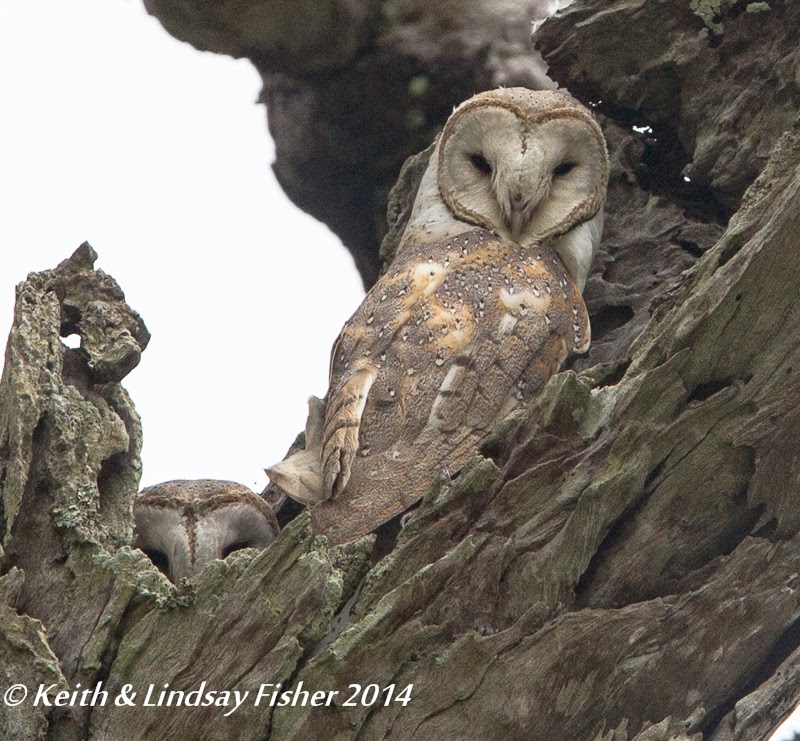
 
Barn Owl - juvenile


Barn Owl - juvenile


Noisy Pitta have started to call and have been seen around the Lodge grounds, we still think we only have one bird present. There has been a couple of sightings of Lovely Fairy-wren in the grounds, one along Bushy Creek and another at the Crake Pool. Fourteen species of honeyeater were seen and one heard, which was only four less than the total recorded at the Lodge. Again Pied Monarch and Yellow-breasted Boatbill have both been calling well and being seen. Barred Cuckoo-shrike have made a few appearances but have not been regular. Golden, Grey and Rufous Whistler have all been seen in and around the Lodge as have Northern, Rufous and Grey Fantail. Only a couple of sightings of Leaden Flycatcher over the two weeks but Lemon-bellied Flycatcher have been around with up to six seen at a time. Victoria's Riflebird were seen in the first week but not in the second so they might have left. A Tawny Grassbird was briefly seen in an adjacent cane paddock where it was calling. Metallic Starling returned on the 10th August from Papua New Guinea with numbers continuing to increase along with the nesting activity at their colony in Geraghty Park.
Further Afield:-

Blue-faced Parrot-Finch are being seen infrequently near Abattoir Swamp with only a couple of birds seen. Australian Bustard are displaying at Maryfarms between Mt. Molloy and Mt. Carbine and a single Australian Pratincole is still present at this location after about 3 weeks. Mt. Lewis is as good as ever with bird guide Doug Herrington from Birdwatching Tropical Australia reporting five male Golden Bowerbird seen in one visit! All other “Wet Tropic” endemics were found here in the last two weeks, even more reason to stay at Kingfisher Park Birdwatchers Lodge! Our roving bird guides Carol and Andrew Iles reported Tawny Grassbird, White-eared Monarch, Shining Flycatcher and Red-winged Parrot from Julatten as well as an Australian Hobby whizzing down Mt. Molloy main street. Freckled Duck are still at Hasties Swamp near Atherton and have been almost continuously for the past two years, they were joined by an estimated 2000 Magpie Goose this week.


Identification of odd Looking Lewin's Honeyeater:-

The first two images of a meliphagous honeyeater were photographed at Malanda on the Atherton Tableland at about 900m, the third more typical Lewin's  was photographed at the Lodge, they are all ssp. mab, which occurs in Far North Queensland.

After some discussion with a few local and interstate experts it was agreed that this bird is an odd looking Lewin's, it certainly had the Lewin's call. It has an odd shaped ear patch, which is a lot smaller than a normal Lewin's of the ssp mab. The ear patch looks more like a Graceful. The lower mandible is slightly curved like a Graceful and not straight like Lewin's  the length of the bill looks slightly longer in these comparison images than Lewin's. The underparts don't have as much streaking as Lewin's and the face is less grey than a Lewin's. It is possible this could be a Lewin's/Graceful hybrid as there altitudinal range does overlap (Graceful usually occur below 600m). Note:- Lewin's Honeyeater ssp. mab does not have the distinct crescent shape to the ear patch of southern birds but a slightly less shaped crescent as shown in the 3rd image.Thanks to the experts for their comments. 


Lewin's Honeyeater ssp. mab


Lewin's Honeyeater ssp. mab


Lewin's Honeyeater ssp. mab - typical


Reptiles and Mammals

In addition to the mammals and reptiles mention on night walks we had other interesting sightings including Red-legged Pademelon, Agile Wallaby, Platypus with two regularly showing, Water Rat, Green Tree Snake and Australian Scrub Python. Over the two week we had 17 mammal species and 12 amphibian/reptiles.

Insect:-
This interesting beetle turned up at the reception area feeder one evening, it is a Carion Beetle Diamesus osculans. In Australia there are only three species in two genera mainly found in forested areas within 300km of coastal areas in eastern and northern Australia. This species is also found in Papua New Guinea and in Asia. (info. From “A Guide to the Beetles of Australia” George Hangay and Paul Zborowski). This is the first one we have seen in the Lodge grounds.
Carion Beetle

Thanks to our bird guide neighbours Carol and Andrew Iles for helping to compile the weekly bird lists, don't forget to contact them if you need any bird guiding.


Kingfisher Park Birdwatchers Lodge Business and Property For Sale
Click here for more sale details


Sunday, 1 June 2014

1st June 2014 Kingfisher Park Birdwatchers Lodge

Weather Report
Mixed weather over the last two weeks, mainly drizzle with a few sunny days but temperatures were kept low only getting up to 24ºC. The first week we had 29mm of rain and the second week some rain fell with 10mm on four rainy days, again as in the previous two weeks just enough to be annoying.

Last Two Weeks Bird Sightings:-
The first week had 84 species and second week 94 species.
Species lists can be found on the Eremaea eBird site.  18th - 24th May and 25th - 31st May

Birding Highlights:-
A single Australasian Grebe was along McDougall Road, a first for two months. Also along here were over 300 Cattle Egret who roost in the trees around the lagoon. A Black-breasted Buzzard was seen by one of our guests over Geraghty Park, this was the second time in a few weeks one has been seen in the area. Red-necked Crake have only been heard and not seen, the area they were frequenting has now dried up and they have gone further into the rainforest. Fan-tailed Cuckoo arrived back from southern parts of Australia on 27th May with at least three birds calling around the Lodge. Lesser Sooty Owl was heard but not seen, probably due to the pair of Barking Owl who were around the Lodge grounds every night keeping it away. One Barn Owl was seen in a nest tree which may mean they are getting ready to breed again as it is the right time of year. At least four Papuan Frogmouth have been seen in the area and an Australian Owlet-nightjar heard calling one night. Double-eyed Fig-Parrot were seen digging out a nest hole in a tree but the branch it was in broke off and they have not been back since. A pair of Red-winged Parrot were seen near the Julatten school (just in our 1.5km Lodge area) by Carol Iles our neighbouring bird guide. This is about the closest they come to the Lodge apart from a couple of sightings in Geraghty Park. Spotted Catbird are still coming to the feeder in the morning and also feeding on the fruit of a Soursop tree in our orchard. Red-backed Fairy-wren have been seen along McDougall Road, usually sitting on the fences. 12 species of honeyeater over the two weeks, including Scarlet, White-cheeked and Macleay's. The Macleay's Honeyeater have been hogging the bird feeder and chasing off the Lewin, Yellow-spotted and Graceful Honeyeater. 
 
Macleay's Honeyeater


Yellow-breasted Boatbill continue to call and be very active so they are being seen regularly. Barred Cuckoo-shrike have been calling and around in small numbers as have Varied Triller.

Little (Rufous) Shrike-thrush have been very active and calling a lot, they are common residents around the Lodge and are not to be confused with the Bower's Shrike-thrush. The Bower's are normally resident up on the mountains behind us and can be seen usually above 600m on Mt. Lewis, we are only 430m which is within the range of the Little who can be found up to 600m. Bower's do come down in the winter months but we only see one or two. Bower's has more obvious striations on throat and breast, also their bill is black (adult male and older immature males) or grey/black (adult and immature females as well as immature males) whereas Little have a pinkish-brown/grey bill and a light coloured eye-ring. Bower's have dark grey back and head, the little have olive-brown, although we have seen a few little with quite grey back and rumps. There are seven sub-species of Little Shrike-thrush in Australia, the one found here is giseata. All these sub-species have plumage variation with the sexes being similar.

Little (Rufous) Shrike-thrush


Bower's Shrike-thrush

At least one male Golden Whistler is still around the Lodge and has been joined by a Yellow Oriole which is more a species of the coast in our region but has been creeping into our area over the last few years. A few Spangled Drongo are still around but the majority of them have gone further north. Pied Monarch have become more active and are calling as have at least two female Victoria's Riflebird who have been getting around the Lodge together.

Further Afield:-
A Spotted Harrier was seen over the adjacent cane paddock by our neighbour Carol Iles and was probably the same one we saw a few weeks earlier at the same location. A (Common) Cicadabird was calling along Euluma Creek Road in Julatten, unusual for this time of year. On 28th May Del Richards from Fine Feather Tours reported a Brown Songlark (female) at Maryfarms, north of Mt. Molloy. It was perched on a fence with a female White-winged Triller and Black-faced Woodswallow. This was a first sighting for him since the 2002 drought. Both Brown Songlark and Black-faced Woodswallow are uncommon at this location.

Reptiles and Mammals:-
At least three Red-legged Pademelon are still around the Lodge grounds after one was taken by an Australian Scrub Python. Two species of bat recorded for this period, they were Large-footed Myotis (fish eating bat) and Northern Broad-nosed Bat. Striped Possum were seen, one was in our neighbours garden, another was seen late in the second week jumping around the trees near the Lodge reception. The persistent drizzle was to the frogs liking with Jungguy Frog, White-lipped Tree Frog, Roth's Tree Frog, Desert (Red) Tree Frog, Cogger's Frog, Dainty Green Tree Frog and Cane Toad.

Cogger's Frog
An adult Northern Leaf-tailed Gecko was spotlighted on a tree in the rainforest and an immature one, only 60mm in length, was rescued from the amenities block and released back into the rainforest. This is the first time we had seen an immature Leaf-tailed Gecko, which as you can see from the photos is very cute and very well camouflaged.

Northern Leaf-tailed Gecko - immature

This tree-dwelling nocturnal species relies on its camouflaged appearance to avoid discovery by predators. They are found in rainforests, wet sclerophyll forests, rocks and on the forest floor at night. We have found them on the floor where they run with their tail up in the air. During the day they are hiding behind loose bark or tree crevices. At night they come out and perch head down on large trees in the rainforest or on our orchard trees, we usually find them between 1-3m from the ground. They mainly eat large invertebrates such as Katydid, Cricket, Cockroach and Spider. Breeding season is usually just before the "Wet Season" in October or November when the females lay one or two soft-shelled eggs in moist soil or leaf litter. After about three months the young hatch and have to start catching insects straight away. They don't reach adulthood until two years and go on to live for about nine years.

Australian Scrub Python were seen in our neighbours garden, this one had just had a meal and was looking to rest up somewhere. Judging by the bulge in it's body it must have eaten something at least as big as a White-tailed Rat. This close up of it's head has a mosquito on it, they are not fussy who they get their blood from!

Australian Scrub Python

Finally whilst our neighbour Carol was guiding one of our guests on Mt. Lewis recently they came across this Queensland Blue Earthworm Terriswalkeris terraereginae an invertebrate which can grow up to 2 meters. We've only seen one which is not surprising as they only come to the surface after heavy rains when they are disturbed from their burrows. This image was taken by Ross Monks -thanks Ross.
 
Queensland Blue Earthworm
Thanks to Carol and Andrew Iles our neighbouring bird guides for helping compile the weekly species list.

Abattoir Swamp:-
Abattoir Swamp is about 6km from the Lodge and is a good birding area but unfortunately the boardwalk to the bird hide has collapsed and the local Mareeba Shire Council have told us that they have no money to repair it at the moment. We had sent them a summary of birds and the importance of this facility to birdwatchers and local businesses but this did not make any difference to their decision to close the boardwalk apart from making them aware. They did say they would look at it in the future. The car park is a good birding spot so it is still worth stopping here.


Abattoir Swamp Boardwalk

Abattoir Swamp Boardwalk - damage

Kingfisher Park Birdwatchers Lodge Business and Property For Sale
Click here for more sale details

Monday, 5 May 2014

3rd May 2014 Kingfisher Park Birdwatchers Lodge

Weather Report
The first week was quite wet with 71.5mm of rain falling, just to keep the ground sodden. However the second week was absolutely glorious, no rain, cooler temperatures down to18ºC and up to 27ºC. The humidity also dropped from the mid 90% to 62%

Last Two Weeks Bird Sightings:-
These can be found on the Eremaea eBird site for  20th - 26th April and 27th - 3rd May

Birding Highlights:-
An uncommon visitor was a Pied Currawong seen by our neighbour and local bird guide Carol Iles flying past her house and heading for the Mt. Lewis Range. We only get one or two sightings, but not every year. Looks like most of the summer migratory species have left as we have not seen Buff-breasted Paradise-Kingfisher since the 21st April or Black-faced Monarch since 27th April. Dollarbird have also not been seen for a week, but flocks of up to 80+ immature Metallic Starling are still with us. Waterbirds have been scarce with the highlight a Nankeen Night Heron along McDougall Road. Australian White Ibis have been hanging around the Barramundi Farm along with a pair of White-bellied Sea-Eagle. Other raptors seen were Whistling and Black Kite, Brown Goshawk and Collared Sparrowhawk. Red-necked Crake have not been so obvious over the last week with no sightings, only heard, also Pale-vented Bush-hen have gone quiet and not been seen for nearly a week. This one is about 3 months old.


Pale-vented Bush-hen

Bush Stone-curlew are around the area which has some good bush but these three choose to roost during the day in amongst junk at the rear of the local nursing home. 
 

Bush Stone-curlew

Ocassionally they do go to more pleasant surrounds as below.


Bush Stone-curlew


Double-eyed Fig-Parrot have been feeding in a couple of fruiting fig trees, mainly female and juveniles. Barking Owl have been around for most of the last two weeks, calling and seen a few times. Azure Kingfisher have been zipping up and down Bushy Creek or fishing in the Crake Pool. Rainbow Bee-eater have been around in groups and roosting in nearby trees. Spotted Catbird have started to come back to the feeder for banana as have the honeyeaters, mainly Yellow-spotted, Graceful, Blue-faced and Macleay's. Grey Fantail arrived back at the beginning of May with at least two calling. Pied Monarch have been around, but not calling much whereas Yellow-breasted Boatbill have been very vocal. Victoria's Riflebird (female) has been seen in the Lodge grounds and in Geraghty Park picking off bark looking for insects. Pale-yellow Robin are always favorites with our guests as they are so confiding and cute (and easy to photograph!)


Pale-yellow Robin

Olive-backed Sunbird have been busy feeding on some of the flowering gingers.


Olive-backed Sunbird


Chestnut-breasted Mannikin where seen collecting nesting material along Mt. Kooyong Road.

Further Afield:-
Mt. Lewis still had a few Blue-faced Parrot-Finch in the 10km clearing at the beginning of May, but more were seen further down the mountain about 1-2 km from the bottom of the road. Other birds reported from the lower slopes of Mt. Lewis included Chestnut-breasted Cuckoo, White-eared Monarch and a male Victoria's Riflebird. Carol and Andrew Iles reported some good birds along Quaid's Road opposite Lake Mitchell (between Mareeba and Mt. Molloy), they included Banded Honeyeater, Noisy Miner who only occur in a few isolated areas in Far North Queensland, and flocks of Striated Pardalote. They also heard Grey Butcherbird, Pied Currawong and Northern Fantail. Euluma Creek Road in Julatten had an Australian Hobby and Brown Falcon plus White-headed Pigeon and Wompoo Fruit-Dove. Ferrero Road, near Port Douglas, had 28 adult Magpie Goose plus one juvenile with them. A 55 minute visit to Cattana Wetlands in Cairns turned up 32 species including an adult Wandering Whistling-Duck with five ducklings, three Australian Pelican soaring overhead, good views of at least 10 Double-eyed Fig-Parrot and a rather scruffy Little Pied Cormorant. Yorkey's Knob Lagoon at the golf course has been progressively modified over the years with the island being joined to the mainland and trees removed and this  has caused a drop in species using it. We did see an Australasian Darter carrying nesting material into one of the remaining trees, and a Buff-banded Rail heading into mangroves. The area along the back of the Yorkey's Knob Beach has some good vegetation with many species using it including Rose-crowned Fruit-Dove (thanks to Tony Neilson for supplying the photo below), 
 

Rose-crowned Fruit-Dove

Lovely Fairy-wren, Black Butcherbird and several pairs of Olive-backed Sunbird. This immature Helmeted Friarbird was interesting for the amount of bare skin around the eye which extended to the bill, unfortunately the sun cast a shadow from the branch over the birds face.


Helmeted Friarbird

Reptiles and Mammals:-
A Bush Rat appeared at our feeder after an absence of about 2 months, hopefully more have survived the two Barking Owl which have been hanging around the area. Frogs have been around in small numbers with Jungguy Frog, White-lipped Green Tree Frog, Roth's (Laughing) Frog, Desert (Red) Tree Frog, Dainty Green Tree Frog and Cane Toad being seen plus Striped Marsh frog only heard. Boyd's Forest Dragon have been hiding with only one or two appearances, Eastern Water Dragon have been regularly along Bushy Creek and Major Skink have also been showing.Bats have been roosting under our neighbours Carol and Andrew's house, we have seen Northern Broad-nosed Bat, Little Bent-winged Bat and Large-footed Myotis here. We think these ones are Northern Broad-nosed Bat.


Northern Broad-nosed Bat?