Showing posts with label Bush Stone-curlew. Show all posts

Sunday, 2 June 2013

2nd June 2013 Kingfisher Park Birdwatchers Lodge

FYI: The latest version of the Bird Trails Tropical Queensland brochure for the Cairns region has just been released. It covers Cairns, Daintree, Cairns Highland (Atherton Tableland) and Mission Beach areas. It has a map of the area showing all the best birding sites, bird guides and places to stay along with contact details and the various suggested trails around the area. The website shown on the brochure is not completed yet so has not gone live. You can download a copy from our website, just click on the brochure below.


Weather Report:-
Frustrating couple of weeks with lots of drizzle which did not produce much rain. Most of the drizzle came from the coast as the south-easterly winds were quite strong bringing the rain onshore. However there were a few breaks with sunshine and clear conditions temperatures ranging from 18ºC to 28ºC. Rainfall for the two weeks was 15.5mm. .

The cloudy weather did bring some good photo opportunities of the mountain range behind the Lodge. This one was taken with a 300mm F2.8 lens early morning.


Mt. Lewis Range in Cloud

Past Two Weeks Bird Sightings:-
Bird sightings for the first week were 86 seen and 11 heard, second week sightings were, 96 seen and 8 heard. The last two weeks bird lists can be found on the Eremaea Birds Website:- May 19th – May 25th and May 26th - June 1st

Birding Highlights:-
Magpie Goose were heard honking as they flew over the Lodge one night and were seen along McDougall Road the next day in one of the wetlands. Emerald Dove started to re-appear after their numbers dropped for about a month, they even started calling which might be a sign that the breeding season is not far off. Small flocks of Topknot Pigeon have been seen flying over from the mountains which hopefully signals their return to far north Queensland. A male Superb Fruit-Dove was caught helping itself to some palm tree fruit in front of the accommodation units late one afternoon and Wompoo Fruit-Dove also visited this food resource several times. Papuan Frogmouth was seen at the nursing home during the first week but disappeared during the second only to re-appear at the end of the week. A White-necked Heron, an uncommon visitor, was foraging in some ponding amongst a cane field behind the nursing home late one afternoon. A Nankeen Night Heron, occasional visitor, was along Bushy Creek one afternoon and at least five Royal Spoonbill were seen heading for the local Barramundi Farm. Raptors were around in low numbers with sightings of one Black-shouldered Kite, Spotted Harrier, Brown Falcon and Nankeen Kestrel plus a pair of White-bellied Sea-Eagle, two Whistling Kite and up to eight Black Kite. Red-necked Crake was heard quite frequently in the evening calling from the patch of rainforest between the Lodge and the Rex Highway but not sighted. Two Pale-vented Bush-hen were heard along Bushy Creek when a neighbour drove past in a tractor; noise quite often triggers them to call especially noisy cars, motorbikes and aeroplanes. Bush Stone-curlew have been very vocal at night up and down the road adjacent to the Lodge. These two, caught checking out the irrigation pipes of the nearby nursing home garden, could be the culprits.

Bush Stone-curlew

Double-eyed Fig-Parrot were seen flying over and were probably checking out a local fig tree which has fruits that are almost ripe - expect it to be ready in a week or two. Little Bronze-cuckoo have been around calling quite a lot and been seen, most are the nominate species not the usual Gould's sub-species that we get here; one Gould's was seen at the end of week two. 

 
Little Bronze-Cuckoo (Gould's)


Barking Owl have been heard calling in the evening and early morning with one spotted on the edge of the Lodge grounds early one morning and another one perched in front of the accommodation units at the end of a night spotlighting tour, great views. At least four Eastern Barn Owl have been around, one was seen clutching a small mice/rat. An Azure Kingfisher was at the Crake Pool perching on a vine and diving in to collect some small fish late one afternoon. Blue-winged Kookaburra have been calling and seen in Geraghty Park most times we have looked. Spotted Catbird have been calling mainly early morning as they skulk around in the rainforest. Honeyeaters were about in small numbers with 12 species seen and another two heard. A single Barred Cuckoo-shrike was perched high in the orchard one morning preening on top of a Blue Quandong tree and not seen again over the two weeks. A Bower's Shrike-thrush was a surprise in the camping area as it foraged in a fig tree, it showed its distinctive black bill (adult male), grey upper parts and streaked deep rufous upper breast. We do get one or two coming down from their more usual haunts up above 600m in the mountains during the cooler months. It was only seen once before disappearing. An adult Yellow Oriole continues to move around the Lodge and our neighbours garden calling as it goes. Northern Fantail has been around spasmodically as have Leaden Flycatcher. A territorial dispute erupted in Geraghty Park between four Magpie-lark which became quite violent as this image shows with three of the birds getting stuck into each other with a blur of wings, the fourth bird joined in for a brief period before the intruders were sent packing! Not a particularly good photo but it does show the ferocity of the encounter.


Magpie-lark

Pied Monarch has been around the Lodge grounds as well as coming down to Bushy Creek late afternoon for a bathe. A pair of Yellow-breasted Boatbill were dueting to each other one morning in the rainforest, they kept going for over 15 minutes and were still going when we left. Not heard this calling to each other before and it was hard to know which bird was responding, male or female. Still only a few Grey-headed Robin have come down off the mountains with only two or three heard and seen; quite a contrast to last year when there were three or four times as many. Tawny Grassbird are still around with a couple heard in an adjacent cane field.

Further Afield:-
The strangest sighting was of a Budgerigar on Mt. Lewis, yes it was green and no it was not an escapee! An image and information is on the Eremaea Birds site. Budgerigar were also reported from Rinyirru (Lakefield) National Park by Doug Herrington and the BirdLife Northern Queensland Group. It is certainly a year for Budgerigar on the east coast with flocks of up to 900 reported from Townsville and district. Diamond Dove are still being found at Maryfarms (between Mount Molloy and Mt. Carbine) with others reported from around Mareeba. An adult Spotted Harrier was soaring over paddocks along Euluma Creek Road, in Julatten at the end of the second week, before landing in a cut cane paddock. Such a majestic bird with its contrasting grey upper wings and deep rufous breast.

Reptiles and Mammals:-
We had a student at the Lodge for just over a week who put out remote cameras for an experiment with mammals and it was very interesting to see what came to the feeding station by the reception area. At least two Long-nosed Bandicoot (one pregnant) came during the night, a species we don't see often earlier in the evening and a Black Rat turned up. One was reported a few weeks ago but not seen since, so the footage was confirmation of the sighting. We have only seen one previously at the feeder a few years ago and certainly would not encourage it to bring its mates along! A 4m+ Scrub (Amethystine) Python was seen crossing the road to reception one night, it had a large bulge in it so must have had a recent meal, possibly a White-tailed Rat. This would possibly be the largest python to be seen in the Lodge, its definitely the largest in our eight years. A Leaf-tailed Gecko was a great find on a night spotlighting tour – the first for several months. Boyd's Forest Dragon have been hiding most of the time but the odd one has been showing now and again. One around the reception area feeder came in for banana and another one was standing on the road near the entrance to the Lodge. This one did not want to move even when an Orange-footed Scrub Fowl almost walked on it! It needed some encouragement to get off the road and back into the rainforest. 


Boyd's Forest Dragon


Not many frogs around despite the drizzle, a White-lipped Tree Frog decided to set up home on a guest car between the cab and the back canopy, it did quite a few kilometres before it was coaxed out and relocated.

Other Criters:-
This rainforest Preying Mantis sp. turned up one evening and stayed long enough to get a photo.




Sunday, 20 May 2012

20th May 2012 Kingfisher Park Birdwatchers Lodge


8.5mm of rain fell over the last two weeks on 5 rain days. Most of the other days were either sunny and very pleasant or cool and overcast. The minimum temperature was down to 15.2ºc and the maximum only up to 23.7ºc. The humidity was quite high and varied between 72% and 95%.

Bird species were for the week before last were 100 seen and 3 heard, this last week sightings were 86 seen and 9 heard. 20 mammal and reptile species were seen. The last two weeks bird lists are on the Eremaea Birds & Eremaea Birds website and morning walk lists can also be found at this link on Eremaea Birds

Highlights:
The highlight for the last two weeks has to be the return of “Katie” our Buff-banded Rail after being away since Christmas. Those of you who don't know, Katie was one of two Buff-banded Rail chicks raised by our neighbours Carol and Andrew Iles (well known bird guides). Katie took up residence in the Lodge grounds and was very good at cleaning rooms of insects as well as cleaning out a few guests caravans, she was very popular but occasional blotted her copybook by pecking a few guests. Hope she has matured and now behaves herself. She turned up this past week knocking on the kitchen door for some free handouts and as a thank you she cleaned up a few rooms, the office and reception area of insects! Great to have her back after running off with her boyfriend five months ago. Nice to know what she was doing; we were rather hoping she would be back with a few little Katies but not to be. 

Buff-banded Rail - Katie

Lowlight was the last of our Buff-breasted Paradise-Kingfisher who departed on the night of 7th May to head north to Papua New Guinea, this is the latest departure we have recorded at the Lodge.

Apart from Katie their has been a few more highlights: First returning birds for the season were, an Oriental Cuckoo photographed by one of our guests perched on a fence post along Mt. Kooyong Road, a male Cotton Pygmy-goose on a lagoon along McDougall Road which was only present for one day, an Australian Reed-Warbler heard in the adjacent cane field along Bushy Creek, Golden Whistler calling in the Lodge grounds after an absence of two years – they migrate altitudinally from the mountains behind the Lodge as does the occasional Bowers Shrike-thrush we saw this week pouncing onto the ground to grab a large grasshopper in the camping area. Another migrant turned up in our neighbours garden, two Satin Bowerbird.

Other sightings:

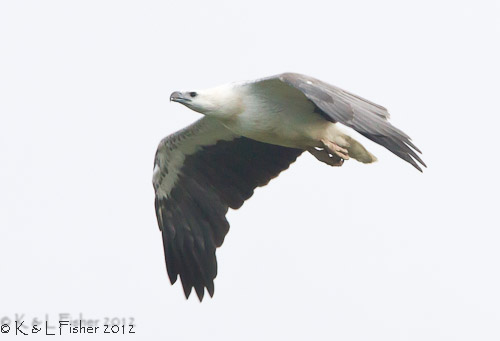
A few waterbirds were found in the lagoons along McDougall Road, these included Magpie Goose, Wandering Whistling-Duck, Pacific Black Duck, Hardhead, Australasian Grebe, Australasian Darter, Little and Pied Cormorant and White-faced Heron but as in previous weeks they are in low numbers and moving around the area. Pigeons have been quiet with only Topknot Pigeon seen over the last two weeks when up to 45 birds were seen foraging in a fig tree along McDougall Road. Still no sign of any Papuan Frogmouth around the area but we did hear Australian Owlet-nightjar calling in the Lodge grounds on several occasions. Raptors have again been around but infrequently; those recorded were Black-shouldered Kite, White-bellied Sea-Eagle, Whistling, Brahminy and Black Kite, Grey Goshawk and Brown Falcon.


White-bellied Sea-Eagle
 
Bush Stone-curlew have been seen regularly roosting near the local nursing home (shown below) and Masked Lapwing have been gathering in small groups of up to 16 birds. 
 

Bush Stone-curlew

Sulphur-crested Cockatoo have been getting stuck into some of the fruit in our orchard and our neighbours garden. They have been into the Grapefruit’s, destroying the flesh to get at the seeds also some of the mandarins have gone the same way.This one decided to investigate a tree hollow and got a surprise as it contained an Eastern Barn Owl and it's letting the owl know what it thinks of it!

Sulphur-crested Cockatoo

Little (Goulds) Bronze-Cuckoo have been the most common cuckoo around with one sighting of a Pheasant Coucal and a Brush Cuckoo. Little Kingfisher was seen in the previous week but not this week however Azure Kingfisher has been seen regularly in and around Bushy Creek and the Crake Pool. Blue-winged Kookaburra have been vocal and flying around Geraghty Park and Laughing Kookaburra numbers are the highest we can remember (which is not very long!). 


Laughing Kookaburra

Noisy Pitta are still with us, calling but not being seen – not enough effort being put in to find them! Spotted Catbird are putting in infrequent visits to the feeder to grab some banana and a Great Bowerbird was feeding on palm seeds at the rear of the Lodge. Lovely Fairy-wren continue to be heard and seen in our neighbours garden, usually late afternoon. Brown Gerygone have ventured into the rainforest adjacent to the orchard and Fairy Gerygone have started calling and chasing each other. Twelve species of honeyeater were seen and one, Black-chinned heard. Of these the Scarlet is the most spectacular but tends to stay high in the eucalypt trees for tantalising glimpses. Little Shrike-thrush have been as active as ever, this one was foraging on the ground and grabbed a moth. 
 

Little Shrike-thrush

Black Butcherbird has been around lurking in the rainforest but only heard. A Spangled Drongo has started to visit our feeder by the reception and is probably the same one we have had visiting for the last few years. Rufous and Grey Fantail along with the Northern Fantail have been regularly sighted around the Lodge grounds as have Pied Monarch and Yellow-breasted Boatbill. Lemon-bellied Flycatcher were foraging across the Rex Highway opposite Geraghty Park about a metre above the ground which is unusual as they are normally high up in the trees and sallying forth to catch insects high up. A few juvenile Metallic Starling are still around which is late in the season up here. They maybe found on the coast between Cairns and Port Douglas all year around. Olive-backed Sunbird have been busy foraging and checking out old and new nest sites.

Olive-backed Sunbird - male

Large flocks (200+) of Chestnut-breasted Mannikin, mainly immatures, are still around which indicates a good breeding season.

Chestnut-breasted Mannikin - juveniles

Further Afield:-
22 Sarus Cranes were seen at Gallows Farm on the road from Atherton to Malanda on the Atherton Tableland. A Black-breasted Buzzard was a good sighting at Maryfarms north of Mt. Carbine as they are very uncommon in our area. Also at this location were seven Brolga soaring overhead. Both the Maryfarms sightings were made whilst our neighbour Carol was guiding our guests. Del Richards from Fine Feather Tours reported a female Satin Flycatcher in Julatten and a Red-backed Kingfisher at the bottom of the Rex Range between Julatten and Mossman, both species are migrants to our area. Mt. Lewis is as good as usual with a (Lesser) Sooty Owl seen on a night spotlighting tour. During the day most of the Wet Tropic endemics have been seen including a female or immature Golden Bowerbird, Fernwren and Atherton Scrubwren. Blue-faced Parrot-Finch have not been seen on Mt. Lewis for several weeks now and have not turned up in areas they appear in at lower altitudes as their food source has not started seeding yet. There has been reports of them in the Gurka Road area on the Atherton Tableland at the back of Mt.Bellinden Ker.

Reptiles and Mammals:-
A Carpet Python was a visitor to our neighbours house and stayed around for at least 10 days, this is a species we have not recorded in the Lodge grounds in the seven years we have been here. A 2.5m Australian Scrub Python (formerly Amethystine Python) was spotted slowly making its way across the path to our storage shed before disappearing into an old rock pile in the rainforest. A Northern Leaf-tailed Gecko was spotlighted low down on a tree around the orchard one night and Boyd's Forest Dragon sightings have become less frequent over the last two weeks. This gecko is in typical head down pose and very well camouflaged. 


Northern Leaf-tailed Gecko

A Green Ringtail Possum was seen for the first time in more than a month before four were seen on another night, this was followed by none on the following night – that's spotlighting for you. Meanwhile Striped Possum have been seen a few times and one was calling all night on one occasion. A Yellow-footed Antichinus (small placental mammal) has been active during the day coming to the feeder for banana and making an appearance on the reception counter before being chased out! With the drier weather frogs have retreated and apart from White-lipped Green Tree Frog not been seen over the last week and the previous week only turned up one Jungguy Frog.

Other Happenings:
Bird photography has become a major interest with birdos and non-birdos alike; you definitely don't need to be fashion conscience, photographers shall remain nameless!


Photographers Fashion

On the 6th May the moon was the closest it had been to the earth for 20 years and luckily it was a clear night so we could view the moon and take a few images of it. Hope it is this clear when we have the total eclipse in mid-November this year.


Moon

Sunday, 4 March 2012

Birdwatchers Lodge in Far North Queensland, Australia.


Well we had 208.5mm of rain this week and it was not even as a result of the Monsoonal Trough, which is still north of us hovering over Papua New Guinea and the top of Cape York Peninsula. Our rain came from the south-east and headed our way from off shore. It did flood the road to Mount Molloy for a day and flooded access to our water pump beside Bushy Creek. The overcast days kept the temperatures to a maximum 28.1ºc and the minimum up slightly on the previous week to a low of 22.3ºc.

The wet weather allowed fewer bird watching opportunities hence the lower than normal species number of 83 seen and 9 heard. 26 mammal and reptile species were seen. The weeks bird list is on the Eremaea Birds website and morning walk lists can also be found at this link on Eremaea Birds

Highlights:
An Eastern Spinebill turned up in one of our Grevillea's along Mt. Kooyong Road which is an unusual event. They are normally found up on Mt. Lewis more often than down around the Lodge. At last our Papuan Frogmouth was back in a Mango Tree in the orchard, roosting during the day, will she stay around? Red-necked Crake are still around with their 3 juveniles and calling infrequently.

Other sightings:
Orange-footed Scrubfowl have been active scrapping up debris and moving it across the road to the reception and onto their mound beside the road. Most of the debris has ended up on the road! This one was having a break from nest building duties to sit out in the sun in front of the cookshed.

Orange-footed Scrubfowl

The wet weather sent the waterbirds in all directions with few in the wetlands along McDougall Road. A few Magpie Goose were found perched in a tree with several Little Black Cormorant and an Intermediate Egret. Superb Fruit-Dove were heard but both Pied Imperial and Topknot Pigeon were seen. These Pied Imperial Pigeon were perched high in a Blue Quondong tree.


Pied Imperial Pigeon
A few Cattle Egret still in breeding plumage were accompanying cattle in a paddock along McDougall Road. Raptors were again absent with only one Whistling Kite seen and White-bellied Sea-Eagle heard. Pale-vented Bush-hen were again see in in the gully behind our neighbours house and heard calling from several other areas around the Lodge. Three Bush Stone-curlew were resting up for the day under some trees near the local nursing home and a pair of Double-eyed Fig-Parrot were seen flying over in the same area.


Bush Stone-curlew

Channel-billed Cuckoo are still around but less than five seen and heard. Other cuckoos around were Little (Gould's) Bronze-Cuckoo and Brush Cuckoo. Eastern Barn Owl were again in Geraghty Park but no records of Sooty Owl this week. Still one Buff-breasted Paradise-Kingfisher nest with chicks in but juveniles from other nests are growing fast and calling for food all day long. The parent birds are very obvious as they search for food, surprisingly some are still in very good condition with long straight tail streamers at a time when they are unusually damaged or bent from going in and out of the nest chamber for at least 6 weeks. Noisy Pitta was heard but not seen but Spotted Catbird have been seen. Red-backed Fairy-wren were again along McDougall Road while Lovely Fairy-wren were in our neighbours garden near Bushy Creek. Twelve honeyeater species for the week including the previously mentioned Eastern Spinebill and several views of the spectacular Scarlet Honeyeater. This Graceful Honeyeater was sitting on the ground for no apparent reason; it soon moved and flew up when approached.

Graceful Honeyeater

A pair of Cicadabird were on the edge of the orchard late on Saturday afternoon flying around and calling as they enjoyed the sunny conditions.


Cicadabird - male

Black Butcherbird have been around in the rainforest and a pair of Willie Wagtail were taking advantage of the newly mowed orchard to search for insects. Black-faced Monarch are still calling and spending most of their time foraging in the rainforest canopy unlike the Spectacled Monarch who are foraging down to ground level. A pair of Pied Monarch were bathing in Bushy Creek early in the week before it flooded and Yellow-breasted Boatbill have been very active and calling a lot in the rainforest. Lemon-bellied Flycatcher have been calling also and foraging in and around the Queensland Blue Gum in Geraghty Park and the edge of the Lodge grounds. Metallic Starling are still with us but numbers are still dwindling as some head north to Papua New Guinea.

Further Afield:-
Wet weather has caused the temporary closure of the Mt. Lewis road (beyond the gate). This will not effect our guests as this part of the road is a permit only area and they only need to go to the clearing at the 10km mark, the gate is a few hundred metres beyond here. The area around the clearing and the walk to the miners dam has been producing many of the higher altitude endemic species such as Fernwren, Atherton Scrubwren, Mountain Thornbill, Macleay's Honeyeater, Bridled Honeyeater, Grey-headed Robin, Chowchilla, Bower's Shrike-thrush, Victoria's Riflebird, Tooth-billed Bowerbird and a female Golden Bowerbird plus Blue-faced Parrot-Finch at the clearing.


Blue-faced Parrot-Finch

Also on Mt. Lewis was Rufous and Grey Fantail plus sub-species Keasti. With the rain of the last week this part of the road may well become impassable as well but in any case four-wheel drive will be required. The small wetland at Brady Road, Mareeba had quite a few waterbirds plus juvenile White-bellied Cuckoo-shrike and Dollarbird. Also here was a displaying Horsfield's Bushlark which was high above the wetland. There are still plenty of Black Kite along the road from Mount Molloy to Mareeba, which is still surprising as normally most of them have gone inland however quite a lot of the inland is also very wet.

Reptiles and Mammals:-
The wet weather has certainly enticed a few more reptiles and mammals to come out of hiding with 26 seen this week which is more than we have had for most of the year. A nice 2.5m Australian Scrub Python (used to be called Amethystine Python) was crossing the road near our two bedroom units and a Brown Tree Snake was found by the birds coiled up on a callistemon outside the cookshed. A Northern Leaf-tailed Gecko was found during a nightwalk early in the week; the first for several months. Five frog species were found plus cane toads which were collected for disposal, humanely. Striped Possum were seen on three occasions which was the best sightings around the Lodge grounds for over a month. Fawn-footed Melomys, Yellow-footed Antichinus, Bush Rat, Giant White-tailed Rat and Northern Brown Bandicoot were all visitors to the seed feeder near the reception area in the evening. This is a Fawn-footed Melomys at the feeder, they look very cute but don't be fooled, as they love getting into vehicles and chewing the plastic wiring and hose pipes!

Fawn-footed Melomys

Must have been a good week for pythons as we found two more on a property along Euluma Creek Road, one was at least 3m long and quite thick the other one which was nearby was only about 2m and quite thin, great to see them around.

Sunday, 11 September 2011

11th September 2011 Report


3mm of rain this week but still very dry. Overnight temperatures were slightly cooler than last week going down to 14.8ºc in the middle of the week which was 2ºc cooler than last week. The afternoon temperatures were up to 26.9ºc which was about a degree warmer than last week.

Another good week for numbers of bird species with 102 seen, and 8 heard. Reptiles and mammals were 17 which was one more than last week.

The weeks bird list is on the Eremaea Birds website and morning walk lists can also be found at this link on Eremaea Birds.

Main highlights for the week were great views of a preening (Lesser) Sooty Owl perched behind our cook shed at the end of an evening walk. It spent at least 10 minutes perched and calling in between its preening. A Little Kingfisher made an appearance at the Crake Pool late one afternoon and both Eastern Koel and Channel-billed Cuckoo were heard on the morning of the 9th, first returns here for the year.


Channel-billed Cuckoo

Magpie Goose were heard flying over one evening, probably heading to the lagoons along McDougall Road. Once again these two wetlands retained a good collection of waterbirds including two pairs of Cotton Pygmy-goose and a few Comb-crested Jacana. 


Comb-crested Jacana

Superb Fruit-Dove were heard on several days but not seen and some of the hundreds of overflying Topknot Pigeon landed in the rainforest adjacent to the orchard for good views. Again the female Papuan Frogmouth has been calling every night and seen most days roosting on the edge of the orchard. Black Bittern was seen along McDougall Road which is the first time for 10 weeks. White-bellied Sea-Eagle were seen flying past the entrance to the Lodge grounds several times carrying fish and also seen displaying overhead. A Grey Goshawk was heard and both Nankeen Kestrel and Australian Hobby were seen. Katie our Buff-banded Rail continues to entertain our guests cleaning up spiders and crumbs in their rooms or inside their caravans, she is very efficient!

Bush Stone-curlew have been very vocal during the week calling all night, sometimes quite close to the buildings or along Mt. Kooyong Road. We have also been hearing them fly over making a different call to the ones they do on the ground. 


Bush Stone-curlew

A pair of Rainbow Lorikeet have been coming around with two whinging juvenile birds who are constantly begging food and Scaly-breasted Lorikeet have been seen again entering a hole in one of the Queensland Blue Gums. An adult male Little Bronze-Cuckoo (Gould's sub-species) has been foraging around the entrance to the Lodge grounds, calling and giving good views. Eastern Barn Owl numbers still seem to be low with only two seen during a spotlighting trip on one night. A pair of Spotted Catbird have been around with one adult feeding another adult at the feeder one day and another day they were seen in the orchard with one bird chasing the other with a small Candlenut fruit in its bill. We presume this is the male chasing the female and giving her presents before copulating.

Lovely Fairy-wren were in some bamboo alongside Bushy Creek near the nursing home at the end of the week. A good week for honeyeaters with 13 seen, which was one more than last week, plenty of flowering trees and shrubs to attract them. Scarlet Honeyeater were coming down low to feed on the flowers of the Macadamia which is a member of the family Proteaceae, (the same as grevilleas which are known for their bird attracting flowers). Macadamia's are native to Australia and among only a handful of commercially cultivated endemic Australian plants; it is grown for its edible nuts. The White-tailed Rats get most of our nuts! Graceful Honeyeater is a resident in the Lodge grounds and this one was calling as it was photographed making identification easy (if you know the call). It is twisting its head, distorting the yellow ear patch and making it look more like the crescent shape of the Lewin's Honeyeater, adding to the difficulty in identifying it. Graceful Honeyeater are much smaller than Yellow-spotted and Lewin's Honeyeater but in an image you don't get to see the relative size or the more nervous wing flicks that the Graceful tend to do. These three meliphagas honeyeaters with the yellow ear patches prove to be the most difficult honeyeaters for visitors to identify. The best identification article for these birds was written by David James in the September 1995 edition of the Birds Australia magazine Wingspan.


Graceful Honeyeater

Barred Cuckoo-shrike have been around calling and at least five seen perched beside Bushy Creek high up in a Blue Quandong tree. Black Butcherbird have been calling and seen with both the black plumaged adult and juvenile plumaged brown bird sneaking around in the rainforest. The brown bird was seen attacking an Olive-backed Sunbird.

Pied Monarch and Yellow-breasted Sunbird have both been calling and seen throughout the week. A female Victoria's Riflebird was seen once at the bird feeder by the reception area. Two Bassian Thrush were seen at the beginning of the week but had disappeared by the end, same behaviour as last week.

Further afield a male Golden Bowerbird was seen on Mount Lewis along with good views of Superb Fruit-Dove. Three White-headed Pigeon were a few kilometres away in a patch of rainforest off the Rex Highway. Blue-faced Parrot-Finch have not been seen in the area for most of the week and the habitat is looking unsuitable as there is very little seed and it is very dry. A Barking Owl was seen roosting in a patch of rainforest near Abattoir Swamp and is the closest we have had one to the Lodge this year.


Barking Owl

The best mammal for the week was a Short-beaked Echidna seen by our neighbour, Carol the local bird guide, at the back of the Mt. Kooyong Nursing Home, which first one seen for about 3 years. They used to be resident around the Lodge an seen fairly regularly, lets hope they are making a come back. You can just see the black bill at the front of this Echidna digging into the ground.


Short-beaked Echidna

A Green Ringtail Possum was seen opposite the platypus viewing area across Bushy Creek whilst on a nightwalk, not a place we would expect to see one as it is low down and very sparse vegetation alongside a cane paddock. Platypus have been regularly seen in Bushy Creek with at least two performing; one was seen about 7.30am whilst on a morning walk and swam up and down for over five minutes putting on a good show.


Sunday, 21 November 2010

21st November 2010 Report


This week was overcast, sunny and rain, heavy at times. Some rain fell during the night but Friday afternoon was quite heavy with a total of 68mm for the week. Luckily the weather did not stop birdwatching or spotlighting. Top temperature was 29.8ºC and down to 20.9ºC. We recorded 79 bird species seen and 9 heard, mammals and reptiles were 21 seen. 

The weeks bird species list can be found here

Newly fledged birds continue to appear with more juvenile Pale-yellow Robin foraging and being fed whilst another pair of adults are building a nest. The pair of Pacific Baza continue to feed two hungry mouths who are growing rapidly. Two Bush Stone-curlew with two chicks were hanging around in the camping area which is unusual as we don't often get them in the Lodge grounds. They are quite common around the area but prefer to stay out in the more open areas. 


 Bush Stone-curlew - adult + 2 chicks


Buff-banded Rail had at least 3 chicks in our neighbours Barramundi Farm, Macleay's Honeyeater are bringing a few juveniles into the feeder, Red-browed Finch as always have juveniles with them. A Great Bowerbird was seen taking nesting material to a nest across the Rex Highway from Geraghty Park, first nest we've seen of this species. Double-eyed Fig-Parrot and Laughing Kookaburra are feeding nestlings at nests within the Lodge grounds. Noisy Pitta are still feeding at least two juveniles but also collecting nesting material for another nest! Willie Wagtail have three fledged youngsters they are trying to keep food supplied to and Olive-backed Sunbird have laid two eggs in a previously used nest in our neighbours garden and are busy sitting.

A very juvenile Spotted Catbird was found on the ground along the edge of the orchard with no sign of parents around. Several Laughing Kookaburra were eying it off, so they were chased away. Whilst doing this the catbird disappeared into the long grass and was found later in the day back out on the edge of the grass but unfortunately dead with no sign of injury, guess it starved as it was incapable of flying and getting its own food. Hard life being a young bird. Meanwhile nearby, a pair of Spotted Catbird are building another nest, maybe the parents of the unfortunate youngster who abandoned it.

Spotted Catbird - juvenile


Apart from all this nesting activity other sightings include a lone Topknot Pigeon high up in a tree near the Mt. Kooyong Nursing home. Australian Swiftlet have been around and an unconfirmed White-throated Needletail was reported mixed in with them, no sightings of them so far this season. Papuan Frogmouth has been calling from within the rainforest at night and also one day when it was overcast and raining, but no sightings. Little Pied and Little Black Cormorant were seen heading to the Barramundi farm where they no doubt were chased out. A pair of Nankeen Kestrel have been sitting on the power pole ladders along the Rex Highway outside the Lodge, they are there most mornings looking out for a meal. Red-necked Crake are still calling, but not seen this week - a possible sighting got everyone excited until it turned into an Orange-footed Scrubfowl (nice bird but far more common). Channel-billed Cuckoo have been more vocal this week as have been the Eastern Koel and Little-bronze Cuckoo. Sooty Owl has been heard calling in the early hours of the morning and searched for when we had to get up at 4.00am to serve breakfast to one of our tour groups. It was high up in a eucalypt tree making its full vocabulary of calls, but could not be found.  It eventually flew out the back of the tree before calling again some distance away. Anyway it is good to know that at least one is around the area and hopefully will start showing itself again after disappearing for several months.

Buff-breasted Paradise-Kingfisher are now showing well and coming down low as they are excavating nest sites in their termite mounds. Everyone has been getting good views of them displaying, mating and foraging on the ground. Still only three mounds excavated out. Blue-winged Kookaburra have been venturing closer to the Lodge grounds along Mt. Kooyong Road which is about the limit of their territory before they meet up with the Laughing Kookaburra. Fairy Gerygone are coming down low in the rainforest to eye level which is not their normal height, they are usually in the tops of the canopy. A single Lewin's Honeyeater showed at the feeder late in the week after seeing none for nearly two weeks and Scarlet Honeyeater have also been lower down than the tops of the eucalypts for good views, especially the males with their stunning red heads. 


 Scarlet Honeyeater - male


Yellow-breasted Boatbill have been calling a lot in the area last weeks juvenile was in so hopefully the little bloke is surviving. Golden-headed Cisticola have been perched on the top of the grass along Bushy Creek and the neighbouring cane field for good views, especially early morning with the sun on them. 


 Golden-headed Cisticola


Spotlighting was limited to one night this week with the highlight being a Striped Possum gnawing away at a dead tree trunk. Also of interest was Little Red Flying-fox high up on the Blue Quondong Eleocarpus grandis trees, appearing to be eating the fruits; it is a few years since we last saw one here. Last weeks mystery rat sp. was identified as a Canefield Rat by one expert. Only one sighting of it this week along with several Fawn-footed Melomys


Bush Rat - adult and one juvenile


Several sightings of Platypus at the normal late afternoon early morning time slot but unusually one was seen at 10.00am swimming up stream. Frogs were not as numerous which was a surprise given the rain we had, plenty calling but few showing. Boyd's Forest Dragon continues to hang around the restaurant eating area out front of the units and is usually found clinging to a tree or running across the lawn on its hind legs. One Green Tree Snake was seen crossing Mt. Kooyong Road, this was a first for a while.

Further afield we had a report of 3-4 Blue-faced Parrot-Finch at the 10km clearing on Mt. Lewis on the 12th November by one of our guests, none have been seen there since. An Oriental Cuckoo was recorded by Del Richards from Fine Feather Tours along the Mt. Lewis Road and he also reported Chestnut-breasted Cuckoo on the Lower slopes of Mt. Lewis – possibly three. Northern Fantail continues to put on a show at Abattoir Swamp car park and a White-browed Crake was along the edge of the swamp.

The Wonga Beach Barramundi Farm has become a reliable place to see Radjah Shelduck which are still at the salt water ponds. Trish and Andrew from Red Mill House in Daintree Village have asked us to pass on the following “We are currently negotiating with the Barramundi Farm with the view of gaining access for birders. It is disappointing, and also not helping our efforts, when we find that birders have been entering the property without approval. Could you please pass on to all birders that you come into contact with that this property has not given permission for birders to enter, and to do so is selfish and disrespectful. It also jeopardises talks that are ongoing and which could be beneficial to all”. So please if you go looking for them view them from the road and respect the owners property.

Once again interesting fungi has been appearing with the damp conditions, a selection below.


Pycnoporus coccineus ?

Pycnoporus coccineus ?

Interesting how this fungi grows, firstly in a horseshoe pattern before overlapping.


Polyporus arcularius ?

 Fungi sp.