Showing posts with label Kingfisher Park Birdwatchers Lodge. Show all posts

Sunday, 27 July 2014

27th July 2014 Kingfisher Park Birdwatchers Lodge

Weather Report
The first week was mainly dry and sunny' but 3.5mm of rain fell over two nights, the second week began dry before we had 4mm of rain which fell over two days. Temperatures ranged from a cool low of 11.5ºC up to 23ºC, very pleasant and great birding weather.

Last Two Weeks Bird Sightings:-
These can be found on the Eremaea eBird site. 13th - 19th July and 20th - 26th July

The first week has 98 sightings and the second week 109. Rainfall was 6.5mm over four days, much of this fell at night or was fine mist during the day. Overall it was great birding over the two weeks.


Birding Highlights:-

A few waterbirds were around in the local lagoons and Barramundi Farm; these included A couple of Green Pygmy-goose, Pacific Black Duck, Australasian Grebe, Little Black and Little Pied Cormorant, a single Australian Pelican, Great, Intermediate and Cattle Egret, White-faced Heron, Australian White and Straw-necked Ibis plus three Royal Spoonbill. Orange-footed Scrubfowl (they should be called orange-legged) have been very noisy calling day and night and chasing each other, they are quite comical to watch as they strut around.


Orange-footed Scrubfowl


Raptors were quite good with Black-shouldered Kite, Swamp and Spotted Harrier, Grey Goshawk, Collared Sparrowhawk, Black and Whistling Kite along with White-bellied Sea-Eagle. A Red-necked Crake was calling one evening but not seen. Brown Cuckoo-Dove have been taking advantage of several fruiting trees including Celerywood and a Strangler Fig with up to five seen at one time. Bar-shouldered Dove have been around the Lodge grounds and at the Barramundi Farm, they are a very attractive dove.


Bar-shouldered Dove


A single Wompoo Fruit-Dove has been around the Lodge grounds and calling. Not much cuckoo action with only a Fan-tailed Cuckoo heard and a Little Bronze-Cuckoo seen. Barn Owl have been noisy with one pair having three juveniles to feed and another pair with at least two chicks still in a nest. The two Barking Owl which have been around on and off for the last two years continue to be around, but not every night. Australian Owlet-nightjar has been heard on several nights, but not seen. Papuan Frogmouth numbers have increased to five in the immediate area with a male and female taking up residence in our orchard, so hopefully they will stay and breed here, welcome back! This picture shows three Papuan Frogmouth roosting during the day and pretending not to look like birds.


Papuan Frogmouth


Rainbow Bee-eater are still with us, but only about 12 have been recorded which is a decrease in numbers over the last few weeks. Up to six Double-eyed Fig-Parrot have been coming to a fruiting Cluster Fig to feed on the green fruits. At least two pairs of Spotted Catbird are in the Lodge grounds and our neighbours Carol and Andrew's garden. This one was queuing up for a free feed at their bird feeder.


Spotted Catbird

Our single Noisy Pitta continues to make appearances in our orchard to the delight of our guests. 15 species of honeyeater were recorded including at least two Black-chinned (Golden-backed Form) were are still around. A single male Yellow-throated Scrubwren is still with us after first being sighted a month ago, an altitudinal migrant from the mountains behind us. Yellow-breasted Boatbill have been showing well and coming down to lower levels in the rainforest for good views as have the Pied Monarch. A male Common Cicadabird was seen on a couple of morning walks, which was the first sightings for this year.


Common Cicadabird - male


A couple of Bower's Shrike-thrush are still around and showing well. Australasian Figbird have been scarce over the last few weeks, but towards the end of the second week they re-appeared in flocks of 30-40. These males are eating the fruits of an Umbrella Tree in front of our units.

 
Australasian Figbird - male


A female Shining Flycatcher flew through our neighbours garden whilst it was cutting a corner on a bend in Bushy Creek; we only see this species occasionally throughout the year. Another occasional visitor was a Tawny Grassbird foraging near the entrance to the Lodge and darting into the adjacent cane paddock. A few Chestnut-breasted Mannikin were also foraging alongside the cane paddock.


Further Afield:-

Numbers of Blue-faced Parrot-Finch near Abattoir Swamp have increased from the two reported last blog to at least five, but they are very difficult to locate. At Abattoir Swamp our neighbour Andrew Iles (bird guide) had Varied Sitella, which is uncommon at that location. Mt. Lewis is still the place to find the 13 “Wet Tropic” endemics with all being seen in the last two weeks – not on the same day though! At least three Lesser Sooty Owl were seen one evening. Just outside our 1.5km Lodge reporting area were five Purple Swamphen foraging alongside the Rex Highway which is not a good idea! Hopefully they will learn the error of their ways and relocate to the nearest wetland. Square-tailed Kite has been reported in Mt. Molloy and further north at Maryfarms. Hasties Swamp, near Atherton, has been turning up some good waterbirds including Freckled Duck and Glossy Ibis. A Brown Goshawk was around Euluma Creek road in Julatten one afternoon, always nice to see this species.

Reptiles and Mammals:-
The last few weeks have been extremely good for our night walks with plenty to see. One of the highlights was a Short-beaked Echidna which was the first we have seen this year. Other species seen were Striped and Green Ringtail Possum, Northern Brown and Long-nosed Bandicoot, Fawn-footed Melomys feeding on the fruit of an orange tree in our orchard, a brief glimpse of a Platypus in Bushy Creek and Several Northern Leaf-tailed Gecko. A few frogs were also spotlighted – Jungguy Frog, White-lipped Tree Frog, Roth's (Laughing) Frog, Desert Tree Frog, Dainty Green Tree Frog, Cogger's Frog and one small Cane Toad. Apart from those seen on the night walks we also had Bush Rat, Giant White-tailed Rat, Eastern Horseshoe and Northern Broad-nosed Bat, Spectacled Flying Fox a couple of Australian Scrub Python. A large Carpet Python was over the road in the Geraghty Park hall during a residence meeting.
Thanks to our guests for reporting sightings and to Carol and Andrew Iles our roving bird guides for their input into this weeks blog.If you need bird guiding click on their link and send an email.


Kingfisher Park Birdwatchers Lodge Business and Property For Sale
Click here for more sale details


Sunday, 20 April 2014

20th April 2014 Kingfisher Park Birdwatchers Lodge

Weather Report
Cyclone Ita was the big news, the effects of it arriving at the Lodge on Friday night (11th April) with wind and dumping 296mm of rain over two days. Ita came via the Solomon Islands where it had wreaked havoc, but as it moved on passing Papua New Guinea it increased in strength until it hit landfall on the Queensland coast north of Cooktown as a Category 5 cyclone, the highest rating for cyclones. Once it was on the mainland it lost strength quickly and changed direction to go south slowly causing a lot of damage to banana and sugar cane crops and both the human and natural environment. By the time it passed over us it was a category 1 cyclone, but this still bought winds of 110 -130kmh which was more than enough to topple at least 10 of our trees and take the tops out of at least another 15. It was mainly the effects of the big rainfall which caused damage bringing floods which swept through our orchard and reach at least 2m in depth. Our camp ground was underwater and is still drying out. Access to the Lodge was cut for nearly two days with power and phones/internet going down. Power came back on Monday afternoon after two days off but phones and internet not until the next day. Anyway it could have been a lot worse, the water quickly receded leaving us to clean up. The birds did not seem to be affected much by the cyclone and have been more obvious and call a lot since the event.

Camp Ground Flooding


View from units with large tree limb on roof


Water flowing from our orchard across Mt. Kooyong Road, looking towards nursing home


Cattle sheltering in flooded paddock along Mt. Kooyong Road


Bushy Creek debris at Platypus viewing area where our water pump is normally (removed  before the cyclone)

We ended up with a total rainfall over the three weeks of 328mm. Temperatures were between 19ºC to 26.6ºC. 

Last Three Weeks Bird Sightings:-
Sightings are on the Eremaea eBird site. 30th March - 5th April, 6th - 12th April and 13th - 19th April

Birding Highlights:-
A Black-breasted Buzzard flew over the Lodge grounds heading towards the coast on the 10th April. As it flew over the orchard it put up a flock of over 100 Metallic Starling who were noisily feeding in the adjacent rainforest. This is the first sighting of a buzzard over the Lodge in the nine years we have been here (one was seen in nearby McDougall Road back in 2012). The other exciting bird to be seen also on the same day was a roosting Southern Boobook Owl (sub species lurida Little Red Boobook, thanks to Lloyd Nielsen for identifying this one) in our neighbours Carol and Andrew IIles (Local Bird guides) garden. This was the first seen since 19/11/2006 in and around the Lodge. A rather poor shot was taken of the bird roosting high up in the dark of the rainforest.

Southern Boobook- sub species lurida Little Red Boobook

Both Red-necked Crake and Noisy Pitta have been seen with chicks over the past three weeks, the crakes have three while the pitta has two. Both these species had already bred late last year in December. Migrants that are still with us include Channel-billed Cuckoo (seen on the 17th April), Buff-breasted Paradise-Kingfisher (seen on the 17th April), Adult and juvenile Dollarbird (seen on the 18th April) and Black-faced Monarch. Waterbird species have been spread out over the district with not many in our immediate area, the usual Pacific Black Duck, one Australasian Grebe, one Australasian Darter, one Little Black Cormorant and one White-necked Heron along McDougall Road. The local Barramundi Farm had a Purple Swamphen, several Eurasian Coot and a couple of Dusky Moorhen on their overflow pond. Raptor sightings were light on as well with one Black Kite, one Whistling Kite plus a pair of White-bellied Sea-Eagle heard. The Pale-vented Bush-hen chicks from our neighbours garden are now down to four from six, they seem to be dispersing away from their breeding area. A female Common Koel has been hanging around a fruiting palm tree, also in our neighbours Carol and Andrew IIles (Local Bird guides) garden, for the last two weeks.

Common Koel - female

Barking Owl have been heard a couple of times, so they are still hanging around the area. Laughing Kookaburra have been around our orchard with up to five at any one time, this one was perched on a vine along the edge of the rainforest.


Laughing Kookaburra

Small flocks of Rainbow Bee-eater (6-18) have been around over the two weeks. Lewin's and Bridled Honeyeater have been in and around the Lodge after returning from higher altitudes up in the mountains behind us. Cicadabird have been calling and were still with us on the 20th April. Black Butcherbird have been heard calling but only a brown immature bird has been seen. A Northern Fantail was foraging in Geraghty Park one morning, this was a first for several months. Pied Monarch have been around along with Yellow-breasted Boatbill who have started calling a lot, four were seen on a morning walk. A female Victoria's Riflebird has been coming to our neighbours bird feeder and seen once in the Lodge grounds. Grey-headed Robin numbers continue to increase as more come down from the mountains to spend the winter in the Lodge grounds. Olive-backed Sunbird have been seen nesting again in a nest which has been previously used.

Further Afield:-
 A White Tern found exhausted at Hasties Swamp after Cyclone Ita was the most unusual bird for our region, also many reports of both Lesser and Greater Frigatebird along and just inland for the coast between Cairns and Port Douglas, all a result of the cyclone. Six Grey Teal were at the Ferraro Road wetland Craglie, near Port Douglas, an uncommon species in this area. Our roaming neighbours Carol and Andrew had a few interesting birds in the third week along Euluma Creek Road, Julatten, Spotted Harrier, two Brown Falcon, Wedge-tailed Eagle, Pale-headed Rosella, Australian King-Parrot, Tawny Grassbird and Eastern Whipbird. Blue-faced Parrot-Finch have been seen on Mt. Lewis between 1-2km along the road from the Bushy Creek bridge along with White-eared Monarch. At least 3 Chestnut-breasted Cuckoo were also heard calling in the same area and another along Euluma Creek Road. Female Golden Bowerbird have also been seen on Mt. Lewis several times. Eastern Yellow Robin sub-species Eopsaltria australis chrysorrhoa were seen near Abattoir Swamp, not a common species near the Lodge. Eastern Yellow Robin do not occur in the rainforest here unlike the ones around the Border Ranges of Queensland and New South Wales who co-exist with the Pale-yellow Robin. In our region the Eastern Yellow Robin occur in more open sclerophyllous forests and not rainforests. They are excluded by the Grey-headed Robin who occupy this same niche in the "Wet Tropic" rainforests. ["Directory of Australian Birds" (Passerines) - Schodde and Mason - 1999].

Eastern Yellow Robin - sub-species Eopsaltria australis chrysorrhoa

The Birdlife Australia monthly meeting was held at the Lodge Saturday 5th April where we gave a PowerPoint presentation on the birds and wildlife of Kingfisher Park Birdwatchers Lodge, this was followed on the next day by a visit to a private property in Mt. Molloy. The Birdlife Australia group had visited here on the Australia Day long weekend at the end of January and plan to make this venue a regular atlas site visited at three monthly intervals. Interesting birds here were a pair of Wedge-tailed Eagle, which are not common in the area, a pair of Double-eyed Fig-Parrot which flew over and a male and female Lovely Fairy-wren. We ended up with a species list of 35 birds. 

Birding highlights from around the gulf country, Normanton and Karumba area can be found on the Eremaea Birds site posted by Roger Jaensch. Some of the highlights include a possible hybrid between a Pied Heron and Little Egret (photo), Zitting Cisticola possibly nesting (photo) and Great Crested Grebe, north of normal range.

Reptiles and Mammals:-
The highlight over the two weeks was finding an Australian Scrub Python eating a Red-legged Pademelon, which is a small rainforest kangaroo, (not a highlight for the poor unfortunate pademelon!). When we found it on the edge of our orchard it only had the leg sticking out to identify the prey item. The python was probably 3-3.5m. 

Australian Scrub Python - with pademelon inside
 
Australian Scrub Python - just finished swallowing the pademelon

Whilst clearing leaves off the roof we came across another slightly smaller Australian Scrub Python curled up trying to have an undisturbed daytime sleep. Another good sighting made by one of our guests was a Green Ringtail Possum hanging by its tail in a tree along Mt. Kooyong Road in our rainforest, then seen again in our neighbours garden. Green Ringtail Possum are becoming increasingly hard to find around the Lodge so it was good to know at least one is still here. A pair of Striped Possum were heard early one evening grunting to each other, possibly a territorial dispute, and then we heard a thump as one fell to the ground. We then located it at eye level clinging to a bunch of vines which were hanging from a tree. A few frogs have been around, mainly Cogger's and Jungguy Frog but when the rain bought on by Cyclone Ita arrived the Dainty Green Tree Frog started calling in unison. A Platypus was seen, whilst on a morning walk, sitting on an overhanging tree trunk at the side of Bushy Creek having a scratch.

Insects:-
When we were doing our bird survey in Mount Molloy we came across this moth larva of Syntherata janetta, a moth which is found across northern Australia and as far south as Sydney.

Syntherata janetta - lava

Also here we had a few Painted Grasshawk Neurothemis stigmatizans stigmatizans dragonfly.

Painted Grasshawk

Around the Lodge we had these two interesting Katydid species. Thanks to David Rentz for confirming the identifications.

Spiny Katydid, Phricta spinosa

Serrated Bush Katydid Paracaedicia serrata - Yellow morph

This Ulysses Swallowtail was sunning in the orchard one morning with its wings outstretched, something they don't do very often.

Ulysses Swallowtail Papillio ulysses

Fungi:-
This fungi was also seen on the Birdlife bird survey in Mount Molloy.

Fungi sp.

Thanks to Carol and Andrew Iles for their bird sighting input to this weeks blog, they can  be contacted for bird guiding here .


Sunday, 17 November 2013

17th November 2013 Kingfisher Park Birdwatchers Lodge

Weather Report
Over the last two weeks rainfall has been patchy and light with falls of 7mm, 2.5mm and 0.5mm, again it has been dry and hot with temperatures up to 30ºC. Overnight temperatures were only dropping down to 19ºC. Humidity dropped to 51% but went up into the low 90's.

Past Two Weeks Bird Sightings:-
Bird sightings for the first week were 108, 94 seen and a high number of 14 heard, second week sightings were 119 , 110 seen and 9 heard, this was a great week. The last two weeks bird lists can be found on the Eremaea Birds Website:- 3rd - 9th November and 10th- 16th November.

Morning walks turned up between 51 and 61 species.

Birding Highlights:-
The stand out has to be a Lesser Sooty Owl seen perched at eye level whilst on a guided nightwalk on 12th November. This is only the second sighting in six months; both these sightings have been in the last three weeks, which hopefully means were have a resident Lesser Sooty Owl again. The main contingent of Buff-breasted Paradise-Kingfisher arrived over the nights of 8th and 9thNovember when they were heard calling in all parts of the Lodge grounds. Since then they continue to be heard but are proving difficult to see, one was seen swooping a Noisy Pitta in the orchard. A Square-tailed Kite was seen soaring over cane paddocks within the 1.5km radius birding area around the Lodge, quite uncommon these days. Another good sighting was from our neighbour, Andrew, who found a Common Greenshank in a nearby small wetland to add to the Lodge birdlist, which now stands at an impressive 225 species. 

 
Common Greenshank

Red-necked Crake have been seen regularly with at least four heard calling at one time. They have usually been seen around the Bushy Creek/Crake Pool area. Red-winged Parrot was another unusual visitor to our bird list area, seen near the Julatten school; they are usually further west towards Abattoir Swamp and the drier areas of Mt. Molloy. A few stragglers are still with us, a Lewin's Honeyeater, a Rufous Fantail and a Grey-headed Robin. These species have usually moved up to higher altitudes and left the Lodge grounds by now. Superb Fruit-Dove have again been around the Lodge grounds but have only been seen flying away! Pied Imperial-Pigeon have been cooing and displaying with what appears to be two males wooing a single female. A Black-breasted Buzzard was seen over McDougall Road one afternoon, very uncommon here and a Grey Goshawk was circling over the Lodge grounds one morning putting the Rainbow Lorikeet, Pied Imperial-Pigeon and Sulphur-crested Cockatoo to flight. Two adult and one immature White-bellied Sea-Eagle have been seen flying over and perched along Bushy Creek. An Australian Hobby was seen whizzing over the Lodge and was the first seen for a few months. Double-eyed Fig-Parrot have been seen occasionally feeding in a Cluster Fig on the edge of Mt. Kooyong Road. A good number of cuckoos are around the area with Channel-billed, Gould's Bronze-Cuckoo and Brush seen with Pheasant Coucal and Eastern Koel heard. Barking Owl are still around but have not been seen, only heard at a distance. Spotted Catbird have been calling as this one was, whilst perched in the Lodge orchard.


Spotted Catbird

Honeyeaters have again been good with 15 species seen and one heard, that only leaves four not recorded from our list. A pair of White-bellied Cuckoo-shrike have been around the Lodge for the past week.


White-bellied Cuckoo-shrike

Barred Cuckoo-shrike have been foraging in the Lodge grounds over the past week as have Cicadabird. Little Shrike-thrush have been seen making a nest in the Lodge grounds. Pied Monarch and Yellow-breasted Boatbill have also been calling and showing well. Olive-backed Sunbird have been attending to a nest on the edge of the Lodge grounds as well as trying to chase off their reflections in guests car wing mirrors!

Further Afield:-
Lake Mitchell between Mount Molloy and Mareeba has been good for waterbirds with a male Cotton Pygmy-goose seen and a Wood Sandpiper reported by our guide Carol Iles. Carol also reported a pair of Horsfield's Bushlark (uncommon in area) at Rasmussen Road, Julatten and Banded Honeyeater in Fraser Road, Mount Molloy. Big Mitchell Creek, near Lake Mitchell, has been turning up White-browed Robin despite the area being extensively burnt recently. White-gaped Honeyeater have been seen at McLeod River north of Mt. Carbine as well as Banded Honeyeater who have been seen from here back south to Mount Molloy. Lloyd Nielsen reported White-throated Nightjar nesting in the Rifle Creek Reserve in Mount Molloy, this would be a rare sighting. Mt. Lewis has been good as usual with all the 13 “Wet Tropic” endemics seen including Golden Bowerbird (only brown female/immatures), Tooth-billed Bowerbird, Atherton Scrubwren, Chowchilla (proving difficult for some people) and Fernwren. No sign of Blue-faced Parrot-Finch up at the 10km clearing yet, they must be down at lower altitudes on the mountain. 

Late News:- A Grey Wagtail was reported from Lake Evan (Brady Road Swamp) 4km north of Mareeba by Doug Herrington from Birdwatching Tropical Australia on 16th November, must try and check it out. 

Daintree River Trip:-
Was lucky enough to find a spare morning to travel down to the Daintree River and go on a morning trip with Ian “Sauce” Worcester and a couple of our guests. Sauce operates Daintree River Wildwatch and goes out on the river for early morning and sunset river trips looking at the birds and other wildlife on the river. The morning was a bit cloudy with short intermittent showers which did not dampen anyone’s enthusiasm over the 2 hours we were on the river. The list of the 47 bird species we saw can be viewed here on the Eremaea Birds website. Highlights were Cotton Pygmy-goose, Great Cormorant, Great-billed Heron (juvenile) and Latham's Snipe, also a Salt Water Crocodile showed its head alongside the boat when it yawned showing its formidable set of teeth. Below is a selection of birds seen. 


Wompoo Fruit-Dove - on nest


Papuan Frogmouth - male, who incubate during the day


Great-billed Heron
 

Little Pied Cormorant


Great Cormorant


Great Egret (Note gape extending beyond eye, ID feature)

White-faced Heron

Latham's Snipe

Reptiles and Mammals:-

24 reptile and mammals were seen and two heard over the last two weeks. Fawn-footed Melomys and Yellow-footed Antichinus were seen. Two Red-legged Pademelon with a joey were seen in the orchard whilst on a night walk and later in the week the female was seen in the rainforest with the joey looking out of her pouch, great to see they are breeding successfully. A Large Agile Wallaby (male) has also been hanging around in the orchard at night. Both Bush Rat and Giant White-tailed Rat have been seen on night walks as well as raiding the reception area feeder. Striped Possum have been hard to find but there was a couple of sighting over the two weeks. An Echidna was seen on several occasions near Bushy Creek, once when it walked past guests at the Platypus viewing area and stopped for all to get great views.


Short-beaked Echidna

Frogs have been hiding despite a few rain showers but a few individuals have ventured out, Jungguy, White-lipped Tree Frog and Dainty Green Tree Frog have been the ones seen. A Northern Leaf-tailed Gecko was seen one night but not again but Boyd's Forest Dragon have been co-operating and showing regularly. A 2m Scrub Python was seen one night along the road to the reception area and a Green Tree Snake was in the camping area one day. 


How would you like to own and operate Kingfisher Park Birdwatchers Lodge and enjoy a fabulous lifestyle?

  Click here for sale details


Sunday, 6 October 2013

6th October 2013 Kingfisher Park Birdwatchers Lodge Report

Weather Report
Very dry weather again with just a slight hint of rain which did not even register in the rain gauge one day and a brief shower which produced 2mm just after dawn on another day. There were some storms in the area one afternoon but we managed to miss them. Some nights down to 15ºC and warm days up to 27ºc but still cooler than the coast from Cairns to Daintree.

Past Two Weeks Bird Sightings:-
Bird sightings for the first week were 99 seen and 6 heard, second week sightings were 92 seen and 6 heard. The last two weeks bird lists can be found on the Eremaea Birds Website:- 22nd September - 28th September and 29th September - 5th October.

Morning walks were very variable with between 41 and 55 species seen and heard. Total species seen over seven walks was 79.

Birding Highlights:-
Main highlights were seeing a Superb Fruit-Dove after hearing them calling for three weeks, Red-necked Crake running through our neighbours carport, Lesser Sooty Owl calling after an absence of several months, Noisy Pitta 20m up a tree calling non-stop one morning for several hours as well as making regular appearances in the orchard. This is just a reminder as to what the Lesser Sooty Owl looks like!

 
Lesser Sooty Owl

Eight species of pigeon and dove were seen including Wompoo Fruit-Dove foraging low down on the edge of the orchard and a lone Topknot Pigeon on the top of a Blue Quandong tree also on the edge of the orchard. Papuan Frogmouth have been seen regularly on morning walks and also on night walks. The one we have been seeing at night is calling and appears to be a juvenile bird, probably a first year bird moved on by parents who are getting ready to breed this season. White-faced and White-necked Heron have re-appeared with single individuals seen in the McDougall Road lagoons. Black-shouldered Kite have been around and Pacific Baza were around for three days after being absent for several months. At least two Buff-banded Rail have been visiting our neighbours garden but we don't know if one of them is Katie, the resident rail from two years ago. One pair of Bush Stone-curlew have two very small stripy chicks which they are guarding as good parents do. A Sulphur-crested Cockatoo has taken up residence in hollow of a Queensland Blue Gum and is probably nesting. This same hollow has been used by Nankeen Kestrel in the past. Red-backed Fairy-wren have been posing on the fences along McDougall Road most days.

 
Red-backed Fairy-wren - male


It would appear that the last of the Lewin's Honeyeater and Bridled Honeyeater have left our area and moved up to the mountains behind us as they have not been seen for at least 10 days. Graceful Honeyeater obliged for a photo, which shows a few ID features. 


Graceful Honeyeater

You can just see a diffuse yellow belly stripe which the Yellow-spotted Honeyeater does not have, other features are decurved lower mandible (straight in Y-S Honeyeater), clean and tidy underparts (no streaking like Y-S Honeyeater), the feathered extension of the gape is curved under the eye (Y-S tend to be fairly straight).

Two Little Friarbird turned up in the orchard for a day and a Noisy Friarbird was heard once, both these species are occasional visitors. Barred Cuckoo-shrike have been around in small numbers but appear to be passing through in the search for better pickings. At least one Spangled Drongo is still around but Rufous Fantail may have left as they have not been see for a week. Northern Fantail have been heard around the Lodge and Leaden Flycatcher have also been around calling. The returning Black-faced Monarch have been calling a lot but not seen much, when they have been seen it has usually been bathing in Bushy Creek late in the afternoon. Pied monarch and Yellow-breasted Boatbill have been active calling and showing well. Lemon-bellied Flycatcher have been in the nearby eucalypt woodlands and several pairs of Pale-yellow Robin are sitting on nests. Metallic Starling continue to build up their colony with an increasing amount of nests each day and Olive-backed Sunbird are still sitting in a nest.


Further Afield:-
Maryfarms north of Mt. Molloy has been good over the past two weeks with displaying Australian Bustard, a Black-breasted Buzzard, up to 30 Diamond Dove and a flock of Red-tailed Black Cockatoo. 

 
Australian Bustard - male

Closer to home a fruiting fig tree at the back of Julatten has been attracting flocks of Barred Cuckoo-shrike, White-bellied Cuckoo-shrike, Australian Figbird and Double-eyed Fig-Parrot. Black-chinned Honeyeater were at Wessels Road near Abattoir Swamp and at least four Blue-faced Parrot-Finch were in another area near the swamp. At Abattoir Swamp a Spotless Crake was seen – the hide is still closed due to broken walkway. 

Just north of Mareeba is a small wetland we have been calling Brady Road Swamp which is on private property. Our neighbour and bird guide Andrew recently met the owner of the property the wetland is on, Fay. She is happy to have birders checking out the wetland, which can be viewed from the main road or along a power line corridor between the highway and the wetland. As usual please don't encroach onto private property. Fay named the wetland Lake Evan after her husband (bit grandiose to call it a lake!), so we suggest this name is adopted. Brady Road is named after their grandson who lives at the end of the road.

Reptiles and Mammals:-
27 mammals and reptiles over the last two weeks, which is the most we have seen for several months. A brief shower of rain late one afternoon tempted a few frogs out of hiding, Stoney Creek Frog, Cogger's Frog, White-lipped Tree Frog, Northern Dwarf Tree Frog, Desert Tree Frog and Cane Toad were the ones sighted. We found a Striped Possum on one of our nightwalks, which was the first for several months, it was a large male. Let hope he can avoid the attentions of the Barking Owl! Two Carpet Python were disturbed at the nearby nursing home by builders doing renovations, they were relocated to a more peaceful area. A welcome visitor to the Lodge was a 1m Lace Monitor who was seen going up a tree behind the bunkhouse, this is the first sighting for well over a year, it was seen later in the week walking across the camping area before heading up another tree. Hope it stays around. Our neighbours had Northern Broad-nosed Bat mating underneath their house and an Eastern Tube-nosed Bat was seen whilst on a nightwalk feeding on a Guava Fruit in the orchard. Thanks to one of our guests Phil Kelly for letting us use his excellent image of this bat.

 
Eastern Tube-nosed Bat
Insect:-
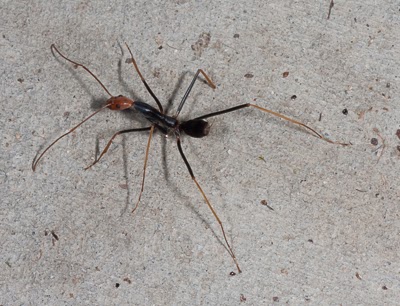
This interesting ant was running around on the veranda outside the units, would not stop still for a photo but eventually managed a reasonable shot of it. Not into ants so don't know the species!

Ant sp.
Recent Books:-
Gary Oliver called by to drop off his recently published book Birdshoot Australia.

This is a result of a 12 month challenge to break the record for photographing the most Australian species in a single year. Gary and his wife Glenda travelled over 55,000kms visiting every state in Australia. Its a fascinating read especially the bit about the Lodge! If you want a copy of the book you can phone Gary 0419 511 501.


Another recently released book is Sue Taylor's Best 100 Birdwatching Sites in Australia.


This is Sue’s personal list of her favorite places to bird. It is a well laid out book with lots of photos and information spread over two pages for each location, once again the Lodge features (at number 8). This is a very useful book to help you plan your trips to good birding locations and to target species on your “wants” list.

Thanks to Gary and Sue for the time and effort in producing two excellent books.