Showing posts with label Jungguy Frog. Show all posts

Sunday, 14 December 2014

14th December Kingfisher Park Birdwatchers Lodge

14th December 2014 Kingfisher Park Birdwatchers Lodge

Weather Report
At last some rain to report, a big storm dumped 61mm on one day plus a further 16mm on 4 days. A few more storms have been in the area but seemed to miss us. Humidity was up to 95% with lots of sunshine and temperatures reached 33ºc on one day but generally lower with the cloud cover and passing storms.

Last Two Weeks Bird Sightings:-
These can be found on the Eremaea eBird site. 30th November - 6th December and 7th- 13th December The first week had 107 species recorded  and the second week 99.

Birding Highlights:-
A first for our 1.5km reporting area was a Sharp-tailed Sandpiper reported by Carol Iles our roaming bird guide. Carol saw it in one of the McDougall Road lagoons. The McDougall Road lagoons are on private properties and viewed from the road, they have had quite a few good waterbirds on them over the past two weeks. These were, 38 Magpie Goose, 8 Wandering Whistling-Duck, Pacific Black Duck, Grey Teal, 2 Australasian Grebe, Little Black and Pied Cormorant, Australasian Darter, 2 Australian Pelican, Great, Intermediate and Cattle Egret, 1 White-faced Heron, 1 Glossy Ibis, Australian White Ibis, Royal Spoonbill, 1 White-browed Crake and 1 Comb-crested Jacana. Good selection of waterbirds. A few more raptors have been around these past two weeks with Spotted Harrier, Collared Sparrow Hawk, Black and Whistling Kite plus 2 White-bellied Sea-Eagle. Red-necked Crake are continuing to appear at the Crake Pool in the afternoon, usually between 5.30 and 6.30, where It has been bathing. We say it as we have only seen one at a time. Pale-vented Bush-hen has only been heard over the last week a few times and that was in the distance down stream from the Lodge along Bushy Creek. One pair of Bush Stone-curlew have one off spring and have been keeping quiet over the last month. 


Bush Stone-curlew - adult and juvenile
 
At least six Wompoo Fruit-Dove have been around as has a similar number of Superb Fruit-Dove but they are much more difficult to see than the wompoo. 


Superb Fruit-Dove - male

Topknot Pigeon have disappeared over the last week and the numbers of Pied Imperial-Pigeon have also dropped. Brush Cuckoo are in full song, triggered by the oncoming rain showers and both the Australian Koel and Pheasant Coucal have been calling.

Lesser Sooty Owl have again been around but not every night but when they have been here they are calling and showing well. There is a pair which hopefully will stay around and breed in the area next year. Also Barn Owl and Barking Owl have been heard and seen. Our pair of Papuan Frogmouth who have been sitting on a nest since 10th October have abandoned it about a week ago with not sign of any egg having been hatched. It is the first time that this pair have tried to nest in the Lodge grounds so maybe inexperienced, certainly judging by their unconventional nest which had some very large branches in it. Normally their nests are made of not many small twigs, similar to a pigeons nest. The good news is that another pair in the area now have a quite sizable chick. They started sitting on the 4th October, incubation time is 40 days and the time up to the 14th December must make the chick about 25 days old. Buff-breasted Paradise-Kingfisher have started to dig out their nests in the termite mounds on the rainforest floor and have been showing well, perching for the photographers. We have not checked out all the 40+ termite mounds on the property yet but at least 4 mounds have been dug. Last year we had 8 pairs nesting, hopefully we have at least this number this year. 


Buff-breasted Paradise-Kingfisher

Now that the Double-eyed Fig-Parrot have finished nesting they have become hard to see with only a few observed flying over. At least one pair of Noisy Pitta are in the Lodge grounds and are being seen usually early morning. One bird was seen carrying nesting material. Lovely Fairy-wren visited our neighbours bird bath one day, lucky them. 13 species of honeyeater were recorded with a Helmeted Friarbird being the most unusual. Brown-backed Honeyeater were seen nesting in Geraghty Park. Yellow-breasted Boatbill and Pied Monarch have been calling and seen but the monarch has been proving more elusive than the boatbill. Barred Cuckoo-shrike have been calling and a few have been nest building. Common Cicadabird have also been vocal and Australasian Figbird have been sitting in nests. No sightings of Black-faced Monarch nests yet but they have been calling a lot, probably waiting for more rain to fall. Pale-yellow Robin are still nesting and posing for photographs. This one was taken to see how good the Canon EOS 7D MKII is at handling high ISO and was taken at 3200 ISO, not to bad for noise at this size and crop. It is certainly way ahead of the original 7D which showed lots of noise about 800 -1000 ISO.


Pale-yellow Robin

Metallic Starling are also continuing to add to their colonial nests with more adults and juvenile birds joining in at their colony. Olive-backed Sunbird are also nesting, hope this nest is successful after their last one failed.

Further Afield:-
A very strange sighting of an Australian Brush-turkey with a purple collar was had on Mt. Lewis, the report is on the Eremaea Birds site  with a very fuzzy image.
http://www.eremaea.com/BirdlineRecentSightings.aspx?Birdline=5 . It is possibly the Cape York race 'purpureicollis' which only occur as far south as Shiptons Flat (just south of Cooktown). There is some conjecture as to how this bird arrived this far south, it has been suggested that it was released here or walked across the mountain ranges as they are not good fliers. I guess we will never know. Blue-faced Parrot-Finch is on most guests wants list at this time of year and usually they are not too much of a problem, however, this year has been very dry and grass growth has been retarded with no seeding as yet. Mt. Lewis is the favourite place to look but so far this season the little finches have been hard to find. Four is the most seen at any one time but 1-2 has been the normal when they are present. There has been few sightings over the last month with only one seen occasionally except on the 13th December when two were seen early in the morning (before 7.00am) at the 10km clearing on Mt. Lewis. Hopefully the start of some rain will encourage the grasses to grow and start seeding. Also at the 10km clearing a pair of Barred Cuckoo-shrike were building a nest. Spotted Whistling-Duck have been in the news for our region lately with sightings at Wongaling Beach, near Mission Beach south of Cairns, Keatings Lagoon near Cooktown, 10 at Cattana Wetlands in Cairns and at least 6 reported by Murray Hunt, who runs Daintree Boatman Nature Tours, at a lagoon alongside the Daintree River. 

 
Spotted Whistling-Duck

A Wedge-tailed Eagle was seen at Abattoir Swamp, an uncommon visitor.

Reptiles and Mammals:-
A Short-beaked Echidna was seen in the Lodge grounds one night, the first for about six months. They have not been seen much this year with only 3-4 sightings. Frogs have been out enjoying the humid conditions with Jungguy Frog, White-lipped Tree Frog, Northern Dwarf Tree Frog Roth's (Laughing)Tree Frog, Desert (Red or Naked)Tree Frog, Dainty Green Tree Frog and Cogger's Frog all seen plus Green Tree Frog heard. Our Platypus have been performing in Bushy Creek even when the level rose and it became muddy for a while after the 61mm of rain we had. An Australian Scrub Python was seen a couple of times but no other snakes were seen.

Spiders:-
Spiders seem to like the warmer weather with many species out and about. Plenty of Wolf Spider and Huntsman, including Grey Huntsman and this unidentified huntsman which was on the ceiling near our kitchen one night, another one of this species was spotlighted on a log beside Bushy Creek whilst we were on a night walk.


Huntsman sp.

Huntsman sp. - showing two rows of four eyes

Also seen was a Giant Silverback, one of the trap door spiders which has previously featured in our blog.

Fish:-
Bushy Creek has many fish species beside the Platypus in it, this Coal Grunter is just one of them.


Coal Grunter

Abattoir Swamp update:-
Many of you would have visited Abattoir Swamp over the last few years and found the boardwalk to the hide in a state of disrepair. It got to the stage where it was closed off due to safety concerns. We sent a four page submission to our local council asking them to repair it but they said they had insufficient funds to do the remedial work. So we asked our local Julatten and Mt. Molloy Association of Residents and Ratepayers (JAMARR) to look into it. The outcome was that the council approved JAMARR to repair the bridge using volunteers. This has now been done and is awaiting the council engineers to sign off on it and re-open it. Thanks to all those involved in repairing this important part of the birding communities infrastructure in our area.


Abattoir Swamp Hide and Boardwalk

This will be the last blog for 2014. We would like to wish everyone a great and safe Christmas and New Year. Also thanks to the many wonderful guests we have had over the past year and for all the positive comments about the blog - Keith & Lindsay.


Sunday, 24 August 2014

24th August 2014 Kingfisher Park Birdwatchers Lodge

Weather Report
The first week had 32.5mm of rain which fell over six days, the second week had no rain just sunshine. Temperatures ranged from a cool low of 13.2ºC up to 23.8ºC which is about average for this time of year.

Last Two Weeks Bird Sightings:-
These can be found on the Eremaea eBird site. 10th - 16th August and 17th - 23th August The first week we had 106 sightings and the second week 112, pretty good numbers!

Morning and Evening Guided Walks:-
Morning walks (2½ hours) produced between 43-55 species, the lower count was due to rain disrupting the walk. The species lists can be found on the Eremaea eBird site. Click on Explore Data then Hotspots and type in Kingfisher Park – you will then see the Lodge in the drop down menu. Click this on and a map will appear with two markers, click these and you can have access to all our records. It sounds long winded but it is really easy. Alternatively you can click this link which will take you directly to Hotspots http://ebird.org/ebird/hotspotshttp://ebird.org/ebird/hotspots.
Again we saw up to 11 Barn Owl on night walks and one Barking Owl. Mammal sightings were good with two Tree Mouse (Prehensile-tailed Rat) on one night, Fawn-footed Melomys, Eastern Horseshoe Bat and Northern Blossom Bat, two Striped Possum and both Long-nosed and Northern Brown Bandicoot. Frogs seen were Jungguy Frog, White-lipped Tree Frog, Red Tree Frog, Roth's (Laughing)Tree Frog, Dainty Green Tree Frog, Cogger's Frog and Cane Toad. Several Northern Leaf-tailed Gecko were also found.

Other Birding Highlights:-

Both Green and Cotton Pygmy-goose have been along McDougall Road as well as up to three Australian Pelican and White-necked Heron. Pacific Black Duck have been along McDougall including these two who were loafing, thought we would put in an image of these birds as some of the more common birds tend to get overlooked.


Pacific Black Duck

At least 32 Straw-necked Ibis were foraging in a cut cane paddock adjacent to the Lodge; straw-necks are not as common as Australian White Ibis around Julatten. Black-shouldered Kite have been regulars with one adult and two juveniles seen. A Pacific Baza was seen one day at the front entrance to the Lodge but not seen since. Also flying over the Lodge were a pair of Grey Goshawk being chased by a pack of Blue-faced Honeyeater. Another blue-face was seen chasing a Whistling Kite over Geraghty Park, this time it was hanging onto the tail of the kite! Other raptors seen were Wedge-tailed Eagle, White-bellied Sea-Eagle and over 50 Black Kite foraging in and around cut cane paddocks including this immature bird. 


Black Kite - juvenile

Red-necked Crake have started to call so we know they are around but only one sighting over the last two weeks. Wompoo Fruit-Dove have also been calling and being seen as a few more trees start fruit. Topknot Pigeon are still flying over in small flocks and very occasionally dropping into the Lodge grounds. An Australian Owlet-nightjar has been heard calling around the Lodge grounds and also in the vicinity of a previous daytime roost site but has not been seen. The two Papuan Frogmouth continue to roost in the Lodge grounds with four more seen roosting nearby. This is the male with the female hidden by the leaves in one of the Lodge mango trees about 6-7m up which is higher than they normally roost which is more like 4-5m.

 
Papuan Frogmouth

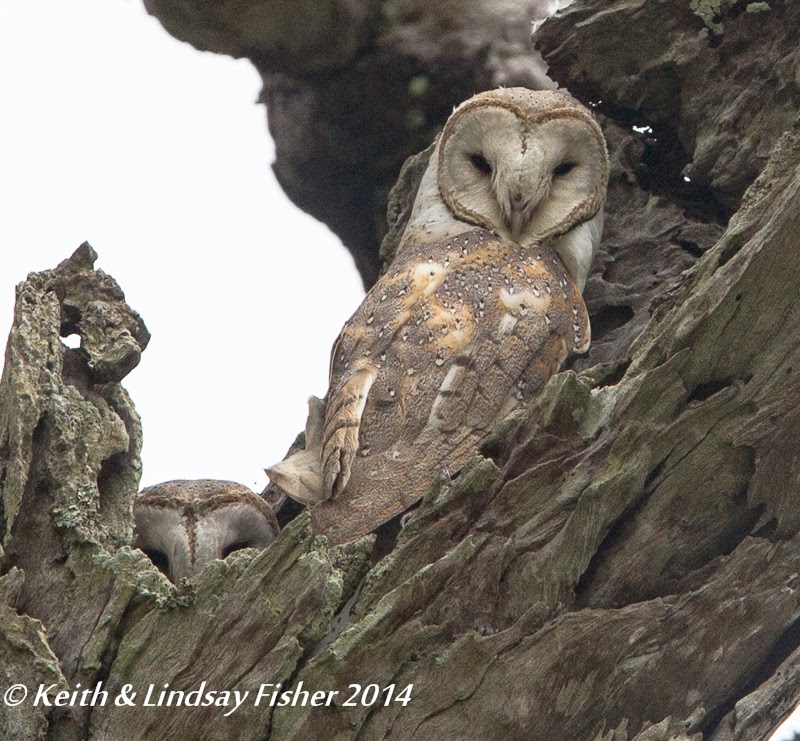
Two Azure Kingfisher have been seen along Bushy Creek flying along and perching near the Platypus viewing area, which has a nice new seat after the previous one was washed away in the flood caused by Cyclone Ita in March. Both Nankeen Kestrel and Australian Hobby have been seen around the Lodge. Scaly-breasted Lorikeet numbers have dropped off as the Queensland Blue Gum are finishing flowering but at least one pair are nesting in these trees and Double-eyed Fig-Parrot have been seen flying over since they, and the Australasian Figbird, have finished off the fruiting figs. Barn Owl have juveniles who have been sitting up in their nests dozing during the day like these ones were. 

 
Barn Owl - juvenile


Barn Owl - juvenile


Noisy Pitta have started to call and have been seen around the Lodge grounds, we still think we only have one bird present. There has been a couple of sightings of Lovely Fairy-wren in the grounds, one along Bushy Creek and another at the Crake Pool. Fourteen species of honeyeater were seen and one heard, which was only four less than the total recorded at the Lodge. Again Pied Monarch and Yellow-breasted Boatbill have both been calling well and being seen. Barred Cuckoo-shrike have made a few appearances but have not been regular. Golden, Grey and Rufous Whistler have all been seen in and around the Lodge as have Northern, Rufous and Grey Fantail. Only a couple of sightings of Leaden Flycatcher over the two weeks but Lemon-bellied Flycatcher have been around with up to six seen at a time. Victoria's Riflebird were seen in the first week but not in the second so they might have left. A Tawny Grassbird was briefly seen in an adjacent cane paddock where it was calling. Metallic Starling returned on the 10th August from Papua New Guinea with numbers continuing to increase along with the nesting activity at their colony in Geraghty Park.
Further Afield:-

Blue-faced Parrot-Finch are being seen infrequently near Abattoir Swamp with only a couple of birds seen. Australian Bustard are displaying at Maryfarms between Mt. Molloy and Mt. Carbine and a single Australian Pratincole is still present at this location after about 3 weeks. Mt. Lewis is as good as ever with bird guide Doug Herrington from Birdwatching Tropical Australia reporting five male Golden Bowerbird seen in one visit! All other “Wet Tropic” endemics were found here in the last two weeks, even more reason to stay at Kingfisher Park Birdwatchers Lodge! Our roving bird guides Carol and Andrew Iles reported Tawny Grassbird, White-eared Monarch, Shining Flycatcher and Red-winged Parrot from Julatten as well as an Australian Hobby whizzing down Mt. Molloy main street. Freckled Duck are still at Hasties Swamp near Atherton and have been almost continuously for the past two years, they were joined by an estimated 2000 Magpie Goose this week.


Identification of odd Looking Lewin's Honeyeater:-

The first two images of a meliphagous honeyeater were photographed at Malanda on the Atherton Tableland at about 900m, the third more typical Lewin's  was photographed at the Lodge, they are all ssp. mab, which occurs in Far North Queensland.

After some discussion with a few local and interstate experts it was agreed that this bird is an odd looking Lewin's, it certainly had the Lewin's call. It has an odd shaped ear patch, which is a lot smaller than a normal Lewin's of the ssp mab. The ear patch looks more like a Graceful. The lower mandible is slightly curved like a Graceful and not straight like Lewin's  the length of the bill looks slightly longer in these comparison images than Lewin's. The underparts don't have as much streaking as Lewin's and the face is less grey than a Lewin's. It is possible this could be a Lewin's/Graceful hybrid as there altitudinal range does overlap (Graceful usually occur below 600m). Note:- Lewin's Honeyeater ssp. mab does not have the distinct crescent shape to the ear patch of southern birds but a slightly less shaped crescent as shown in the 3rd image.Thanks to the experts for their comments. 


Lewin's Honeyeater ssp. mab


Lewin's Honeyeater ssp. mab


Lewin's Honeyeater ssp. mab - typical


Reptiles and Mammals

In addition to the mammals and reptiles mention on night walks we had other interesting sightings including Red-legged Pademelon, Agile Wallaby, Platypus with two regularly showing, Water Rat, Green Tree Snake and Australian Scrub Python. Over the two week we had 17 mammal species and 12 amphibian/reptiles.

Insect:-
This interesting beetle turned up at the reception area feeder one evening, it is a Carion Beetle Diamesus osculans. In Australia there are only three species in two genera mainly found in forested areas within 300km of coastal areas in eastern and northern Australia. This species is also found in Papua New Guinea and in Asia. (info. From “A Guide to the Beetles of Australia” George Hangay and Paul Zborowski). This is the first one we have seen in the Lodge grounds.
Carion Beetle

Thanks to our bird guide neighbours Carol and Andrew Iles for helping to compile the weekly bird lists, don't forget to contact them if you need any bird guiding.


Kingfisher Park Birdwatchers Lodge Business and Property For Sale
Click here for more sale details


Sunday, 30 March 2014

30th March 2014 Kingfisher Park Birdwatchers Lodge

We are back online after being away since the beginning of the month, our friends Kath and Dave looked after the Lodge for us and kept the bird records for the three weeks while we were on holiday, thanks to them for doing such a great job. Their records plus the last weeks are summarised below.


Weather Report
Rainfall over the period we were away amounted to 172mm which we know from our travels to SE Queensland, Northern New South Wales and Lord Howe Island would be most welcome there as it was very dry when we were visiting. Hopefully this last week has put some useful rainfalls in those areas. In addition the last weeks rainfall was 59.5mm on six rainy days. For the year so far we have recorded almost 1100mm. Temperatures ranged from 19ºC to 29ºC.

Bird Sightings:-
The past four weeks sighting were around 100 species per week.


Birding Highlights:-
Three Cotton Pygmy-goose in one of the McDougall Road wetlands in the first week of March. Wompoo and Superb Fruit-Dove were both seen and heard, in addition a pair of Superb Fruit-Dove were spotlighted roosting on 29/3 in the rainforest. No sightings of Papuan Frogmouth in the Lodge grounds, but three were roosting nearby in the last week of March. Two Black-necked Stork have been around most weeks. Pacific Baza showed up in the first week and both Brown Goshawk and Collared Sparrowhawk have been in the area. Red-necked Crake have been seen over the last three weeks, including three recently fledged juveniles with two adults, pottering around in the rainforest. This sighting means that this pair have bred a second time this season. Pale-vented Bush-hen have been showing each week with at least nine seen in the last week of March. This juvenile bird is about two months old and is one of five survivors from a clutch of six.

Pale-vented Bush-hen - juvenile

Both Buff-banded Rail and White-browed Crake were seen along McDougall Road. Red-tailed Black Cockatoo were around for the first two weeks of March, but have not been seen or heard since. Cuckoos have been quite obvious with the highlight a flock of 30+ Channel-billed Cuckoo, which usually gather in groups of immatures at this time of year to fly north. Other cuckoos seen or heard were Pheasant Coucal, Eastern Koel and Little (Gould's) Bronze-Cuckoo. A pair of Barking Owl returned for a couple of weeks, but moved off when they realised they had cleaned the area out of food when they were here before for 18 months! 

 
Barking Owl

Lesser Sooty Owl has been heard most weeks, but not seen. Buff-breasted Paradise-Kingfisher numbers appear to have decreased since we were away as we have not seen or heard many, but we have seen a few adults and a few juvenile birds so they are still around to be observed. 


 Buff-breasted Paradise-Kingfisher - juvenile

13 species of honeyeater were seen including Lewin's Honeyeater who have returned from higher altitudes where they breed. A White-bellied Cuckoo-shrike was seen feeding a juvenile and both Barred Cuckoo-shrike and Cicadabird have been seen. A Grey Whistler was seen feeding a recently fledged young; would like to know where they nest as we have never found one in nearly nine years. 

 
Grey Whistler

Little (Rufous) Shrike-thrush, Leaden Flycatcher, Black-faced Monarch and Lemon-bellied Flycatcher were also seen feeding juveniles. Grey-headed Robin have returned from the mountains behind the Lodge and both Fairy and Tree Martin were seen along McDougall Road. Metallic Starling are still with us, but will be leaving soon to head north or maybe just go down to the coast where they are all year now. Red-browed Finch were seen breeding which seems to be an all year event! Australian Pipit have also returned to the area.

Further Afield:-
Australian King-Parrot and White-eared Monarch were both seen along Pinnacle Road, Julatten. 

 
Australian King-Parrot - male

There were up to four Yellow-billed Spoonbill at Lake Evan (Brady Road Swamp), 4km north of Mareeba in the last week of March, not a common bird in our region. Two Latham's Snipe were seen at Ferraro Road, Port Douglas. Eastern Yellow Wagtail were being seen at Tinaburra Boat Ramp, Lake Tinaroo (Atherton Tableland) and adjacent areas until about mid-March with up to 14 bird present. Little Kingfisher were reported from Centenary Lakes and Kewarra Beach, both sites in Cairns.

Reptiles and Mammals:-
Sightings have been a little patchy with occasional Fawn-footed Melomys, Yellow-footed Antichinus, Red-legged Pademelon and Striped Possum. Regulars include Boyd's Forest Dragon, Eastern Water Dragon, Spectacled Flying Fox, Jungguy Frog and White-lipped Tree Frog. Eastern Tube-nosed Bat has also been seen regularly. A Platypus was spotlighted in Bushy Creek on 29/3 and was the first seen for about five weeks. Our neighbours reported a Macleay's Water Snake on Mt. Kooyong Road also on the 29th; it was having difficulty moving on dry land.


Bird Trails Tropical Queensland Brochure:-

http://www.birdwatchers.com.au/PDF/Bird%20Trails%20Brochure%202014.pdf


A new brochure for 2014-2015 has just been released with updated information on the best birding sites, birding guides and places to stay in the Daintree, Cairns Highlands (Tablelands), Julatten and Mission Beach areas. It can be downloaded from here.

We hope to have the camp ground and bunk house opened again by next weekend, 5-6th April, weather permitting!


Sunday, 25 August 2013

25th August 2013 Report Kingfisher Park Birdwatchers Lodge

25th August 2013 Report.
Another two weeks of great weather, dry and cool overnight 13ºC with mild daytime temperatures up to 23ºC. Ideal birding conditions.

Past Two Weeks Bird Sightings:-
Bird sightings for the first week were 103, 102 seen and 1 heard, second week sightings were 110, 103 seen and 7 heard. The last two weeks bird lists can be found on the Eremaea Birds Website:- 11th August - 17th August and 18th August - 24th August.

Morning walks were good with between 52 and 56 species seen and heard.

Birding Highlights:-
The strangest sighting was of five Australian Pelican standing in a cut cane paddock looking lost. Not sure what they were thinking, probably wondering where the water has gone!

Australian Pelican

Topknot Pigeon have started to show in increasing numbers with two landing in a Blue Quandong Eleocarpus grandis tree in the orchard one morning, others have been flying over. 

Topknot Pigeon

Bar-shouldered Dove numbers continue to increase, this one was on a fence post around a nearby cane paddock.


Bar-shouldered Dove

Large-tailed Nightjar have been heard calling around the Lodge over the last week and other reports have them further afield in the district. A White-necked Heron was along McDougall Road, this is a species we don't see very often in our 1.5km recording area. Six Straw-necked Ibis turned up foraging in a cut cane paddock late one afternoon and was just about the most we have seen together all year. Pacific Baza came for a day calling and flying over the Lodge and Geraghty Park before they disappeared. Whistling Kite have been hanging around the cut cane paddocks,


Whistling Kite

Red-necked Crake appeared behind the cookshed late one afternoon at the water bowl and again crossing the path to Bushy Creek from the orchard on another occasion when it was almost dark. One even called out late on another afternoon after being quiet for several months. Double-eyed Fig-Parrot have been flying over the Lodge but on a guided morning walk a male and female were seen high up in a Blue Quandong tree and seen again in the same tree next day. A Brush Cuckoo was seen sitting on a fence post along McDougall road by Carol our guide whilst out with two guests, this must be the first one for the season as we have not had any other reports. Barking Owl were seen on a nightwalk inspecting or actually using a hollow in a Queensland Blue Gum to nest in. A Barking Owl was seen on another nightwalk a week later in a different tree just perched high up not doing anything so we are not sure what they are up to. Rainbow-bee-eater are still around but their numbers seem to be decreasing.


Rainbow Bee-eater

14 Honeyeater species including Bridled and Black-chinned were seen over the past two weeks, only one Noisy Friarbird was heard and no Helmeted Friarbird who may have gone back down to the coast. This Varied Triller looks like a young adult male race Yorki .

Varied Triller

The male Golden Whistler  previously mentioned is still with us and has now been around for a few months, must be close to heading back up to the mountains for the summer. Rufous Whistler have been calling in the drier woodland area of Geraghty Park where this male was calling.

Rufous Whistler

A single Bower's Shrike-thrush has been around the Lodge ground but not for the last 10 days. This average image shows the black bill and grey upperparts, richer rufous underparts with streaked breast.

 
Bower's Shrike-thrush


This female Australasian Figbird was taking advantage of old Metallic Starling nests to steal nesting material for herself.


Australasian Figbird - female

An Olive-backed Oriole was feeding in a small bush in Geraghty Park, whilst we were on a guided walk, giving great views of this bird low down rather than straining to see it high in the trees where they usually hang out. At least one Spangled Drongo is still around; its been coming into our feeder to get sugar water and chasing all the other honeyeaters away. Rufous, Grey and Northern Fantail have all been seen along with an increasing number of Willie Wagtail. There were three female Victoria's Riflebird foraging in a Striped Cucumber Vine Diplocyclos palmatus in the orchard on one occasion and one also seen foraging on these small black fruit of a Celerywood tree. Note long bill of female, immature males have a shorter bill.

 
Victoria's Riflebird


Lemon-bellied Flycatcher have been showing well in Geraghty Park, often sitting on the handrail around the oval. Two Bassian Thrush turned up in the orchard and adjacent rainforest for a couple of days and then disappeared. They come down from the mountains behind the Lodge in the cooler winter months usually earlier in the year; this year we have only had a juvenile Bassian Thrush come for one day, previous years we often have up to five stay for a few months. The pair of Olive-backed Sunbird who regularly nest around the buildings in Geraghty Park were back refurbishing last years nest (well the female was) but unfortunately it fell off the piece of wire it was attached to. We put it back up but so far the birds have not been back. Our neighbours have been hearing Blue-faced Parrot-Finch, occasionally seeing one or two in their backyard and telling us they were heading our way but so far no sightings in the Lodge grounds.


Further Afield:-
Best sighting in the area was by Del Richards from Fine Feather Tours who had a Grey Falcon being harassed by a group of Black Kite at Cooktown Crossing on the Mitchell River off the Hurricane Station Road north of Mt. Carbine. There has been previously very rare sightings of Grey Falcon in our region. Mt. Lewis has still been generally quiet but with a lot of patience and time most species can be found. Our guide Carol had a great day recently with two of our guests seeing three adult male Golden Bowerbird and two female/juvenile birds which is the most seen for many years. One fruiting Celerywood tree on the mountain was attracting up to 13 Tooth-billed Bowerbird along with Victoria's Riflebird and many other birds. Hasties Swamp on the Atherton Tableland now has four Freckled Duck and two pairs of Australasian Shoveler. Two Black Falcon were reported on Eremaea Birds website at Kairi on the Atherton Tablelands. Our neighbours reported a Southern Cassowary with three half grown juveniles at Mt. Hypipamee (The Crater) in the car park at 8.00am. It would appear that they are becoming more common here and used to people as they approach looking for food. There must be irresponsible people feeding them (we heard some tour guides were feeding them), which will lead to them becoming aggressive and then there will be calls to remove them, denying others the opportunity to see these magnificent birds, (off the soap box now!). Doug Herrington reported three Australian Pratincole at Mt. Carbine and two Cotton Pygmy-goose at Lake Mitchell.


Reptiles and Mammals:
25 species of reptile and mammals were seen over the two weeks. A Yellow-footed Antichinus was seen carrying nesting material up a tree near the Crake Pool in the orchard one afternoon and at least three Red-legged Pademelon (small rainforest kangaroo) were also in the orchard. Agile Wallaby have been feeding in the cut cane paddocks with up to five seen at any one time and a large male was seen in our orchard. A Green Ringtail Possum was spotted whilst on a nightwalk curled up on a branch of a Blue Quondong tree. Platypus have been seen in Bushy Creek early morning, late afternoon and a couple of times on night walks. Also seen on a nightwalk in Bushy Creek was a Water Rat, not often seen. Frogs have been quiet due to the dry weather but a small sprinkle of rain late in the second week bought out a few Stony Creek Frog Litoria jungguy with the larger females in the orchard and a couple of smaller, yellower males on the rock wall beside Bushy Creek calling – not quite the wet season but these frogs must have been celebrating the end of a few dry weeks! 

 
Stony Creek Frog


A Boyd's Forest Dragon appeared near our restaurant deck on the side of a tree and stayed motionless with its eyes open for four days before disappearing. It later returned when the nights started to warm up at the end of the second week.

 Other Wildlife:
 This moth, called a Tiger Moth , appeared on the wall of the Laundry.

 
Tiger Moth Amata trigonophora


Sunday, 19 May 2013

19th May 2013 Kingfisher Park Birdwatchers Lodge

Weather Report:-
Mixed weather over the past two weeks with a few wet rainy days, some drizzly cool days and some lovely sunny weather with temperatures ranging from 18ºC to 28ºC. Rainfall for the two weeks was 56mm.

Past Two Weeks Bird Sightings:-
Bird sightings for the first week were 95 seen and 6 heard, second week sightings were 98 seen and 7 heard. The last two weeks bird lists can be found on the Eremaea Birds Website:- May 5th – May 11th and May 12th - May 18th


Birding Highlights:-
Our last Buff-breasted Paradise-Kingfisher left on the 8th May setting a record for latest departure by one day. Always sad to see them go as they are such an iconic and beautiful bird to have around the Lodge. Two species, Varied Triller and Black-faced Monarch, have bred very late this year with a pair of trillers feeding a youngster near the nursing home and an adult monarch feeding a begging juvenile. Both these species are about 6-8 weeks beyond normal breeding season. Waterbird numbers have been increasing at the nearby Barramundi Farm with mainly Pacific Black Duck and Hardhead with up to five Royal Spoonbill, eight Australian White Ibis, several Intermediate Egret and one Eastern Great Egret. Little Black Cormorant turn up but are quickly chased off! Cattle Egret numbers are still increasing with an estimated 2000 along McDougall Road one evening as they came into roost. A bit different to the lone Eastern Great Egret that has been hanging around with them. This bird has been around the area since last year and has a damaged leg which dangles down when flying but seems to be ok when it is walking.


Eastern Great Egret with Cattle Egret

 
Eastern Great Egret

At least one Wompoo Fruit-Dove has been coming into bunches of palm fruits outside the accommodation units usually early morning or late afternoon and a single Topknot Pigeon was in our neighbours garden for one day. Papuan Frogmouth have not been seen in the Lodge grounds for several weeks but they have been found near the local nursing home but they are not our ones, they are a pair with a first year juvenile. Raptors have been around with a Collared Sparrowhawk being seen along McDougall Road several times and Pacific Baza have been around the Lodge. An Australian Hobby was around the back of the nursing home along with a Black-shouldered Kite who were eyeing each other off from adjacent perches. Red-necked Crake have been heard around the Lodge grounds and seen in our neighbours bird bath! A juvenile Pale-vented Bush-hen was seen at the beginning of the first week in our neighbours garden but not since, so they have probably left the area. A Black-fronted Dotterel was at the Barramundi Farm for a few days. A female Double-eyed Fig-Parrot at the front entrance to the Lodge on a guided morning walk was a great sighting as it clung to the side of a dead tree branch in the sun. Barking Owl were heard during the early part of the second week but not for the last four days but Sooty Owl was heard during the Barking Owl absence. Blue-winged Kookaburra continue to show well in Geraghty Park as do several pairs of Forest Kingfisher. Rainbow Bee-eater have been around the Lodge in big numbers with several hundred passing over on northward migration, they have been in the area for the last two weeks. 
 

Rainbow Bee-eater

A Noisy Pitta has been heard but not seen unlike Spotted Catbird who are very vocal and have been seen. Lovely Fairy-wren have been seen several times in our neighbours garden, usually late afternoon as they move to roost in bamboo along Bushy Creek. Eleven honeyeater species were seen and one, Black-chinned Honeyeater heard. The odd Barred Cuckoo-shrike has been seen but no Cicadabird over the last two weeks. At least one Yellow Oriole has been around the Lodge grounds calling but only one, of the usually more common, Olive-backed Oriole was heard. A Black Butcherbird caught and ate a Cogger's Frog along our main driveway about the same time that we heard a White-lipped Tree Frog crying out as it had been caught by something, probably a Green Tree Snake – hard life being a frog. A few Rufous Fantail are still here and are being joined by Grey Fantail (sub-species alisteri) who have migrated from southern parts. Pied Monarch are coming down to bathe late afternoon in Bushy Creek and one was foraging at the back of the accommodation units one morning with a female Victoria's Riflebird. 


Victoria's Riflebird -  female

At least 12 Golden-headed Cisticola were calling and foraging in a grassy paddock behind the nursing home with two Tawny Grassbird whilst on a guided morning walk. The cisticolas were in breeding plumage and the two grassbirds were sitting up on the grass stems showing well for over five minutes which is quite unusual as they are usually skulking around in the dense lower stems. A Bassian Thrush was seen along McDougall Road which might mean that a few are coming down the mountains to lower altitudes. A few usually make it to the Lodge grounds each year. Australasian Pipit have been seen in the fields behind the nursing home and at the local Barramundi Farm.


Australasian Pipit


Further Afield:-
Two White-browed Woodswallow were perched on power lines at West Mary Road, Maryfarms (between Mount Molloy and Mt. Carbine), not often reported this far east. At least two Black-throated Finch were seen nesting along the Hurricane Station Road north of McLeod River. Red-backed Kingfisher was seen at Mt. Carbine by our bird guide Carol Iles


Red-backed Kingfisher

An Azure Kingfisher was at Brady Road Swamp just north of Mareeba, not a normal place for this species out in the dry open woodland but they do turn up in odd places, we had one in the rainforest at 950m on Mt. Lewis! Speaking of Mt. Lewis it proved good for one couple who saw a male Golden Bowerbird fly across the road, always a difficult bird to see. Two Pacific Baza have been around Euluma Creek Road, Julatten circling and calling over the past two week, maybe going to nest in the area? A Square-tailed kite was circling over the Peninsular Highway on the northern outskirts of Mount Molloy on Saturday 18th before gliding on upswept wings over the treetops adjacent to the highway. Here it encountered a flock of Sulphur-crested Cockatoo who noisily escorted it out of their territory.

Reptiles and Mammals:-

17 species of reptiles and mammals were seen, which was again down on previous weeks due to a lesser effort in looking, especially at night due to unfavourable weather. A few frogs were tempted out of hiding by the drizzly weather with Jungguy Frog, White-lipped Green Tree Frog and Cane Toad seen, Cogger's Frog was heard. 


Jungguy Frog

A Green Tree Snake took up residence in our neighbours property when it made a home in a flowerpot. The pot was disturbed and the snake leapt out much to the surprise of our neighbour! The fishing bat, Large-footed Myotis also made its roost under the same neighbours house. A Striped Possum was coming to a flowering banana tree each night to get the nectar and a Northern Brown Bandicoot made occasional visits to the seed feeder by the reception area.