Showing posts with label Barred Cuckoo-shrike. Show all posts

Sunday, 24 August 2014

24th August 2014 Kingfisher Park Birdwatchers Lodge

Weather Report
The first week had 32.5mm of rain which fell over six days, the second week had no rain just sunshine. Temperatures ranged from a cool low of 13.2ºC up to 23.8ºC which is about average for this time of year.

Last Two Weeks Bird Sightings:-
These can be found on the Eremaea eBird site. 10th - 16th August and 17th - 23th August The first week we had 106 sightings and the second week 112, pretty good numbers!

Morning and Evening Guided Walks:-
Morning walks (2½ hours) produced between 43-55 species, the lower count was due to rain disrupting the walk. The species lists can be found on the Eremaea eBird site. Click on Explore Data then Hotspots and type in Kingfisher Park – you will then see the Lodge in the drop down menu. Click this on and a map will appear with two markers, click these and you can have access to all our records. It sounds long winded but it is really easy. Alternatively you can click this link which will take you directly to Hotspots http://ebird.org/ebird/hotspotshttp://ebird.org/ebird/hotspots.
Again we saw up to 11 Barn Owl on night walks and one Barking Owl. Mammal sightings were good with two Tree Mouse (Prehensile-tailed Rat) on one night, Fawn-footed Melomys, Eastern Horseshoe Bat and Northern Blossom Bat, two Striped Possum and both Long-nosed and Northern Brown Bandicoot. Frogs seen were Jungguy Frog, White-lipped Tree Frog, Red Tree Frog, Roth's (Laughing)Tree Frog, Dainty Green Tree Frog, Cogger's Frog and Cane Toad. Several Northern Leaf-tailed Gecko were also found.

Other Birding Highlights:-

Both Green and Cotton Pygmy-goose have been along McDougall Road as well as up to three Australian Pelican and White-necked Heron. Pacific Black Duck have been along McDougall including these two who were loafing, thought we would put in an image of these birds as some of the more common birds tend to get overlooked.


Pacific Black Duck

At least 32 Straw-necked Ibis were foraging in a cut cane paddock adjacent to the Lodge; straw-necks are not as common as Australian White Ibis around Julatten. Black-shouldered Kite have been regulars with one adult and two juveniles seen. A Pacific Baza was seen one day at the front entrance to the Lodge but not seen since. Also flying over the Lodge were a pair of Grey Goshawk being chased by a pack of Blue-faced Honeyeater. Another blue-face was seen chasing a Whistling Kite over Geraghty Park, this time it was hanging onto the tail of the kite! Other raptors seen were Wedge-tailed Eagle, White-bellied Sea-Eagle and over 50 Black Kite foraging in and around cut cane paddocks including this immature bird. 


Black Kite - juvenile

Red-necked Crake have started to call so we know they are around but only one sighting over the last two weeks. Wompoo Fruit-Dove have also been calling and being seen as a few more trees start fruit. Topknot Pigeon are still flying over in small flocks and very occasionally dropping into the Lodge grounds. An Australian Owlet-nightjar has been heard calling around the Lodge grounds and also in the vicinity of a previous daytime roost site but has not been seen. The two Papuan Frogmouth continue to roost in the Lodge grounds with four more seen roosting nearby. This is the male with the female hidden by the leaves in one of the Lodge mango trees about 6-7m up which is higher than they normally roost which is more like 4-5m.

 
Papuan Frogmouth

Two Azure Kingfisher have been seen along Bushy Creek flying along and perching near the Platypus viewing area, which has a nice new seat after the previous one was washed away in the flood caused by Cyclone Ita in March. Both Nankeen Kestrel and Australian Hobby have been seen around the Lodge. Scaly-breasted Lorikeet numbers have dropped off as the Queensland Blue Gum are finishing flowering but at least one pair are nesting in these trees and Double-eyed Fig-Parrot have been seen flying over since they, and the Australasian Figbird, have finished off the fruiting figs. Barn Owl have juveniles who have been sitting up in their nests dozing during the day like these ones were. 
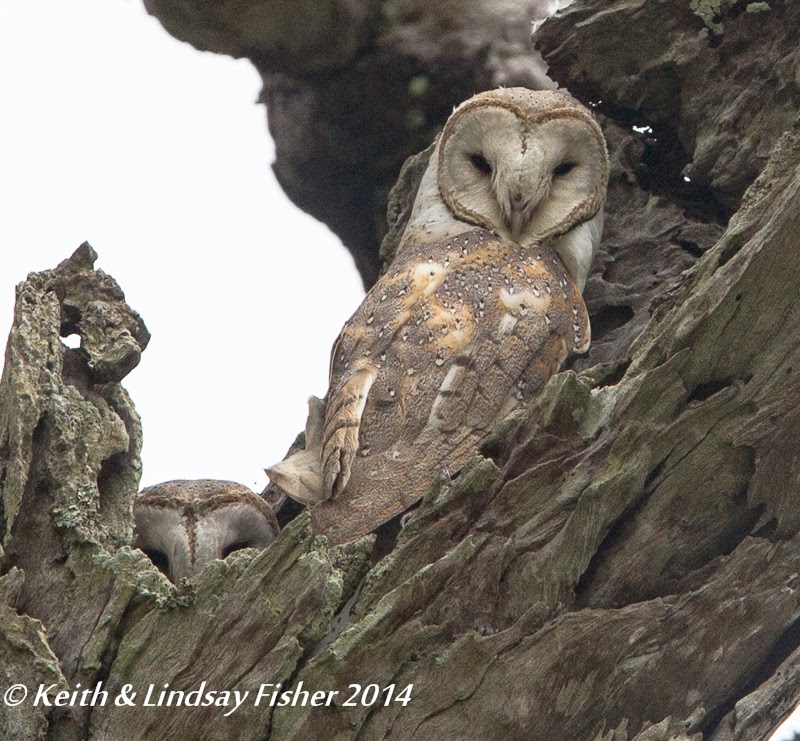
 
Barn Owl - juvenile


Barn Owl - juvenile


Noisy Pitta have started to call and have been seen around the Lodge grounds, we still think we only have one bird present. There has been a couple of sightings of Lovely Fairy-wren in the grounds, one along Bushy Creek and another at the Crake Pool. Fourteen species of honeyeater were seen and one heard, which was only four less than the total recorded at the Lodge. Again Pied Monarch and Yellow-breasted Boatbill have both been calling well and being seen. Barred Cuckoo-shrike have made a few appearances but have not been regular. Golden, Grey and Rufous Whistler have all been seen in and around the Lodge as have Northern, Rufous and Grey Fantail. Only a couple of sightings of Leaden Flycatcher over the two weeks but Lemon-bellied Flycatcher have been around with up to six seen at a time. Victoria's Riflebird were seen in the first week but not in the second so they might have left. A Tawny Grassbird was briefly seen in an adjacent cane paddock where it was calling. Metallic Starling returned on the 10th August from Papua New Guinea with numbers continuing to increase along with the nesting activity at their colony in Geraghty Park.
Further Afield:-

Blue-faced Parrot-Finch are being seen infrequently near Abattoir Swamp with only a couple of birds seen. Australian Bustard are displaying at Maryfarms between Mt. Molloy and Mt. Carbine and a single Australian Pratincole is still present at this location after about 3 weeks. Mt. Lewis is as good as ever with bird guide Doug Herrington from Birdwatching Tropical Australia reporting five male Golden Bowerbird seen in one visit! All other “Wet Tropic” endemics were found here in the last two weeks, even more reason to stay at Kingfisher Park Birdwatchers Lodge! Our roving bird guides Carol and Andrew Iles reported Tawny Grassbird, White-eared Monarch, Shining Flycatcher and Red-winged Parrot from Julatten as well as an Australian Hobby whizzing down Mt. Molloy main street. Freckled Duck are still at Hasties Swamp near Atherton and have been almost continuously for the past two years, they were joined by an estimated 2000 Magpie Goose this week.


Identification of odd Looking Lewin's Honeyeater:-

The first two images of a meliphagous honeyeater were photographed at Malanda on the Atherton Tableland at about 900m, the third more typical Lewin's  was photographed at the Lodge, they are all ssp. mab, which occurs in Far North Queensland.

After some discussion with a few local and interstate experts it was agreed that this bird is an odd looking Lewin's, it certainly had the Lewin's call. It has an odd shaped ear patch, which is a lot smaller than a normal Lewin's of the ssp mab. The ear patch looks more like a Graceful. The lower mandible is slightly curved like a Graceful and not straight like Lewin's  the length of the bill looks slightly longer in these comparison images than Lewin's. The underparts don't have as much streaking as Lewin's and the face is less grey than a Lewin's. It is possible this could be a Lewin's/Graceful hybrid as there altitudinal range does overlap (Graceful usually occur below 600m). Note:- Lewin's Honeyeater ssp. mab does not have the distinct crescent shape to the ear patch of southern birds but a slightly less shaped crescent as shown in the 3rd image.Thanks to the experts for their comments. 


Lewin's Honeyeater ssp. mab


Lewin's Honeyeater ssp. mab


Lewin's Honeyeater ssp. mab - typical


Reptiles and Mammals

In addition to the mammals and reptiles mention on night walks we had other interesting sightings including Red-legged Pademelon, Agile Wallaby, Platypus with two regularly showing, Water Rat, Green Tree Snake and Australian Scrub Python. Over the two week we had 17 mammal species and 12 amphibian/reptiles.

Insect:-
This interesting beetle turned up at the reception area feeder one evening, it is a Carion Beetle Diamesus osculans. In Australia there are only three species in two genera mainly found in forested areas within 300km of coastal areas in eastern and northern Australia. This species is also found in Papua New Guinea and in Asia. (info. From “A Guide to the Beetles of Australia” George Hangay and Paul Zborowski). This is the first one we have seen in the Lodge grounds.
Carion Beetle

Thanks to our bird guide neighbours Carol and Andrew Iles for helping to compile the weekly bird lists, don't forget to contact them if you need any bird guiding.


Kingfisher Park Birdwatchers Lodge Business and Property For Sale
Click here for more sale details


Sunday, 2 February 2014

2nd February 2014 Kingfisher Park Birdwatchers Lodge

Weather Report
The past few weeks has seen variable weather with a Cyclone threat which luckily for us went further south and caused very little damage. We did not get much rain, our January total rainfall was 217mm on 16 rain days, which was at least 50% less than our normal rains for this time of year. Temperatures had been around 21ºC -28ºC but after the cyclone passed by at the end of January we got west to northerly winds and an increase in temperatures up to 34ºC which is abnormally hot.

Past Three Weeks Bird Sightings:-
Sightings have now been transferred from Eremaea Birds to Eremaea ebird. The link to the Australian portal is Here . Here you can find all the information to allow you to input or retrieve data. It is early days with the new system so it will take a while to become familiar with it and work out how to retrieve data for Kingfisher Park BL.

Trip Report:-
Finally finished putting together our last years trip report for our visit to South Australia. You can find it at this link on our website


Birding Highlights:-
We can't top the Yellow-billed Kingfisher reported in the last blog seen along Bushy Creek. We heard the kingfisher calling in the rainforest adjacent to Bushy Creek the morning after it was seen but were unable to see it. Since then there has been no other reports of Yellow-billed Kingfisher in the area. Another new bird for our 1.5km area Lodge bird list was Plumed Whistling-Duck, 22 were seen standing beside a dam behind Geraghty Park on our Birdlife Australia Day weekend, this puts our list up to 225 species. Two groups of Papuan Frogmouth have been seen in the Lodge and along the nearby Bushy Creek, the three along Bushy Creek are two adults and a juvenile from last years nest in the local nursing home. The two in the Lodge grounds are a male and female which did not nest last year, they have been moving around each day and have been difficult to find. A Superb Fruit-Dove was actually seen in a fruiting tree on the edge of the Lodge one morning, this represented the third sighting in six months during which they have been heard most days. Should be called Superb Hiding-Dove! Pied Imperial Pigeon have been increasing in numbers with at least 200 seen feasting on fruiting trees in the Lodge grounds and surrounds. These birds are probably coming from Low Isles off the coast of Port Douglas. It was only four years ago that the first Pied Imperial Pigeon arrived at the Lodge. Nesting Pacific Baza has two very large chicks standing up in their nest waiting to be fed by the busy adults. Red-necked Crake also have three chicks in tow and have been seen several times. The adult birds have been coming regularly to the Crake Pool in the morning and evening for a bathe. Our neighbours saw a pair of Pale-vented Bush-hen come to their bird bath with six chicks several times, how lucky are they. 


Pale-vented Bushen - chick in birdbath


Pale-vented Bushen - adult with three chicks

Other pairs of bushen have been glimpsed in the grassy edges of the roads around the Lodge and also along Bushy Creek but they are very secretive. All the nesting Buff-breasted Paradise-Kingfisher are now feeding young in their nests, there are at least seven nests with another possible one within the Lodge grounds. Several pairs of Noisy Pitta have been around the Lodge and adjacent area with at least four juvenile birds seen foraging and being fed by adults. At least 12 species of honeyeater have been seen including White-throated Honeyeater and Black-chinned Honeyeater heard. 

 
White-throated Honeyeater


An Olive-backed Oriole nest successfully fledged one bird from a nest only about 2m off the ground in a neighbours Raintree. Pied Monarch are calling and being seen and Yellow-breasted Boatbill have just started to call after being quiet for a few months.

Further Afield:-
At least 50Fork-tailed (Pacific) Swift were over Cattana Wetlands, Cairns on the 20th January at 8.30am. Two Yellow Wagtail were reported from Lake Evan (Brady Road Swamp) 4km north of Mareeba on 24th January. Two Pink-eared Duck were also at this location a week earlier. On 31st January one of our guests reported a Freckled Duck at Daves Dam 25km north of Mt. Carbine, believed to be the first record from here. Four birders from Townsville sighted a Nankeen Night Heron roosting on Mt. Lewis at 950m on 21st January, very unusual, record can be found on Eremaea Birdline. Del Richards from Fine Feather Tours had a Dusky Honeyeater from the same location, this was a first for him so it must be very unusual.

Reptiles and Mammals:-
A few snakes have been around the grounds, a Green Tree Snake was in the orchard and a small Australian Scrub Python was curled up on a tree at the end of the units veranda, giving the birds something to shout at. A Yellow-footed Antichinus is living in a tree hollow beside our camp kitchen and often seen running along the rafters. Red-legged Pademelon are around in the rainforest during the day and come out into the grassy orchard at night. At least 50 Red-legged Pademelon were seen in a 10km stretch of the Mt. Lewis one night which is an extraordinary number. Striped Possum was seen on a couple of occasions but are proving very elusive at the moment. No sign of Green Ringtail Possum since last September which is a worry. Frogs seen were Jungguy Frog, White-lipped Tree Frog, Desert Tree Frog, Dainty Green Tree Frog, Coggers Frog and Cane Toad plus Northern Dwarf tree Frog was heard. Boyd's Forest Dragon, Eastern Water Dragon and Major Skink have all been regulars.

Spider:-
This Giant Silverback spider (Genus Idiommata, family Barychelidae) was found at the rear of our units, it was a first for us. It was relocated to the rainforest after we took a few images of it. It was quite aggressive rearing up and showing its fangs. These spiders are venomous but not deadly. They build a burrow in the ground which is short, open, often with a collar of leaves; a short horizontal flask down the burrow is sealed by a thick door. Thanks to Graham Anderson and Dr. Robert Raven (Queensland Museum) for identifying the spider.

Giant Silverback

2014 Australia Day Weekend at Kingfisher Park Birdwatchers Lodge, Julatten:-

BirdLife Northern Queensland held its 14th annual Australia Day long weekend get-together at Kingfisher Park Birdwatchers Lodge, Julatten, hosted by Keith & Lindsay. It was well attended with over 30 people coming to enjoy, field trips, guided walks, talks and a movie night. As usual these weekends are very social with lots of interesting food and a relaxed atmosphere.

Saturday morning saw the group going up onto Mt. Lewis to look for some of the Wet Tropic endemics, all 13 occur on the mountain. The main attraction here was Blue-faced Parrot-Finch, which occur here from November to April. We were not disappointed as there were at least eight feeding alongside the road. Other good sightings were white phase Grey Goshawk, male Golden Bowerbird, two families of Chowchilla having a territorial dispute, Victoria's Riflebird and a Barred Cuckoo-shrike feeding young in a nest, in all we saw 27 species. Late afternoon we went to Wessel Road in Julatten to look at open woodland and Melaleuca swamp country, here we found 29 species including Buff-banded Rail plus Lovely and Red-backed Fairy-wren. The evening was spent eating a communal dinner followed by a talk from Lloyd Nielsen. Lloyd is a well known ornithologist who lives in the area and has been studying local bird fauna for many years. His talk was about the status of Fuscous and Yellow-tinted Honeyeater in our region. His preliminary studies suggest that there is the possibility that there are no Fuscous Honeyeater in our region but several forms of Yellow-tinted Honeyeater or even a new species. Several populations on the Atherton Tableland and Lakefield National Park occur in distinctly different habitats and have different calls to each other. Two distinct populations occur either side of a 700m woodland barrier in one area of the Atherton Tableland. It would appear that it is a very complicated identification problem that needs further investigation requiring DNA testing to sort it out – sounds like a good project for a Ph.D. Student. This is an image from one of the populations on the Atherton Tableland of what maybe another form of the Yellow-tinted Honeyeater.

Yellow-tinted Honeyeater?

Sunday morning was spent at a private property along Rifle Creek in Mt. Molloy where we saw 35 species including Black Bittern, Pacific Baza, Double-eyed Fig-Parrot, Shining Flycatcher and Eastern Yellow-Robin. Also seen here were hundreds of Sapphire Flutterer dragonflies. 
 

Sapphire Flutterer

Early afternoon we had a talk by Kath Shurcliff, Birdlife North Queensland Convener, about the list and atlas entry of the Eremaea Birds online database for birds, which has now moved to a new site called Eremaea ebird which is a real-time, online checklist program. eBird has revolutionized the way that the birding community reports and accesses information about birds. Kath introduced us to the differences between the two databases and how to use ebird for entering and retrieving data. The aim is to get everyone using ebird and making their records, many of which are hidden away in notebooks, available for everyone to access.The evening was spent watching a DVD, filmed at the Lodge, about the breeding cycle of the Buff-breasted Paradise-Kingfisher which migrate from Papua New Guinea to breed in North Queensland rainforest each year during the “Wet Season. They nest in low terrestrial termite mounds before heading back to PNG in April.

Monday morning was spent in and around the Lodge for two hours during which time we recorded 52 species including Plumed Whistling-Duck, White-bellied Sea-Eagle, 30+ Red-tailed Black Cockatoo were the first for this season,(they usually are present in January - February) and a White-bellied Cuckoo-shrike nest with two very large chicks in it. 


White-bellied Cuckoo-shrike


We experienced a few showers of rain but luckily they did not interfere with a very successful weekend in which we saw 113 species and heard a further 11 species.

Thanks to all those that made the weekend a success especially Del Richards, Lloyd Nielsen, Kath Shurcliff and Doug Herrington Birdlife North Queensland Activities Officer.

Kingfisher Park Birdwatchers Lodge Business and Property For Sale
Click here for more sale details


Sunday, 14 July 2013

14th July 2013 Kingfisher Park Birwatchers Lodge

Weather Report:-
In a word yeuk! Well it did start out great for the beginning of the first week but deteriorated into drizzle for most of the remaining week and all the second week. There were a few breaks which allowed some good birding but the high pressure zone south-west of Australia in the Tasman Sea remained pretty static sending high winds and rain onto the tropical north Queensland coast. Despite this the rainfall was pretty low with only 7mm for the first week and 20.5mm for the second week. Temperatures were down to 10ºC and only up to18ºC on some days. The highest temperature was 25ºC on one day.

Past Two Weeks Bird Sightings:-
Bird sightings for the first week were 103, 101 seen and 2 heard, second week sightings were 102, 99 seen and 3 heard. The last two weeks bird lists can be found on the Eremaea Birds Website:- 30th June - 6th July and 7th July - 13th July

Birding Highlights:-
A very juvenile Emerald Dove decided to visit us in the office and landed on the computer screen before moving to the shelf and checking out the hole punch!


Emerald Dove-juvenile

A Great-billed Heron was a nice surprise on a morning walk, it was standing on the bank of Bushy Creek by the Mt. Kooyong Road bridge before it flew off downstream. We do see the odd one along Bushy Creek but not usually until August through to December with one exception in 2011 when we had one along McDougall Road creek on 8th July. A single Straw-necked Ibis was foraging in a paddock opposite Geraghty Park one morning which was one of very few sightings this year. Yellow-billed Spoonbill are not very common in our area but one was seen flying over Geraghty Park on a morning walk which was a first for the walk. It was seen several days later perched in a dead tree opposite Geraghty Park by some ponding. Pacific Baza sightings have been scarce this year so two calling and seen on a morning walk both perched and flying over was a great sighting. A Wedge-tailed Eagle moved into the area, probable to check out the cut cane paddocks, and was seen soaring over McDougall Road whilst an Australian Hobby was perched in a tree below. Just after dark on several nights a Brown Falcon has been flying over the Lodge grounds calling and heading towards McDougall Road where we think it is roosting. We have seen this behaviour before, usually when we have been looking for owls. Red-necked Crake are still being heard but not seen – grrrr. A pair of Sulphur-crested Cockatoo have been doing the rounds of the orchard chewing off branches and generally pruning trees! They are not called chainsaws of the sky for nothing! This is one of the culprits who looks very innocent.


Sulphur-crested Cockatoo

The fruiting fig mention in the last blog at the end of Mt. Kooyong Road still has some fruit on it and attracting many birds including Barred Cuckoo-Shrike and Double-eyed Fig Parrot which have all been juveniles or females, no males spotted with them – interesting. 
 

Double-eyed Fig-Parrot - female

Barking Owl are still calling through the night as well as 3.00 o'clock in the afternoon one day. They have been seen sitting on our entrance sign quite often and in this area some birds legs were found and identified as a Pale-vented Bush-hen, also here was a dead Red-browed Finch; both likely victims of the Barking Owl. The bush-hen was of interest as there has not been any sightings for a few months and we assumed they had all left the area, maybe not. Rainbow Bee-eater have been foraging low down and taking advantage of the railing around the Geraghty Park oval to perch on.

Rainbow Bee-eater

Eleven honeyeater sightings over the two weeks plus Black-chinned Honeyeater (Golden-backed) was heard but not seen. A male Golden Whistler turned up at the water bowl opposite the units one afternoon and has subsequently been seen and heard around the grounds. We get the occasional one coming down off the mountains behind us in the winter months and they usually stay until about August/September. This is also the case for Bower's Shrike-thrush which also come down occasionally and one was seen on a morning walk on the 13th foraging in the Lodge grounds. Both Black (adult) and Brown (juvenile) Black Butcherbird have been around the grounds calling and skulking through the rainforest. 


Black Butcherbird - juvenile

All the fantails have been seen over the two weeks, Rufous, Grey and Northern plus Willie Wagtail. Pied Monarch are still coming to Bushy Creek for an afternoon bath and Yellow-breasted Boatbill have been very vocal and showing well. An Australian Reed-warbler was calling from an adjacent cane paddock and after a lot of perseverance was seen flitting around. Chestnut-breasted Mannikin have been making the most of the seeding cane paddocks and forming quite large flocks.

Further Afield:-
Chestnut-breasted Cuckoo was seen at the base of Mt. Lewis along the road and further up the mountain a brown Golden Bowerbird was seen. West and East Maryfarms Roads south of Mt. Carbine are still turning up Diamond Dove with over 200 present late on the afternoon of 7th July, also here was a Rufous Songlark and on the 3rd was a Spotted Harrier plus Red-backed Kingfisher on the 13th. Wetherby Station lagoon between Julatten and Mt. Molloy had a good variety of waterbird including Pink-eared Duck on the 6th , a first for this location, full list on Eremaea Birds site. Pink-eared Duck were also on Brady Road Swamp north of Mareeba on the 4th, full list on Eremaea Birds site. Pink-eared Duck are on just about all the regions wetlands and Hasties Swamp is no exception, here they are sharing a quiet corner with a row of Plumed Whistling-Duck.

Plumed Whistling-Duck and Pink-eared Duck

Reptiles and Mammals:
A total of 19 mammal and reptile species were seen over the two week which is about average for the winter months. Several sightings were had of Striped Possum around the Lodge grounds and a Green Ringtail Possum was seen roosting during the day high in a tree behind our bunkhouse. Both Long-nosed and Northern Brown Bandicoot were seen but only a few times as numbers are still down. A few frogs ventured out with the highlight being a Green Tree Frog in an adjacent cane field; this species is quite uncommon here unlike the White-lipped Green Tree Frog which we see most weeks. Platypus was seen late in the afternoon when almost dark at the viewing area on Busy Creek. Red-legged Pademelon are appearing in the orchard and Agile Wallaby are foraging around in cut cane paddocks. A Green Tree Snake was in vegetation along Bushy Creek and an 2m Australian Scrub Python was in our neighbours garden and almost got hit by a brush-cutter (whipper snipper or strimmer) as it lay in the grass. Late in the evening of the 13th a White-tailed Rat came to the reception area feeder, which was the first one we have seen for nearly two weeks.

Kingfisher Park Birdwatchers Lodge Business and Property For Sale

Click here for sale details


Sunday, 7 April 2013

7th April 2013 Kingfisher Park Birdwatchers Lodge

Weather Report:-
Weather over the last two weeks has been mainly sunny with some cloud and a little rain. The monsoonal trough has gone north to Papua New Guinea with little prospect of it coming south again according to the weather bureau. So the rain we have been getting is the normal drier season showers coming from the south-east and onto the coast.

In the first week rain amounted to 74.5mm with 57mm of that falling on the first day, the second week only 8mm fell . The humidity was high for most of the period 60-92% with most lows around the low 60's and into the low 70's.Temperatures ranged from a low of 18.2ºC to a high of 27.0ºC which was very pleasant.

Past Two Weeks Bird Sightings:-
Bird sightings for the first week were 114, 107 seen and 7 heard, second week sightings were 108, 103 seen and 5 heard. The last two weeks bird lists can be found on the Eremaea Birds Website:- March 24th – March 30th and March 31tst - April 6th

Birding Highlights:-
A Eurasian Coot was seen in one of the lagoons along McDougall Road for several days and was a new species for our 1.5km bird list Surprising one has not shown before as they have been recorded in all the local wetlands quite regularly. No sign of the possible Red Goshawk mentioned in the last blog. Buff-breasted Paradise-Kingfisher are again in the news with several juvenile birds being spotted in the rainforest including this one who fledged on the 10th March. This image was taken on the 5th April making it just over 3 weeks old.

Buff-breasted Paradise-Kingfisher - juvenile

This female Buff-breasted Paradise-Kingfisher showing its tail cocked, short and much blue at the base is a female. It was the parent of the youngster shown in the last blog which had come out of the nest in pin feathers and did not survive.

Buff-breasted Paradise-Kingfisher - adult female

Wompoo Fruit-Dove along with Superb Fruit-Dove have been seen around the Lodge grounds with the superb making regular visits to some fruiting palms in front of the accommodation units much to the delight of the guests who have been getting great views of this difficult to see bird.

Superb Fruit-Dove - male

A single Pied Imperial Pigeon has been around for most of the last two weeks at a time when most of the other pied's have headed north to Papua New Guinea. Papuan Frogmouth sightings have been patchy with one seen roosting in the orchard some days or up near the reception area but most days hiding somewhere else. Australian Owlet-nightjar has been heard calling during the day but not tracked down as it is in a patch of dense rainforest, not in its home in the tree hollow for the last few years out on the edge of the forest. On 2nd April 16 White-throated Needletail were seen flying over the Lodge in a one hour period, most were single sightings with one of four birds together. Also at the same time four Dollarbird were hawking insects with White-breasted Woodswallow and a Spangled Drongo. The Dollarbird were probably on their way north along with small groups of juvenile Channel-billed Cuckoo that have been seen moving over the last three weeks. A pair of Black-necked Stork have been seen in a lagoon between the Lodge and McDougall Road with Black Bittern seen along McDougall Road. The local Barramundi Farm has been turning up a few good birds which can be seen from the road, these include Pacific Black Duck, Hardhead, Australasian Darter, Little Black Cormorant, White-necked Heron, Eastern, Intermediate and Little Egret, White-faced Heron, Australian White Ibis and Royal Spoonbill. Good raptor sightings over the last two weeks: Black-shouldered Kite, White-bellied Sea-Eagle, Whistling, Brahminy and Black Kite, Brown and Grey Goshawk,Spotted Harrier, Brown Falcon and Australian Hobby. Both Red-necked Crake and Pale-vented Bush-hen have been seen in our neighbours garden but only heard at the Lodge. Double-eyed Fig-Parrot have only been seen flying over and either Chestnut-breasted or Fan-tailed Cuckoo have been calling. Because their calls are very similar we have not been able to determine what species is calling. Barking and Eastern Barn Owl have been seen and Sooty Owl only heard. Laughing Kookaburra have been around in ever increasing numbers and are taking an unnaturally large amount of prey items including, nestlings, small birds (even Metallic Starling), insects, small reptiles and mammals. They look very cute as this one does perch on a tree stump looking out for anything that moves and is small enough for a meal.

Laughing Kookaburra

A White-throated Treecreeper was along McDougall Road on the 6th April and would have moved down from the mountains behind us where they normally reside. Thirteen species of honeyeater were recorded including a first at the feeder when a Bridled Honeyeater came for banana. Barred Cuckoo-shrike and Cicadabird have been around and quite vocal as have been Grey Whistler. Black-faced Monarch are also still around and should be heading north very soon. Pied Monarch and Yellow-breasted Boatbill are around but not calling much so are difficult to see. It would appear that only one Grey-headed Robin has come down off the mountains behind us so far this season as we have only seen one occasionally.

Further Afield:-
A vagrant Black-tailed Gull (Japanese Gull) was seen on the Cairns Esplanade on April 1st (no not an April Fools Joke!) an image and more information can be found on the Eremaea Birds site. We looked on the 5th April but no sign of it or even any Silver Gull. We had seen this gull in Darwin back in the early 1980's and again more recently in Townsville. Two Crimson Finch were along Walkers Road in Cairns, (south of the Yorkeys Knob roundabout on highway), this is a fairly reliable place for this species. At least 30 Glossy Ibis were present at Brady Road Swamp 4km north of Mareeba at the beginning of April. Three Blue-faced Parrot-Finch were seen about 5km up the Mt. Lewis Road and another couple reported from Sweetwater Lodge in Julatten. It would appear that they are moving down the mountain as only one bird has been reported from the 10km “clearing” on Mt. Lewis in the last week. White-headed Pigeon have been in the local area but not around the Lodge grounds, this one was in a group of eight which landed in a tree for a rest.

White-headed Pigeon

Reptiles and Mammals:-
The banana feeder has proved a good place to be with Boyd's Forest Dragon, Major Skink and Yellow-footed Antichinus all making use of this food source. The antichinus was also seen grabbing a centipede which was longer than itself! These two images show the antichinus at the banana feeder and the Boyd's Forest Dragon who was nearby puffing up his throat pouch towards the antichinus who was eating “his” banana – none to pleased!

Yellow-footed Antichinus


Boyd's Forest Dragon

Our neighbours had a Striped Possum in a bunch of bananas outside their upstairs front room window one night. They also has a Slaty-grey Snake in their yard along with a couple of bat species, Large-footed Myotis (fish eating bat) and Northern Broad-nosed Bat. A single Northern Brown Bandicoot continues to come to the seed feeder most nights but the Long-nosed Bandicoot are keeping to the rainforest. A Red-legged Pademelon (small rainforest kangaroo) has been foraging in the orchard most days in the early morning of late evening.

Insects and Fungi:-
A few butterflies are around including this Large Green-banded Blue.

Large Green-banded Blue

Also a few moths including this one which was attracted to the mosquito trap.


Moth sp.

Fungi are still appearing with the most obvious being the Crinoline Fungi which have popped up in the mulch and are pollinated by flies which are attracted by their rotting smell as the fly in this image is doing.

Crinoline Fungi

This other fungi is less obvious.


Fungi sp.


Sunday, 15 July 2012

15th July 2012 Kingfisher Park Birdwatchers Lodge


The first week was dry, no rainfall to record and the second week was wet with annoying drizzle and some heavier falls resulting in 34.5mm. The top temperature was 24.0ºC and the minimum was 11.3ºC but most mornings had higher minimums of up to 21ºC. The humidity was high up to 98% and down to 73%.


Bird sightings for the first week were a high 100 seen plus 6 heard only. The second week had slightly less sightings due mainly to the inclement weather, 96 seen plus 5 heard. Mammal and reptile species were slightly more than the last two weeks – 28 species were seen over the two weeks. The last two weeks bird lists are on the Eremaea Birds Website for Week1 and Week2 plus morning walk lists can also be found at this link on Eremaea Birds


Birding Highlights:

A Pacific Baza eating a White-lipped Green Tree Frog (not a highlight for the poor old frog!) outside the rear of the reception area, this was the first baza we have seen for a month. 


Pacific Baza - eating frog


A Little Kingfisher was along Bushy Creek Saturday afternoon of the second week which was a good sighting for one of our guests. At least four Barred Cuckoo-shrike were feeding in a fruiting fig tree beside the Rex Highway whilst on a morning walk. The morning walk was also a highlight with 61 species, the most recorded this year for a walk. An Australian Reed-Warbler was heard in a cane paddock, near our neighbours house, before being seen foraging amongst the cane. Not a common species here with only a few sightings each year.


Other sightings:
Waterbird numbers and species continue to fluctuate with Magpie Goose, Wandering Whistling-Duck, Hardhead and Royal Spoonbill being the most un-predictable in the area. A few juvenile Emerald Dove are around with this one coming to the feeder and chasing off the adults, in between times it stops to have a drink but not before walking around the bowl! 


Emerald Dove - juvenile

Wompoo Fruit-Dove were heard and a few Topknot Pigeon have been seen flying over. The female Papuan Frogmouth continues to play hide and seek but was in its usual on a few occasions, once after overnight rain it was very bedraggled and hardly recognisable as a bird! Australian Owlet-nightjar appeared at its daytime roost a couple of times and heard calling from the edge of the Lodge grounds mid-morning one day from a different area to the daytime roost. Australian Swiftlet have been aerial foraging low over cut cane paddocks along with Fairy Martin. Black-necked Stork are still around making appearances at Barramundi Gardens fish farm and along McDougall Road. Both Whistling and Black Kite have been foraging on the cut cane paddocks with up to 18 sighted at one time. A pair of Whistling Kite have been aerial displaying over the cane paddocks and maybe the pair which regularly nest near the Lodge getting ready for this years nesting cycle. Both Brown Goshawk and Collared Sparrowhawk have been in the area, usually along McDougall Road. One Nankeen Kestrel was on a power pole along the Rex Highway one day and an Australian Hobby was sitting at the top of a dead tree along Mt. Kooyong Road opposite the Lodge one afternoon. Double-eyed Fig-Parrot continue to fly over in ones and twos but not stopping as only one of the fig trees in the immediate area have ripe fruit on them at the moment with no sign of fig-parrots on it. A Pheasant Coucal was disturbed at the side of the Rex Highway whilst on a morning walk and a first for five weeks. The pair of Barking Owl reported previously are still with us and can be heard most evenings and early mornings calling. Noisy Pitta was around the feeder during the dry days but went back into the rainforest when the rain came. The feeder with the banana was still an attraction for the pitta as this photo shows.


Noisy Pitta - at feeder
 
Two Spotted Catbird were also coming in for banana and up to four Great Bowerbird were at the lone fruiting fig tree along with 50+ Australasian Figbird, a few White-bellied Cuckoo-shrike and the previously mentioned Barred Cuckoo-shrike. Lovely Fairy-wren were again heard in our neighbours garden late afternoon and appear to be roosting in a patch of bamboo alongside Bushy Creek. 12 honeyeater species around which are the same ones for the last month. Pied Monarch have been busy with one showing up one morning in a patch of rainforest next to the units foraging low down for good views. Grey-headed Robin have been regulars in the orchard and in the rainforest but this one has taken up residence in front of the units and around the feeder, very cute!


Grey-headed Robin

A pair of Olive-backed Sunbird have a nest in Geraghty Park which was constructed in a week by the female, male was supervising! They have not started using it yet.


Further Afield:-
Previous reports of 40+ Diamond Dove at Maryfarms near Mt. Carbine were eclipsed this week with 135 reported from the same location by Del Richards from Fine Feather Tours. Where and why are they coming in such large numbers this far east? A White-necked Heron was foraging at the side of the Rex Highway about 2km from Mount Molloy towards Julatten, an uncommon bird in the area. Also along this road on the same day were two Wedge-tailed Eagle soaring near Abattoir Swamp, another uncommon bird which was probably attracted by the cane harvesting. A pair of Fernwren collecting nesting material at Mowbray National Park (about 450m), Julatten, was an unusual record. They are normally found above 600m although they come down to almost sea level in Mossman Gorge National Park and normally nest around October - February but have been found breeding in July-August. A few sightings have been made of Blue-faced Parrot-Finch near Abattoir Swamp but only small numbers of less than five.

Reptiles and Mammals:-
It has been a few good weeks for mammal and reptile sightings with a couple of night walks being exceptional, even in the drizzly rain. One night walk produced Fawn-footed Melomys, Diadem Leaf-nosed Bat, Bush Rat, Giant White-tailed Rat, Green Ringtail Possum, Striped Possum, Long-nosed and Northern Brown Bandicoot, Spectacled Flying Fox, Jungguy Frog, White-lipped Tree Frog, Desert Tree Frog, Dainty Green Tree Frog, Cogger's Frog, Cane Toad, two Northern Leaf-tailed Gecko including one on the ground with its tail in the air and Boyd's Rainforest Dragon. Wish all night walks were like that one! 


Jungguy Frog

Platypus was seen in Bushy Creek one evening and a Yellow-footed Antichinus was coming to the feeder for banana when the pitta wasn't there.


Yellow-footed Antichinus
 
Yellow-footed Antichinus

A 3m Australian Scrub Python was seen crossing the road near our two bed-roomed units one evening. Late in the week three Red-legged Pademelon were seen in the orchard, which is great as we have only been seeing the occasional one. 10 - 20 years ago they were common in the orchard but disappeared for many years.