Showing posts with label Moth. Show all posts

Sunday, 31 October 2010

31st October 2010 Report


What an amazing week, no rain, plenty of sunshine, great temperatures – 19.2º to 29.4ºC which was warmer than last week. Absolutely ideal birdwatching conditions. Bird sightings were good with 79 seen and 9 heard. Mammals and reptiles were also good mainly due to an increase in the amphibians (frogs) which was surprising considering the dry conditions.


Buff-breasted Paradise-Kingfisher has been calling and seen more often this week with some birds coming down low. At least one pair have started digging out their nest chamber in the termite mounds. Noisy Pitta have also started to show more hopping around out in the open areas. This is partly due to eventually getting the long grass in the orchard mowed as the ground dried out sufficient to get the mower in and the possibility that they are feeding young as one bird was seen carrying worms in its bill. This is early if they are nesting, about a month early.

Superb Fruit-Dove have once again frustrated guests with their calling but not showing. Wompoo Fruit-Dove have been seen as have Pied Imperial Pigeon and Topknot Pigeon. Brown Cuckoo-Dove have been in the rainforest at the edge of the orchard feeding on berries.

Brown Cuckoo-Dove


Papuan Frogmouth were roosting in the orchard area at the beginning of the week but by the end they had disappeared, hopefully they have started nesting. They are calling most nights as have been the Australian Owlet-nightjar who have not been showing at their daytime roost. A lone Australian White-Ibis flew over one morning, a species we have not seen for a few weeks. Pacific Baza has been sitting on its nest all week and the local pair of White-bellied Sea-Eagle have been soaring overhead and calling a lot. With a restart of cane harvesting at the end of the week Whistling and Black Kite along with a very scruffy Wedge-tailed Eagle who was in moult were attracted to the possibility of scavenging unfortunate animals who were caught up in the cutting machinery. Red-necked Crake were also calling a lot but not seen. Double-eyed Fig-Parrot are nesting in the lodge grounds and a female was seen peering out of its nest hole one morning and a pair were seen feeding on a  Fig tree nearby on the same morning.


Double-eyed Fig-Parrot


Dollarbird have been calling and pairing up and Spotted Catbird have been feeding nestlings. Large-billed Gerygone have been re-visiting the nest they build a few months ago and carrying food. The outcome of the original breeding event was not know but as they are feeding young again in the same nest its possible the first attempt was not successful. Lewin’s Honeyeater are still around and Scarlet Honeyeater have returned. The odd Barred Cuckoo-shrike is still being seen and both male and female Cicadabird are being seen with an effort required to track them down. Little Shrike-thrush were seen feeding a very recently fledged juvenile bird who was having difficulty hanging onto a vine.
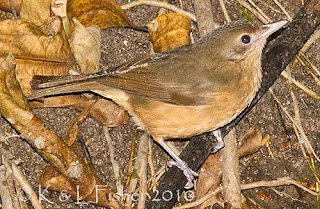


Little Shrike-thrush


White-breasted Woodswallow are back at the old Magpie-lark nest and continue to re-furbish it with small twigs. Torresian Crow are busy trying to ward off the attentions of Channel-billed Cuckoo who are following the crows trying to parasitise them. Black-faced Monarch are calling well as are Yellow-breasted Boatbill and Pied Monarch. Lemon-bellied Flycatcher have been actively hunting along the edge of the Lodge grounds in the eucalypts. Golden-headed Cisticola have been calling from the cane fields which is something they have not been doing for at least four months. Fairy Martin also returned after an absence and Metallic Starling juveniles have started to appear showing their white streaked breasts. Chestnut-breasted Mannikin have started to come to the seed feeder along with the usual Red-browed Finch. This one below is pulling a funny face!


Chestnut-breasted Mannikin

A full species list for the week can be found Here


Seven species of frog and toad were seen this week, Striped Marsh Frog, Jungguy Frog, White-lipped Tree Frog, Northern Dwarf Tree Frog, Dessert or Red Tree Frog, Cogger’s Frog and Cane Toad. Boyd’s Forest Dragon and Eastern Water Dragon have been showing well and a few Major Skink have been around. Platypus are still showing well in the early morning and late evening.


Striped Marsh Frog


Further afield White-eared Monarch was seen on the lower slopes of Mt. Lewis by Del Richards from Fine Feather Tours, Barking Owl was at Big Mitchell Creek on the way to Mareeba, Superb Fruit Dove, Buff-breasted Paradise-Kingfisher and Victoria’s Riflebird have been showing at Mowbray National Park, the Emerald Creek (near Mareeba) pair of White-browed Robin were seen feeding a juvenile. On the Daintree River boat tours Pale-vented Bush-hen, Black Bittern and Little Kingfisher are being seen.


More fungi have been appearing this week.


Fungi sp.


Fungi sp.


This interesting moth also turned up this week.


Moth sp.


Sunday, 6 June 2010

6th June 2010 Report


  Quite a dry week with only 6.5mm of rain, sunny and overcast days with temperatures down to 18ºC and a top of 25ºC. Bird numbers were 70 bird species seen and 2 heard - mammals and reptiles were 14 seen.


 Once again the (Lesser) Sooty Owl was calling during the week near the reception area in the evening before again heading towards Geraghty Park as it did the previous week. We have not been able to find out where it is going once it gets into the park as it stops calling. Brown Cuckoo-Dove have been feeding on fruiting Tobacco Bush and a Wompoo Fruit-Dove has been calling around the Lodge grounds. Papuan Frogmouth has been found in the orchard several times during the week and some guests saw two birds one night around the camping area. Australian Owlet-nightjar has also been calling in the Lodge grounds on two occasions but not seen. A pair of Pacific Baza have been around and calling a lot so they may be getting ready to nest again this year. Meanwhile the Whistling Kite in a neighbours property have been flying around and visiting the nest which probably means they have young in the nest. An Australian Hobby was perched high up in a Blue Quandong tree beside Bushy Creek early one morning. From here it was diving out onto the surrounding grounds trying to catch breakfast. The image below was taken at a distance with a hand held 300mm lens and a 1.4x tele-converter on an EOS 7D camera. Whilst it is not the best image in the world it is pretty good considering it has also been heavily cropped.


Australian Hobby


  A pair of Double-eyed Fig-Parrot flew over calling once and Australian King-Parrot made a return for two days. Eastern Barn Owl continue to play games with us, this time there were two birds roosting in the same tree hollow twice during the week and no sign of visiting their nest site. A third bird was seen on the edge of another suspected nest site. A pair of Azure Kingfisher continue to visit the Red-necked Crake pool during the day. Maybe we should rename the pool to Azure Kingfisher pool as the crakes have not been heard or seen there for some time, hopefully they will return when the water level drops a bit more. Noisy Pitta has been calling during the day and seen on several occasions but has been keeping to the rainforest. Both adult and brown juvenile Black Butcherbird have been around the Lodge grounds as has been a brown sub-adult male Victoria's Riflebird. Red-browed Finch have been around with young ones, the one in the image below lacks the red eye stripe of the adults but has the red on the upper tail coverts and tail.


 Red-browed Finch - juvenile


 In the local area a large fruiting fig tree has been a magnet for fruit eating birds, a visit late one morning produced the following, 6+ Wompoo Fruit-Dove, 20+ Double-eyed Fig-Parrot, 1 Tooth-billed Bowerbird, numerous honeyeaters including Graceful, Yellow-spotted, Lewin's and Macleay's, 2 Barred Cuckoo-shrike, numerous Australasian Figbird, 1 Olive-backed Oriole and a small flock of Silvereye. Will have another look this coming week. A dam north of the McLeod River produced Squatter Pigeon and Black-throated Finch. Female Golden Bowerbird has been seen several times around the parking area on Mt. Lewis but no sign of any males recently.
 

Vine Moth Nyctemera secundiana


 A few interesting Moths this week a Vine Moth Nyctemera secundiana (also called Magpie Moth) which is found on Cape York Peninsula down to Taree in New South Wales, They are distasteful to predators and quite active during the day as this one was. It's the first time we've seen one here but we could easily overlook them. The moth below is called a Four O'clock Moth due to its habit of flying in the afternoon/evening, this one was out at 8.00am! Thanks to Rupert for this ID and description.


Four O'clock Moth Dysphania numana

Sunday, 30 November 2008

30th November Report


Again hot, humid and thunderstorms during the week with only 20mm of rain from three rain showers. Bird sightings for the week were 73 seen plus 9 heard, reptiles and mammals were 12 seen. Butterfly's and moths were in evidence with Ambrax Swallowtail, Ulysses, Common Crow, Blue Triangle, Blue-banded Eggfly, Lemon Migrant, Evening Brown and Hercules Moth plus many more unidentified. Other insects of interest were a couple of species of Longicorn Beetle - Xixuthrus
microcerus 75mm long and Cyocyphax pranethoides 30mm long and very uncommon.

Cyocyphax pranethoides

Bird highlights for the week were a pair of Black-chinned Honeyeaters feeding in Grevillea sp. these are a quite uncommon species in our area with only a few sightings during the year. The Papuan Frogmouth chick continues to grow at a fast pace and has been seen sitting up beside the proud parent during the day. A Pacific Baza is also sitting on a nest and the Nankeen Kestrels who were also nesting nearby fledged at least one chick. The young bird was seen next to the nest site being fed by the parent but unable to maintain its balance and it ended up hanging upsidedown clutching some leaves.

Nankeen Kestrels at nest

The Buff-breasted Paradise-Kingfishers continue digging out their nests in termite mounds, six nests have so far been located. A pair of Spangled Drongos also started to build a nest but did not continue with it, a pair of Magpie-lark has also just started building.