
Temperature range this week was a much warmer than the previous few weeks, 19ºC to 24ºC. Drizzle at the beginning of the week produced 5.5mm in the rain gauge before dry weather for the rest of the week. Bird numbers were well up on last week due to the dry weather and a few more morning walks which produced 91 bird species seen and 2 heard. Mammals and reptiles were 19 species seen which was down on last week, but it included some good ones.
Highlight for the week has to be two Red-necked Crake which were calling to each other between the Crake Pool and our neighbours garden about 6.45 one evening. Lets hope this is an omen of things to come and these elusive birds start showing themselves again. A lone Metallic Starling was seen mid-week associating with Australasian Figbird and at the end of the week there were four birds in the orchard which probably signals their return from Papua New Guinea.
Waterbirds are still appearing in small numbers in the local wetlands around the Lodge with Wandering Whistling-Duck, Australian Wood Duck, Green Pygmy-goose,

Pacific Black Duck, Australasian Grebe, Australasian Darter, Little Pied and Little Black Cormorant, Eastern Great, Intermediate and Cattle Egret, Australian White Ibis and Royal Spoonbill all recorded. Several Wompoo Fruit-Dove have been calling and one was seen low down in the rainforest. Australian Swiftlet were foraging low down over cut cane paddocks early in the week when the cloud was down.

Green Pygmy-goose
Pacific Black Duck, Australasian Grebe, Australasian Darter, Little Pied and Little Black Cormorant, Eastern Great, Intermediate and Cattle Egret, Australian White Ibis and Royal Spoonbill all recorded. Several Wompoo Fruit-Dove have been calling and one was seen low down in the rainforest. Australian Swiftlet were foraging low down over cut cane paddocks early in the week when the cloud was down.
Raptors around the Lodge were also up in numbers with Black-shouldered Kite, Pacific Baza, White-bellied Sea-Eagle, Whistling Kite, Black Kite, Brown Goshawk, Grey Goshawk and Nankeen Kestrel which was sitting in it's nest hollow. A few small parties of Scaly-breasted Lorikeet continue to fly over, but not stopping as the eucalypts have not started flowering yet. Also flying over have been Double-eyed Fig-Parrot, but with a few local fig trees showing signs of ripening fruit they should be tempted to stop over. Several Little Bronze-Cuckoo (Gould's form) were calling throughout the week and seen well on a morning walk. Little and Gould's are currently lumped in the latest Australian taxonomic revision by Christidis and Boles 2008, but they stated that further work was needed on the bronze-cuckoo complex. So keep Gould's as a banker in case they get split again in the future!
Bronze-Cuckoo_13-04-10_IMG_9968.jpg)
Also either a Chestnut-breasted or Fan-tailed Cuckoo was calling across the Rex Highway from the Lodge late one afternoon. The call was a long way away and as they are very similar we could not determine exact species.
Bronze-Cuckoo_13-04-10_IMG_9968.jpg)
Little (Gould's) Bronze-Cuckoo
Also either a Chestnut-breasted or Fan-tailed Cuckoo was calling across the Rex Highway from the Lodge late one afternoon. The call was a long way away and as they are very similar we could not determine exact species.
The Eastern Barn Owl juveniles were seen again during the week flying back to the nest tree so they must be roosting elsewhere now. At the end of the week only two juveniles were seen, lets hope the third was around and not seen. A Great Bowerbird was seen in Geraghty Park foraging in a low bush in fruit before flying up onto a light pole. The male Yellow-throated Scrubwren is still with us along with a couple of Brown Gerygone in our neighbours garden (reported last week). The pair of Large-billed Gerygone with a nest over Bushy Creek (also reported last week) are continuing building it despite attention from the pair of Striated Pardalote which continue to feed young in a nearby nest.
11 species of honeyeater were recorded during the week including Yellow. Several pairs of Yellow Honeyeater are around the edge of the Lodge grounds and neighbours gardens, but rarely venture into the main grounds unlike a few years ago when they regularly came to the feeder near the reception area.
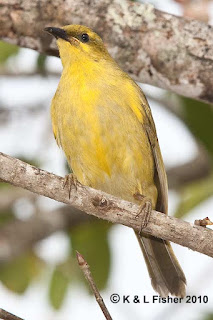
They are quite noisy and can be aggressive to other birds and themselves as these images below show. Two birds locked onto each other and rolled around on the ground for at least five minutes before a third bird appeared to watch the fight.


After a few more minutes it got too much for the third bird and it had to join in, so there were three birds hanging onto each other.

Eventually one bird broke off and flew away leaving the other two to continue rolling around on the ground. After a while the third bird returned to join in before they broke off the fight, which had lasted about 15 minutes, and flew away. We were none the wiser as to who the victor was and we suspect neither were the birds!

Yellow Honeyeater
They are quite noisy and can be aggressive to other birds and themselves as these images below show. Two birds locked onto each other and rolled around on the ground for at least five minutes before a third bird appeared to watch the fight.

Original two Yellow Honeyeater locked in battle

Third bird arrives to watch
After a few more minutes it got too much for the third bird and it had to join in, so there were three birds hanging onto each other.

Three birds fighting
Eventually one bird broke off and flew away leaving the other two to continue rolling around on the ground. After a while the third bird returned to join in before they broke off the fight, which had lasted about 15 minutes, and flew away. We were none the wiser as to who the victor was and we suspect neither were the birds!
Barred Cuckoo-shrike was at last seen at the end of the week after hearing them calling over the previous 2-3 weeks and Grey Whistler has been calling well and occasionally showing itself. After having small flocks of Australasian Figbird last week their numbers have increase this week with quite large vocal gatherings around the Lodge and surrounds. Both adult black and juvenile brown Black Butcherbird were around all week visiting the Lodge and surrounding properties. Pied Monarch have been performing for the guests as they regularly appear for a bath at Bushy Creek in the afternoon. They have not been the only birds seen here with the creek becoming a regular afternoon bathing spot for nearly 20 species. At least one pair of Pale-yellow Robin have finished building their nest which is a few weeks earlier than normal.
A full list of the weeks birds can be found on the Eremaea Birds website using this link
Spotlighting has again been good throughout the week with Striped Possum still being seen feeding on the South American Sapote in the orchard and another high up in the rainforest canopy. The Red-legged Pademelon was still foraging in the orchard along with a large number of Northern Brown and Long-nosed Bandicoot who are digging up the newly mown parts of the orchard. Platypus have been seen almost every evening this week swimming down Bushy Creek or foraging along the rocks at the viewing point off from the orchard which is good as they have been absent for a few months.
Further afield Southern Cassowary was seen along the road into Mossman Gorge which is not a place we have heard of many sightings. At least four Blue-faced Parrot-Finch have turned up locally after proving to be very difficult to find. Our neighbour reported a Black-breasted Buzzard around Julatten being pursued by another bird; buzzards are very uncommon in our area with less than one sighting per year. A Little Eagle was seen in the Mt. Molloy area, again another uncommon species to our district. Mount Lewis has been turning up most of the “Wet Tropic “ endemics – Fernwren, Atherton Scrubwren, Mountain Thornbill, Macleay's Honeyeater, Bridled Honeyeater,

Bridled Honeyeater
Grey-headed Robin, Chowchilla, Bower's Shrike-thrush, Pied Monarch, Victoria's Riflebird, Tooth-billed Bowerbird and female Golden Bowerbird (the males are still scarce). In addition Chestnut-breasted Cuckoo has also been seen here and at Mowbray National Park nearby.


