Showing posts with label Australian Owlet-nightjar. Show all posts

Sunday, 2 November 2014

2nd November 2014 Kingfisher Park Birdwatchers Lodge

Weather Report
Rainfall over the last two weeks was 2mm one day and the next day 1mm, hardly touched the ground! Humidity dropped down to 44% with lots of sunshine and temperatures reaching 32ºc which it has been doing for the last three weeks.

Last Two Weeks Bird Sightings:-
These can be found on the Eremaea eBird site. 19th – 25th October and 26thOctober - 1st November The first week had 116 species recorded, which was the most for a very long time and the second week 104.

Birding Highlights:-
The much anticipated return of the Buff-breasted Paradise-Kingfisher from Papua New Guinea happened on the 31st October when one bird was heard and briefly seen high in the rainforest canopy flying away. One was also heard calling on the following day. Hopefully the main party of birds will be joining this one very soon.

Buff-breasted Paradise-Kingfisher

The pair of Lesser Sooty Owl reported last blog were around for about 10 days but have gone quiet over the last week. Whilst they were calling and flying around they were perching low down for their picture to be taken and were not in the least bothered by us. The were preening and calling to each other before they took off to chase each other.

Lesser Sooty Owl

Apart from these great sightings there were a few waterbirds in the nearby wetlands including six Wandering Whistling-Duck, Australian Wood Duck, one Hardhead, a female Black-necked Stork, one Australian Pelican, one White-necked Heron, both Australian White and Straw-necked Ibis plus three Royal Spoonbill. A flock of Magpie Goose flew over the Lodge one night honking as they went. A lone Comb-crested Jacana was on the lilies in one of the lagoons along McDougall Road. A few raptors were around, mainly Black Kite with a few Whistling Kite but also seen were a pair of Black-shouldered Kite and Pacific Baza, Brown and Grey Goshawk plus White-bellied Sea-Eagle. Red-necked Crake was heard and seen several times at the Crake Pool, and along Bushy Creek. Carol Iles our neighboring bird guide had a Red-backed Button-quail in one of the adjacent cane paddocks, not often seen. Fruiting Blue Quandong trees have been attracting many fruit pigeons, Wompoo Fruit-Dove, Superb Fruit-Dove, Torresian Imperial-Pigeon and flocks of Topknot Pigeon, including this one which had a very enlarged crop, looks more like a displaying Australian Bustard! (excuse the poor cropped image but it was high in the canopy).

 
Topknot Pigeon

Also around were Brown Cuckoo-Dove and the regular Emerald, Peaceful and Bar-shouldered Dove. This Brown Cuckoo-Dove was on the ground with a full crop.


Brown Cuckoo-Dove

Brush Cuckoo have returned and are calling along with Little Bronze-Cuckoo, Australian Koel and Channel-billed Cuckoo. Barn and Barking Owl are also around as are Australian Owlet-nightjar but these have only been heard. Papuan Frogmouth are sitting on nests at the moment and not easy to find. This one was sitting on a nest in the full sun which is what they do in our area, they incubate for upt o 40 days which is a very long period to be in the sun. 

Papuan Frogmouth - male on nest
 
Six Red-tailed Black-Cockatoo flew over the Lodge grounds one morning calling, this is only the second time they have been seen in October for at least nine years. Double-eyed Fig-Parrot continue to feed in a fruiting Cluster Fig and are attending a nearby nest.


Double-eyed Fig-Parrot - male

This male Double-eyed Fig-Parrot flew into a car and was rescued, we kept it in a box for a few hours before it had enough strength to climb onto a branch in the shade for a while. It sat for nearly an hour before it gave a few chirps to say thank you and flew off to hopefully survive.

Double-eyed Fig-Parrot - male

Our single Noisy Pitta continues to show well in and around the orchard area, early morning and late afternoon. It has been calling occasionally but has not been joined by any others yet.


Noisy Pitta

14 species of honeyeater have been seen plus one heard. Bridled and Lewin's are still in the area when normally at this time of year they have gone back up into the mountains. The Eastern Whipbird which arrived a month ago is still going around in circles calling for a mate. It was seen in the rainforest near the Crake Pool about 5m up a tree. Barred Cuckoo-shrike and at leas three male Common Cicadabird have been feeding on fruiting figs. A pair of Leaden Flycatcher were seen at the entrance to the Lodge whilst on a morning walk, they have been very scarce this year. The Lemon-bellied Flycatcher shown on its tiny nest last blog is still on it, not sure if it has a nestling yet. Pale-yellow Robin seem to have finished nesting duties for the time being and are being cute posing on branches in the orchard.


Pale-yellow Robin

Metallic Starling are still busy building nests and have been joined by a few immature birds, whilst the reported Mistletoebird at its nest appears to have fledged one young.

Further Afield:-
Oriental Plover, Australian Pratincole and Banded Honeyeater have been seen in the Maryfarms area, (between Mt. Molloy and Mt. Carbine on the Mulligan Highway/ Peninsular Road). Lovely Fairy-wren were found in Julatten at Mowbray National Park and along Euluma Creek Road. Large-tailed Nightjar were also heard along Euluma Creek Road and Chestnut-breasted Cuckoo plus Oriental Cuckoo were seen at the Mowbray National Park. Freckled Duck have become a fixture at Hasties Swamp near Atherton over the past two years with numbers fluctuating, up to 30 birds present this week. Mt. Lewis has been good as usual with all the 13 “Wet Tropic” endemics seen there over the past two weeks, no sign of Blue-faced Parrot-Finch yet.

Reptiles and Mammals:-
Fawn-footed Melomys have been active around the Lodge, they have been seen at the reception area feeder eating seed and banana, in the compost bin, eating an orange and a Sugar Apple in the orchard. Yellow-footed Antechinus have been chased out of the kitchen and feeding on banana at the feeder. 


Yellow-footed Antechinus
 
At least four Red-legged Pademelon have been in the rainforest and browsing in the orchard at night along with one Agile Wallaby, lean pickings on the browning grass. The pair of Platypus in Bushy Creek have again been performing at the viewing area on most evenings and early mornings. A few species of frog have started calling at the end of the second week and must think that some rain is coming, hope they are right! Those calling were White-lipped Green Tree Frog and Dainty Green Tree Frog along with Cane Toad. A few Northern Leaf-tailed Gecko have been seen as have Boyd's Forest Dragon and Eastern Water Dragon. Major Skink have been active with at least six different ones spotted around the Lodge grounds. 

Visitors:-
A couple of well known visitors called by during the week, Sean Dooley and Stephen Moss.
Sean is well known for his adventures trying to see as many Australian birds in a year as possible. The year of birding is documented in his book "The Big Twitch". Sean is now the editor of the Birdlife Australia magazine and in the past has been a comedy writer for several TV shows. Stephen Moss, who lives in the UK, is well known as an award winning TV producer of Natural History series, an author of many books and birder

Sean (L) and Stephen (R)

Sean and Stephen were up in Far North Queensland as guest speakers at the presentation of the John Hobbs Medal to Far North Queensland local Lloyd Nielsen for a life time of outstanding studies by an amateur ornithologist. Congratulations to Lloyd on a much deserved award, it could not have gone to a more dedicated and great bloke. We are lucky having such great talents in our area.


Thanks to Carol and Andrew Iles our roving bird guides for helping with the bird lists and area sightings. If you need any guiding in our local area contact us and we can put you in touch with them, contact through our secure bookings and enquiries web page. 


Sunday, 21 September 2014

Kingfisher Birdwatchers Lodge 21st September Report

21st September 2014 Kingfisher Park Birdwatchers Lodge

Weather Report
What can we say about the weather? Well we have had no rain over the last two weeks again, just wall to wall sunshine, cool temperatures down to 11.1ºC and much warmer than previous months, up to 27.3ºC, great conditions. Temperatures in the morning have been about 4ºC below the average for this time of year.

Last Two Weeks Bird Sightings:-
These can be found on the Eremaea eBird site. 7th - 13th September and 14th- 20th September The first week had 105 species recorded and the second week 103.

Morning and Evening Guided Walks:-

Morning walks produced between 44 and 55 species, some of the highlights were Pacific Baza foraging in the camp ground, two Blue-winged Kookaburra, Double-eyed Fig-Parrot, Noisy Pitta in the orchard hopping around us for over 10 minutes whilst we were watching a pair of roosting Papuan Frogmouth, Great Bowerbird performing at its bower, a pair of Yellow-faced Honeyeater on a nest, a male Fairy Gerygone foraging on the ground (usually high up in the rainforest) and a pair of Pale Yellow Robin attending a nest. Also a Platypus was seen twice on one morning walk at two different locations and once on a night walk. The full species lists can be found on the Eremaea eBird site. Click on Explore Data then Hotspots and type in Kingfisher Park – you will then see the Lodge in the drop down menu. Click this on and a map will appear with two markers, click these and you can have access to all our records. It sounds long winded, but it is really easy. Alternatively you can click this link which will take you directly to Hotspots http://ebird.org/ebird/hotspots.

Evening walk highlights were Barn Owl, Papuan Frogmouth, Red-legged Pademelon, Striped Possum, Platypus, four different frog species, despite the dry weather, Boyd's Forest Dragon which had re-appeared with the warmer weather, Northern Leaf-tailed Gecko and two Australian Scrub Python. A surprise one night was a roosting Pacific Baza high up in a rainforest tree, a first for a night walk.

Other Birding Highlights:-

An immature Orange-footed Scrubfowl has been around the edge of the orchard foraging in the rainforest and trying to get out of the way of the adults who harass it at every opportunity. Here it is intently looking for food as it scratches away.


Orange-footed Scrubfowl


Red-necked Crake have been regularly coming to the Crake Pool late evenings with one or two seen, one was also seen in the garden in front of the units. A Comb-crested Jacana was in one of the McDougall Road lagoons, this was a first for many months. A pair of Wompoo Fruit-Dove were in the trees around the Crake Pool on the edge of the orchard and a pair of Torresian Imperial-Pigeon flew over Geraghty Park. The Torresian Imperial-Pigeon are recent arrivals to our part of the inland only having been around for the last four years. Small flocks of Topknot Pigeon are still flying over, nine being the most at any one time. Channel-billed Cuckoo have been scarce with only one seen over the last two weeks and several other calling. Papuan Frogmouth have been roosting in the area including these three.


Papuan Frogmouth


Again Australian Owlet-nightjar has been heard, but not seen, very frustrating. Rainbow Lorikeet have been seen nesting as have Double-eyed Fig-Parrot. Bridled Honeyeater have moved into the area and two uncommon Black-chinned Honeyeater were seen in Geraghty Park. The Blue-faced Honeyeater which occurs around the Lodge is in a zone integration between the nominate race Entomyon cyanotis cyanotis from eastern Australia and Entomyon cyanotis griseigularis, the sub-species from Cape York. The one pictured here is an immature bird foraging on a Grevillea in a neighbours garden adjacent to Geraghty Park.


Blue-faced Honeyeater - immature

Yellow-breasted Boatbill have been active and calling as well as showing well. A few Barred Cuckoo-shrike are around the lodge grounds, but proving difficult to see. Northern Fantail have also returned to the fringes of the Lodge grounds and have been heard calling well. Pied Monarch are also around,


Pied Monarch

as is at least one immature male Victoria's Riflebird. 
 
Victoria's Riflebird - immature male


Metallic Starling are slowly making nests, but quite a few have fallen to the ground which is not good for their breeding season. Male Mistletoebird have been calling and showing well, but no sign of nesting yet.


Further Afield:-
An unconfirmed report of vagrant Northern Pintail at Hasties Swamp, only seen once and not relocated again despite several visits to look for them. More information can be found on Eremaea Birds website. Mt. Lewis continues to be the place to see the “Wet Tropic” endemics with all but the Lesser Sooty Owl seen over the last two weeks, even a couple of male Golden Bowerbird were found by our roving bird guides Carol and Andrew Iles, can't beat local knowledge! Carol also reported Spotted Harrier, Dusky Moorhen, Chestnut-breasted Cuckoo, Blue-faced Parrot-Finch, White-eared Monarch and the first reported Black-faced Monarch for the season around the Julatten area plus she had up to eight Australian Pratincole along West Maryfarms Road between Mt. Molloy and Mt. Carbine off the Peninsula Road. The first Large-tailed Nightjar for the season was heard calling in Julatten (by us) on the 21st September, at the same time a Chestnut-breasted Cuckoo was calling! Flowering Grass Tree spikes in Julatten have been attracting many honeyeaters including, Brown, Scarlet and Dusky. This Dusky was on a flower spike and the Brown Honeyeater was waiting his turn.

Dusky Honeyeater

Brown Honeyeater
Rufous Owl is still being reported along the Cairns Esplanade.


Barn Owl Display, Julatten, Far North Queensland

Geraghty Park, Julatten is home to two pairs of Barn Owl which have bred here every year since at least 1995. The nests of these two pairs and a third pair across the adjacent Rex Highway are within 300m of each other. Most years these three pairs have had three young each. In 2014 the two pairs in Geraghty Park had a brood of three and the third nest had four, all of which left their nests and the area by the end of August. On the 3rd September 2014 a visit to one nest site in Geraghty Park was rewarded by a very unusual display by the adult male towards the adult female of the pair. The male was first seen with just its head peering out of a hollow in a Queensland Blue Gum Eucalyptus tereticornis which is its daytime roost/nest tree. After about 5 minutes the adult female appeared at a different tree hollow approximately 2m below the one the male was in, here it perched. Shortly after this the male moved out of its hollow onto an adjacent branch where it was seen to adopt a hunched posture looking down at the female, it then outstretched its wings and began crouching down and raising itself several times before rocking from side to side (wing waving) with its tail raised. It continued this display for approximately 1 minute. The female meanwhile was looking away and taking no notice of the male. The male then folded its wings but continued in the hunched position looking down for approximately 30 seconds before again outstretching its wings and beginning the rocking motion again, this time the female looked up and watched the display. The male continued for another minute, at which time the female flew to a nearby branch. The male continued to stay in a hunched position looking down until it flew to join the female after 2 minutes. Both birds were perched next to each other facing different directions for about three minutes before the male turned around. Both birds then moved close to each other and started allopreening for at least two minutes. This behaviour of allopreening often precedes mating which takes place in the nest (Debus 2009). During the whole period of the display both birds remained silent. We then considered that the birds had been disturbed enough by our presence and we left. It was not know whether the birds did return to the nest to mate. A short video of part of the display taken by Mr. Ota Yu, Japanese tour guide based in Cairns can be found on You Tube . The background noise is excited Japanese taking plenty of photos!
Stephen Debus says that this behaviour has been recorded in Masked Owl but as far as he is aware not in Barn Owl. Thanks for your input Stephen.
The following night we had another look at what the owls were doing but they did not put on a display like they did the previous night. The adult male and female came out of their daytime roost to perch on the branches.


Barn Owl - male on right female on left


After they sat on the branch for a while the male started to outstretch his wings and did a brief wing waving display. The female was not interested as you can see!

 
Barn Owl - male on right female on left


Both birds flew to different perches and the female started to take notice of the male but he had given up by now and was just perching quietly.
 

Barn Owl


Reptiles and Mammals:- 
Fawn-footed Melomys and Bush Rat have been coming to the reception area feeder at night along with up to six Northern Brown Bandicoot which is the most we have seen all year. A Yellow-footed Antichinus was heard scratching in a dead tree before it came out to run up and down the outside and disappear into the tree before coming out of a different hole, this activity continued for well over five minutes. Here it is seen peering out of one of the holes.

Yellow-footed Antichinus


At least two Platypus have been showing well in Bushy Creek in the late evening and early morning  much to the delight of our guests. One of our guests observed an Eastern Water Dragon along Bushy Creek catch a Little Shrike-thrush and eat it; we've seen them raiding nests, but not take an adult bird. The Australian Scrub Python we have living in a large log can often be seen coiled up inside it, this is what you see.


Australian Scrub Python

Sunday, 7 September 2014

7th September 2014 Kingfisher Park Birdwatchers Lodge

Weather Report
What can we say about the weather? Well we have had no rain over the last two weeks, just wall to wall sunshine, cool temperatures down to 10.5ºC (stop laughing you southern Australian people) and up to 23.6ºC, perfect conditions. Temperatures have been about 6ºC below the average for this time of year.

Last Two Weeks Bird Sightings:-
These can be found on the Eremaea eBird site. 24th August - 30th August and 30th August - 6th September The first weeks sightings had 99 seen and 4 heard, the second week 99 seen and 5 heard.

Morning and Evening Guided Walks:-

Morning walks had between 44 and 59 species. Some of the birds seen included Pacific Baza who was flying over Geraghty Park displaying and calling,


Pacific Baza


plus we had Buff-banded Rail, Peaceful Dove building a nest, Wompoo Fruit-Dove, Topknot Pigeon, Papuan Frogmouth, Double-eyed Fig-Parrot digging a nest, Blue-winged Kookaburra, Yellow-breasted Boatbill, Barred Cuckoo-shrike, Pied Monarch, Victoria's Riflebird and Metallic Starling also nest building. The full species lists can be found on the Eremaea eBird site. Click on Explore Data then Hotspots and type in Kingfisher Park – you will then see the Lodge in the drop down menu. Click this on and a map will appear with two markers, click these and you can have access to all our records. It sounds long winded but it is really easy. Alternatively you can click this link which will take you directly to Hotspots http://ebird.org/ebird/hotspots.

Night walks were productive despite it being quite cool and dry which restricted the number of frogs and reptiles which were out. Despite this we managed to see Leaf-tailed Gecko, Jungguy Frog, White-lipped Tree Frog, Red Tree Frog (Desert Tree Frog) and Dainty Green Tree Frog. Mammals seen were Striped Possum, Long-nosed and Northern Brown Bandicoot, Fawn-footed Melomys and Bush Rat. Australian Owlet-nightjar were heard but not seen and a Papuan Frogmouth was seen in camp ground. A pair of Barking Owl were seen perched in a tree beside Bushy Creek calling softly. As we watched them, they mated and the male flew off.

Other Birding Highlights:-
With the change of season from winter to spring there is also a change in some bird species which are in our area. Grey Fantail have left to go back south, we had our first Torresian Imperial-Pigeon, Australian Koel and Channel-billed Cuckoo for the season arrive from the north.
Wetland birds were scarce with only one or two of most seen which included Magpie Goose, Green and Cotton Pygmy-goose, Pacific Black Duck, Hardhead, Grey Teal, Australasian Grebe, Little Pied Cormorant, Australasian Darter, Australian Pelican, White-necked and White-faced Heron plus Intermediate, Great and Cattle Egret.
Plenty of raptors were around to scavenge off the cut cane paddocks, mainly Black Kite which were around in groups of up to about 100, here are some which were hanging around in the trees.


Black Kite

Black Kite

Also here were a few Whistling Kite, a White-bellied Sea-Eagle shown here perched in a Blue Quandong tree

White-bellied Sea-Eagle

and Australian Hobby (not a great image as it is a severe crop,but it gives an idea of what the bird looks like).

Australian Hobby
 
Red-necked Crake were again heard but not seen as was a Spotless Crake along McDougall Road.
Some very young Emerald Dove have appeared and a pair of Wompoo Fruit-Dove have come to investigate a few fruit trees which have just started to have ripe fruit on them. The nesting pairs of Barn Owl have now chased off their offspring from the area and we have only been seeing a few adults. Barking Owl have also quietened down but were seen roosting during the day. Azure Kingfisher have been along Bushy Creek and there has been a few sightings of Little Kingfisher in the Crake Pool on the edge of our orchard.
Sulphur-crested Cockatoo have been seen sitting in their nest hollow in a big Queensland Blue Gum tree and a few Scaly-breasted Lorikeet are still around feeding on the few remaining flowering gum trees. Noisy Pitta has started to call and has been seen in the orchard area, mainly early morning. Spotted Catbird are still coming to the reception area feeder to grab mouthfuls of banana. Red-backed Fairy-wren have been seen perched on the fences along McDougall Road. Twelve species of honeyeater were seen and one, Black-chinned heard. A few Lewin's Honeyeater are still around but the majority of them seem to have left for the higher altitudes of the mountains behind the Lodge. Macleay's Honeyeater is an ever present “Wet Tropic” endemic around the Lodge who have been taking advantage of the flowering grevilleas.

Macleay's Honeyeater

The one male Golden Whistler, that has been with us for a few months, is still around the Lodge grounds and has been joined by a pair of Rufous Whistler who have been present on the edge of the Lodge grounds in the tall Queensland Blue Gum trees. They don't normally hang around for weeks, mainly confining themselves to the nearby Geraghty Park. Northern Fantail have moved back into the Lodge grounds in the last week to take the place of the departing Grey Fantail. A pair of Torresian Crow have also been flying over and calling after being absent for a few months, getting ready to play host to Channel-billed Cuckoo no doubt. Lemon-bellied Flycatcher have joined the Rainbow Bee-eater (who was being blown around in the wind) to perch and forage from the Geraghty Park oval fence.

Lemon-bellied Flycatcher

Rainbow Bee-eater (female - short tail streamer)      

Golden-headed Cisticola have been calling from the remaining uncut cane but are in fewer numbers than previous years. This one was hanging on a seed stalk on the cane singing

Golden-headed Cisticola 

Further Afield:-
Blue-faced Parrot-Finch are still being seen infrequently near Abattoir Swamp with up to five birds seen. Abattoir Swamp itself has been good for honeyeaters and has had a Grey Shrike-thrush nesting on the edge of the car park.Rufous Owl is still being reported along the Cairns Esplanade.


Reptiles and Mammals:-
In addition to those seen on night walks we saw Red-legged Pademelon, Agile Wallaby, a few bats – Eastern Horseshoe Bat, Large-footed Myotis, Northern Broad-nosed and Little Bent-winged bat, Giant White-tailed Tree Rat, Green Ringtail Possum, Spectacled Flying-fox and Eastern Water Dragon. A few snakes were seen, Green Tree Snake, Brown Tree Snake and the highlight a pair of Australian Scrub Python mating on the edge of the orchard whilst stretched out on a log.

 Thanks to our roving bird guides Carol and Andrew Iles who helped compile the bird list and are available for any bird guiding in the area. Contact them directly or through the Lodge.

Sunday, 24 August 2014

24th August 2014 Kingfisher Park Birdwatchers Lodge

Weather Report
The first week had 32.5mm of rain which fell over six days, the second week had no rain just sunshine. Temperatures ranged from a cool low of 13.2ºC up to 23.8ºC which is about average for this time of year.

Last Two Weeks Bird Sightings:-
These can be found on the Eremaea eBird site. 10th - 16th August and 17th - 23th August The first week we had 106 sightings and the second week 112, pretty good numbers!

Morning and Evening Guided Walks:-
Morning walks (2½ hours) produced between 43-55 species, the lower count was due to rain disrupting the walk. The species lists can be found on the Eremaea eBird site. Click on Explore Data then Hotspots and type in Kingfisher Park – you will then see the Lodge in the drop down menu. Click this on and a map will appear with two markers, click these and you can have access to all our records. It sounds long winded but it is really easy. Alternatively you can click this link which will take you directly to Hotspots http://ebird.org/ebird/hotspotshttp://ebird.org/ebird/hotspots.
Again we saw up to 11 Barn Owl on night walks and one Barking Owl. Mammal sightings were good with two Tree Mouse (Prehensile-tailed Rat) on one night, Fawn-footed Melomys, Eastern Horseshoe Bat and Northern Blossom Bat, two Striped Possum and both Long-nosed and Northern Brown Bandicoot. Frogs seen were Jungguy Frog, White-lipped Tree Frog, Red Tree Frog, Roth's (Laughing)Tree Frog, Dainty Green Tree Frog, Cogger's Frog and Cane Toad. Several Northern Leaf-tailed Gecko were also found.

Other Birding Highlights:-

Both Green and Cotton Pygmy-goose have been along McDougall Road as well as up to three Australian Pelican and White-necked Heron. Pacific Black Duck have been along McDougall including these two who were loafing, thought we would put in an image of these birds as some of the more common birds tend to get overlooked.


Pacific Black Duck

At least 32 Straw-necked Ibis were foraging in a cut cane paddock adjacent to the Lodge; straw-necks are not as common as Australian White Ibis around Julatten. Black-shouldered Kite have been regulars with one adult and two juveniles seen. A Pacific Baza was seen one day at the front entrance to the Lodge but not seen since. Also flying over the Lodge were a pair of Grey Goshawk being chased by a pack of Blue-faced Honeyeater. Another blue-face was seen chasing a Whistling Kite over Geraghty Park, this time it was hanging onto the tail of the kite! Other raptors seen were Wedge-tailed Eagle, White-bellied Sea-Eagle and over 50 Black Kite foraging in and around cut cane paddocks including this immature bird. 


Black Kite - juvenile

Red-necked Crake have started to call so we know they are around but only one sighting over the last two weeks. Wompoo Fruit-Dove have also been calling and being seen as a few more trees start fruit. Topknot Pigeon are still flying over in small flocks and very occasionally dropping into the Lodge grounds. An Australian Owlet-nightjar has been heard calling around the Lodge grounds and also in the vicinity of a previous daytime roost site but has not been seen. The two Papuan Frogmouth continue to roost in the Lodge grounds with four more seen roosting nearby. This is the male with the female hidden by the leaves in one of the Lodge mango trees about 6-7m up which is higher than they normally roost which is more like 4-5m.

 
Papuan Frogmouth

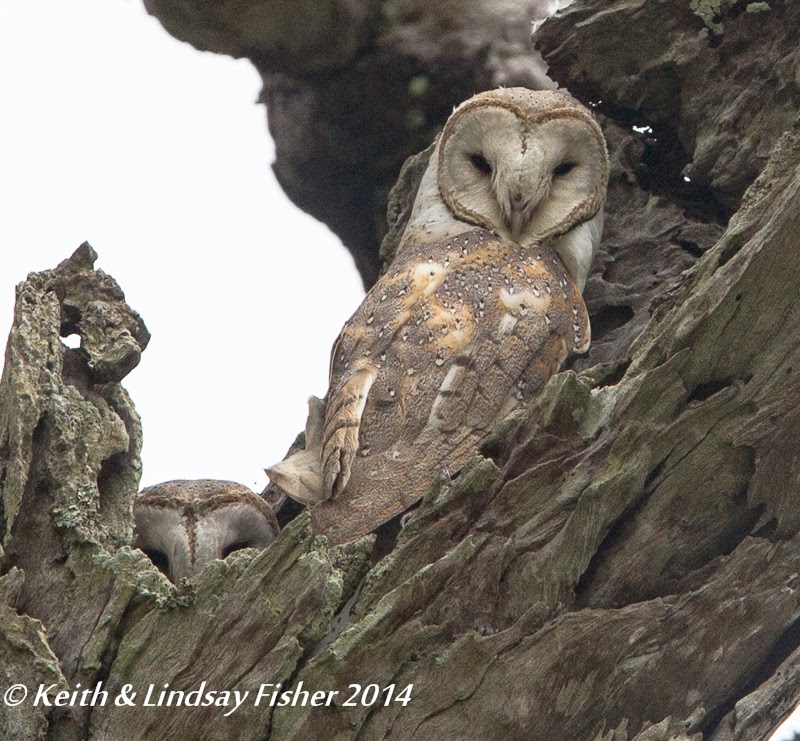
Two Azure Kingfisher have been seen along Bushy Creek flying along and perching near the Platypus viewing area, which has a nice new seat after the previous one was washed away in the flood caused by Cyclone Ita in March. Both Nankeen Kestrel and Australian Hobby have been seen around the Lodge. Scaly-breasted Lorikeet numbers have dropped off as the Queensland Blue Gum are finishing flowering but at least one pair are nesting in these trees and Double-eyed Fig-Parrot have been seen flying over since they, and the Australasian Figbird, have finished off the fruiting figs. Barn Owl have juveniles who have been sitting up in their nests dozing during the day like these ones were. 

 
Barn Owl - juvenile


Barn Owl - juvenile


Noisy Pitta have started to call and have been seen around the Lodge grounds, we still think we only have one bird present. There has been a couple of sightings of Lovely Fairy-wren in the grounds, one along Bushy Creek and another at the Crake Pool. Fourteen species of honeyeater were seen and one heard, which was only four less than the total recorded at the Lodge. Again Pied Monarch and Yellow-breasted Boatbill have both been calling well and being seen. Barred Cuckoo-shrike have made a few appearances but have not been regular. Golden, Grey and Rufous Whistler have all been seen in and around the Lodge as have Northern, Rufous and Grey Fantail. Only a couple of sightings of Leaden Flycatcher over the two weeks but Lemon-bellied Flycatcher have been around with up to six seen at a time. Victoria's Riflebird were seen in the first week but not in the second so they might have left. A Tawny Grassbird was briefly seen in an adjacent cane paddock where it was calling. Metallic Starling returned on the 10th August from Papua New Guinea with numbers continuing to increase along with the nesting activity at their colony in Geraghty Park.
Further Afield:-

Blue-faced Parrot-Finch are being seen infrequently near Abattoir Swamp with only a couple of birds seen. Australian Bustard are displaying at Maryfarms between Mt. Molloy and Mt. Carbine and a single Australian Pratincole is still present at this location after about 3 weeks. Mt. Lewis is as good as ever with bird guide Doug Herrington from Birdwatching Tropical Australia reporting five male Golden Bowerbird seen in one visit! All other “Wet Tropic” endemics were found here in the last two weeks, even more reason to stay at Kingfisher Park Birdwatchers Lodge! Our roving bird guides Carol and Andrew Iles reported Tawny Grassbird, White-eared Monarch, Shining Flycatcher and Red-winged Parrot from Julatten as well as an Australian Hobby whizzing down Mt. Molloy main street. Freckled Duck are still at Hasties Swamp near Atherton and have been almost continuously for the past two years, they were joined by an estimated 2000 Magpie Goose this week.


Identification of odd Looking Lewin's Honeyeater:-

The first two images of a meliphagous honeyeater were photographed at Malanda on the Atherton Tableland at about 900m, the third more typical Lewin's  was photographed at the Lodge, they are all ssp. mab, which occurs in Far North Queensland.

After some discussion with a few local and interstate experts it was agreed that this bird is an odd looking Lewin's, it certainly had the Lewin's call. It has an odd shaped ear patch, which is a lot smaller than a normal Lewin's of the ssp mab. The ear patch looks more like a Graceful. The lower mandible is slightly curved like a Graceful and not straight like Lewin's  the length of the bill looks slightly longer in these comparison images than Lewin's. The underparts don't have as much streaking as Lewin's and the face is less grey than a Lewin's. It is possible this could be a Lewin's/Graceful hybrid as there altitudinal range does overlap (Graceful usually occur below 600m). Note:- Lewin's Honeyeater ssp. mab does not have the distinct crescent shape to the ear patch of southern birds but a slightly less shaped crescent as shown in the 3rd image.Thanks to the experts for their comments. 


Lewin's Honeyeater ssp. mab


Lewin's Honeyeater ssp. mab


Lewin's Honeyeater ssp. mab - typical


Reptiles and Mammals

In addition to the mammals and reptiles mention on night walks we had other interesting sightings including Red-legged Pademelon, Agile Wallaby, Platypus with two regularly showing, Water Rat, Green Tree Snake and Australian Scrub Python. Over the two week we had 17 mammal species and 12 amphibian/reptiles.

Insect:-
This interesting beetle turned up at the reception area feeder one evening, it is a Carion Beetle Diamesus osculans. In Australia there are only three species in two genera mainly found in forested areas within 300km of coastal areas in eastern and northern Australia. This species is also found in Papua New Guinea and in Asia. (info. From “A Guide to the Beetles of Australia” George Hangay and Paul Zborowski). This is the first one we have seen in the Lodge grounds.
Carion Beetle

Thanks to our bird guide neighbours Carol and Andrew Iles for helping to compile the weekly bird lists, don't forget to contact them if you need any bird guiding.


Kingfisher Park Birdwatchers Lodge Business and Property For Sale
Click here for more sale details